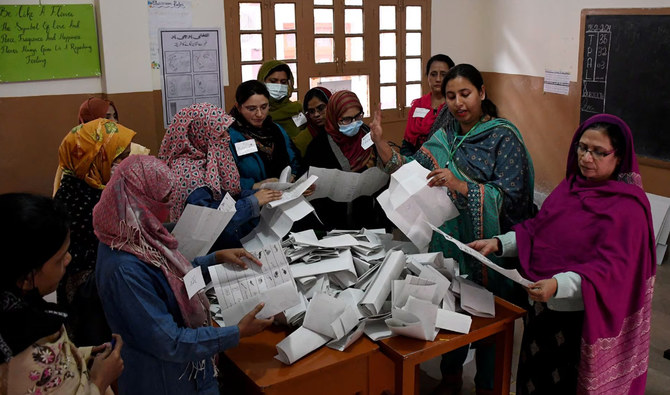
ISLAMABAD: Pakistan’s top court criticized a speech delivered by British High Commissioner Jane Marriot in a letter that emerged in the media on Wednesday, saying her reservations about the judiciary’s role in the conduct of the February 8 general elections, which were widely seen as manipulated, were “unjustified.”
The letter written on May 3 referred to the British diplomat’s speech at the Asma Jahangir Conference held last month in Lahore, wherein she said not all political parties were allowed to fully participate in the electoral contest. Her speech, quoted in the media, specifically mentioned the “legal processes” that deprived them of “recognizable party symbols.”
Many Pakistani political parties criticized the last general elections, saying they did not get the required “level playing field” to perform in the national polls. The complaint made by former prime minister Imran Khan’s Pakistan Tehreek-e-Insaf (PTI) party was particularly high-pitched, as most of its top leadership found itself behind bars on a number of charges amid a crackdown against them that began after violent protests on May 9, which broke out after Khan was briefly detained in a corruption case.
The PTI was also prevented from using its electoral symbol of a cricket bat after a protracted judicial battle by the Supreme Court of Pakistan in a case relating to flawed intra-party polls.
“The law enacted by Parliament (Election Act, 2017) requires democracy within political parties via the holding of periodical intra-party elections; to forestall autocracy, or even dictatorship within them,” the letter written by the Supreme Court registrar explained. “To ensure compliance with this democratic principle the law stipulates that if a political party does not hold intra-party elections, then it would not be eligible for an election symbol.”
“A political party (which had itself voted in this law) did not hold the mandated intra-party elections,” it continued. “The Supreme Court reiterated what the law stipulated ... Therefore, you Excellency’s criticism with regard to this decision, with utmost respect, was unjustified.”
The letter written on the instructions of Chief Justice of Pakistan Qazi Faez Isa noted that the proceedings of the hearing were live televised for the public.
It also highlighted other steps taken by the top court to strengthen democracy in the country and make the national and provincial elections possible earlier this year.
The Supreme Court registrar also maintained that Britain had also made several mistakes in the past which had led to unbearable suffering to people in different parts of the world. It specifically mentioned the overthrow of Iran’s Mohammad Mossadegh’s government in 1953 and the adoption of the Belfour Declarations that led to the creation of Israel.
It maintained the Supreme Court had acknowledged its past mistakes, adding this should also be done with the British government.
“Let us all stand up and be counted for equality, peace and humanity,” it continued.

Pakistan’s top court rebukes British envoy’s critique of election conduct as ‘unjustified’
https://arab.news/8qkmb
Pakistan’s top court rebukes British envoy’s critique of election conduct as ‘unjustified’
- British envoy said last month not all parties could fully participate in the polls, some were deprived of election symbols
- The Supreme Court mentions the past mistakes of British governments that caused suffering to millions around the world
Nearly 25% of Pakistan’s primary schools enrolling girls operate as single-teacher ones— report
- Pakistan needs over 115,000 more teachers in primary schools enrolling girls to meet global benchmark of one teacher per 30 students, says report
- Sixty percent of Pakistani primary schools enrolling girls are overcrowded, while 32% lack clean drinking water or toilets, says Tabadlab report
ISLAMABAD: Nearly 25% of Pakistan’s primary schools that enrolls girls operate as single-teacher ones, a report by a leading think tank said this week, calling on the government to devolve teacher recruitment powers, upskill underutilized teachers and introduce reforms to hire and promote faculty members.
Pakistan faces an acute education crisis which is reflected in the fact that it has the world’s second-highest number of out-of-school children, an estimated 22.8 million aged 5-16 who are not in educational institutions, according to UNICEF.
While poverty remains the biggest factor keeping children out of classrooms, Pakistan’s education crisis is exacerbated by inadequate infrastructure and underqualified teachers, cultural barriers and the impacts of frequently occurring natural disasters.
According to “The Missing Ustaani,” a report published by Islamabad-based think tank Tabadlab and supported by Malala Fund and the Pakistan Institute of Education (PIE), Pakistan needs over 115,000 more teachers in primary schools with girls’ enrolment to meet the basic international benchmark of ensuring one teacher per 30 children. Currently, the average Student-to-Teacher Ratio (STR) across Pakistan’s primary schools with girls’ enrolment is 39:1, it said.
“Approximately 60% of these schools are overcrowded, necessitating the recruitment of over 115,000 additional teachers nationwide,” the report said on Monday. “Compounding this, nearly 25% of primary schools with girls’ enrolment operate as single-teacher schools, placing immense pressure on the quality of education.”
It said the situation is more dire in Pakistan’s poverty-stricken southwestern Balochistan province, where nearly 52% of the schools are single-teacher only ones while the percentage decreases slightly in the southern Sindh province to 51 percent.
The report said while the STR improves to 25:1 at the middle school level, acute shortages of subject specialists emerge as the top-priority concern for quality education in these schools.
“Furthermore, around 32% of primary schools with girls’ enrolment and 18% of middle schools face ‘critical infrastructural shortages’— lacking clean drinking water or toilets in addition to high STRs— which significantly affects girls’ attendance and learning, particularly during adolescence,” the report said.
The report cited a set of priority recommendations to address Pakistan’s systemic teacher deployment challenges and improve educational equity for girls.
It urged the government to devolve recruitment authority to school or cluster levels to enable timely, context-specific hiring. It also called upon authorities to reform teacher transfer and promotion policies to introduce school-specific postings with minimum service terms.
This, it said, would reduce arbitrary transfers and improving continuity in classrooms. The report advised authorities to upskill surplus or underutilized primary teachers to support instruction at the middle school level, helping address subject-specialist shortages.
“Together, these reforms offer a pathway toward a more equitable, efficient, and responsive teaching workforce— one capable of improving learning outcomes and ensuring that every girl in Pakistan has access to a qualified teacher,” the report said.
To tackle Pakistan’s education crisis, Prime Minister Shehbaz Sharif declared an ‘education emeregency’ in September 2024, stressing the importance of education for all.


