BEIRUT: Lebanon has reversed a move to authorize the International Criminal Court to investigate alleged war crimes on its soil, prompting a prominent rights group to deplore what it called the loss of an “historic opportunity” for justice.
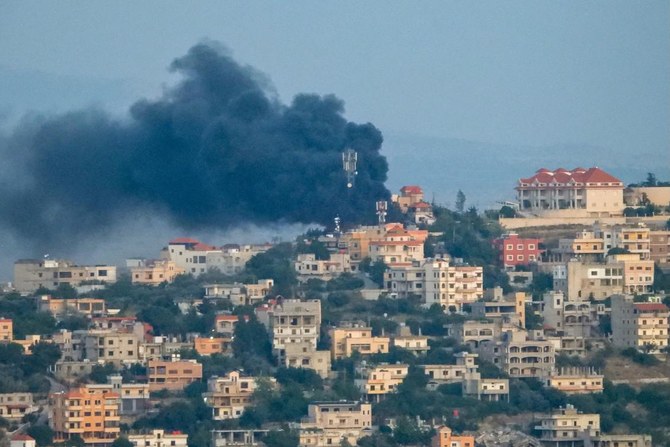
Lebanon has accused Israel of repeatedly violating international law since October, when the Israeli military and Lebanese armed group Hezbollah began trading fire in parallel with the Gaza war. Israeli shelling has since killed around 80 civilians in Lebanon, including children, medics and reporters.
Neither Lebanon nor Israel are members of the ICC, so a formal declaration to the court would be required from either to give it jurisdiction to launch probes into a particular period.
In April, Lebanon’s caretaker cabinet voted to instruct the foreign ministry to file a declaration with the ICC authorizing it to investigate and prosecute alleged war crimes on Lebanese territory since Oct. 7.
Foreign Minister Abdallah Bou Habib never filed the requested declaration and on Tuesday the cabinet published an amended decision that omitted mention of the ICC, saying Lebanon would file complaints to the United Nations instead.
Lebanon has regularly lodged complaints with the UN Security Council about Israeli bombardments over the past seven months, but they have yielded no binding UN decisions.
Habib did not respond to a Reuters question on why he did not file the requested declaration.
A Lebanese official, speaking on condition of anonymity, told Reuters the initial cabinet decision raised “confusion” over whether a declaration would “open the door for the court to investigate whatever it wanted across different files.”
The official said the request to revisit the decision came from George Kallas, a cabinet minister close to parliament speaker Nabih Berri, who heads the Shiite Muslim Amal movement that is allied with the politically powerful Hezbollah.
Hezbollah and Amal have both fired rockets into Israel, killing eight civilians and displacing around 60,000 people from towns near the border since October.
Contacted by Reuters, Kallas confirmed he requested a review of cabinet’s initial decision but denied it was out of fear Hezbollah or Amal could become subject to ICC arrest warrants.
Human Rights Watch condemned the cabinet’s reversal.
“The Lebanese government had a historic opportunity to ensure there was justice and accountability for war crimes in Lebanon. It’s shameful that they are forgoing this opportunity,” said HRW’s Lebanon researcher Ramzi Kaiss.
“Rescinding this decision shows that Lebanon’s calls for accountability ring hollow,” he told Reuters.
Information Minister Ziad Makary, the government spokesman, said that he had backed the initial decision and would “continue to explore other international tribunals to render justice” despite the reversal.
Lebanon backtracked a few days after the ICC requested arrest warrants over alleged war crimes for Israel’s prime minister and defense minister and three Hamas leaders.
The initial push to file an ICC declaration came from MP Halima Kaakour, who holds a PhD in public international law. She recommended the measure to parliament’s justice committee, which unanimously endorsed it. Cabinet approved it in late April.
“The political parties that backed this initiative at first seem to have changed their mind. But they never explained the reason to us or the Lebanese people,” Kaakour told Reuters.
“Lebanon’s complaints to the UN Security Council don’t get anywhere. We had an opportunity to give the ICC a period of time to look at it, we have the documentation — if we can use these international mechanisms, why not?”

Lebanon backtracks on ICC jurisdiction to probe alleged war crimes
https://arab.news/bseuf
Lebanon backtracks on ICC jurisdiction to probe alleged war crimes
- Lebanon has accused Israel of repeatedly violating international law since October
- Foreign Minister Abdallah Bou Habib never filed the requested declaration
UK foreign minister urges UN Security Council to confront ‘bitter truth’ of ‘catastrophically failing Sudan’
- Yvette Cooper recounts harrowing stories of atrocities during the country’s civil war, including ‘point-blank executions of civilians’ and sexual violence against women and girls
- The diplomatic momentum that secured the Gaza ceasefire must now be harnessed to secure peace in Sudan and ensure those guilty of atrocities are held to account, she says
NEW YORK CITY: Britain’s foreign secretary, Yvette Cooper, on Thursday called on the UN Security Council to confront “the bitter truth” that the world has been “catastrophically failing the people of Sudan.”
The UK is chairing the Security Council this month, and Cooper is serving as its president. Setting out the scale of the crisis in Sudan, which has been locked in civil war since April 2023, she cited a report by a fact-finding mission on atrocities in El-Fasher, commissioned by the UK, that was published on Thursday.
She highlighted its accounts of “indiscriminate shootings, point-blank executions of civilians in homes, streets, open areas or while attempting to flee the city.”
In one incident, Cooper said: “A pregnant woman was asked how far she was in her pregnancy. When she responded ‘seven months,’ he fired seven bullets into her abdomen, killing her.”
Hospitals, medical personnel and the wounded “were not spared,” she added, and survivors reported being raped in front of relatives, including children.
The report concluded that the atrocities “bear the hallmarks of genocide,” Cooper said. “El-Fasher should have been a turning point. Instead, the violence now is continuing.”
More than three months after the fall of the city, she said, reports of violations of international humanitarian law and human rights abuses persist. Aid agencies face barriers to access, while schools, hospitals, markets and humanitarian convoys, including those belonging to the World Food Programme, have come under attack.
Since the start of the month alone, she said, there have been reports of strikes on aid operations by both of the warring military factions, the Sudanese Armed Forces and the Rapid Support Forces.
Cooper described what she had witnessed firsthand during a recent visit to the border between Chad and Sudan, and warned that behind the statistics lie shattered lives.
“At the Chad-Sudan border, in a camp of over 140,000 people who have fled Sudan’s conflict, 85 percent of them are women and children,” she said.
A Sudanese community worker told her she believed “half, more than half, the women in the camp had been subjected to sexual violence,” Cooper revealed.
She recounted the case of “three sisters arriving at one of the Sudanese emergency response rooms, who had all been raped. The oldest sister was 13. The youngest was eight.
“There is a war being waged on the bodies of women and girls. The world must hear the voices of the women of Sudan and not the military men who are perpetuating this conflict; voices that ensure that this council confronts the bitter truth, because the world has been catastrophically failing the people of Sudan.”
She described the conflict as “the worst humanitarian crisis of the 21st Century,” with 33 million people in need of assistance, 14 million forced from their homes, and famine “stalking millions of malnourished children.”
It is also a regional security crisis and a migration crisis, Cooper added, as she warned of destabilization across the Horn of Africa and the Sahel, opportunities for extremist groups to exploit the instability, and the risk of increased migration affecting Europe.
Cooper commended US-led efforts to convene regional powers, including Egypt, the UAE and Saudi Arabia, to discuss peace plans, as well as support from the African Union and the EU.
“We will need pressure from every UN member state,” she said. “I urge all of those with influence on both the RSF and the SAF not to fuel further conflict, but instead to exert maximum pressure on them to halt the bloodshed.”
She warned that “the reason that the military men still convince themselves there is a military solution is because they can still obtain ever-more lethal weapons.”
Arms restrictions “need to be enforced and extended,” Cooper said, adding: “Now is the time to choke off the arms flows and exert tangible pressure for peace.”
She also called for greater accountability, saying it was time for more sanctions against the perpetrators. The UK has already sanctioned senior RSF commanders linked to atrocities in El-Fasher, she said, and joined the US and France in proposing that they be designated by the Security Council.
Recalling the diplomatic momentum behind efforts to secure a ceasefire in Gaza last year, Cooper said: “We need that same energy and determination to bring peace for Sudan so we can
secure an immediate ceasefire, humanitarian truce, and so that those responsible for atrocities are held to account.
“Let this be the time that the world comes together to end the cycle of bloodshed and to pursue a path to peace.”


