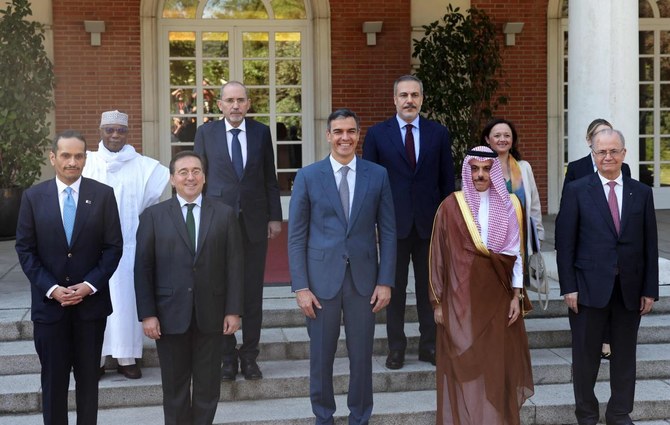
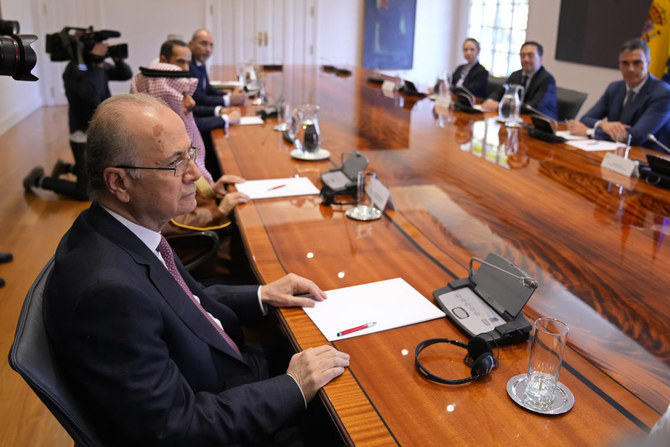
BARCELONA, Spain: Spanish Prime Minister Pedro Sánchez met with Palestinian Prime Minister Mohammad Mustafa and leading officials from several Middle Eastern countries in Madrid on Wednesday after Spain, Ireland and Norway recognized a Palestinian state.
The diplomatic move by the three western European nations on Tuesday was slammed by Israel and will have little immediate impact on its grinding war in Gaza, but it was a victory for the Palestinians and could encourage other Western powers to follow suit.
“On behalf of President (Mahmoud) Abbas and the government of Palestine, the people of Palestine, we warmly welcome Spain’s recognition of the state of Palestine,” Mustafa said after their meeting with Spain’s leader and Spanish Foreign Minister José Manuel Albares.
Mustafa was joined by Saudi Arabian Foreign Minister Prince Faisal bin Farhan, Qatari Prime Minister Sheikh Mohammed bin Abdulrahman Al Thani, Organization of Islamic Cooperation chairman Hussain Ibrahim Taha, and the foreign ministers for Turkiye and Jordan, members of the group called the Foreign Ministerial Committee of Arabic and Islamic countries for Gaza.
More than 140 countries recognize a Palestinian state — more than two-thirds of the United Nations.
With Spain and Ireland, there are now nine members of the 27-nation European Union that officially recognize a Palestinian state. Norway is not an EU member but its foreign policy is usually aligned with the bloc.
Slovenia, an EU member, will decide on the recognition of a Palestinian state on Thursday and forward its decision to parliament for final approval.
“We salute Spain, and we salute Norway, Ireland and Slovenia for doing the right thing. We urge other European partners to do the same thing,” said Jordanian Foreign Minister Ayman Safadi.
The move to recognize a Palestinian state has caused relations between the EU and Israel to nosedive. Madrid and Dublin are pushing for the EU to take measures against Israel for its continued attacks on southern Gaza’s city of Rafah.
The decision by Spain, Ireland and Norway comes more than seven months into an assault waged by Israel following the Oct. 7 Hamas-led attack in which militants stormed across the Gaza border into Israel, killing 1,200 people and taking about 250 hostage. Israel’s air and land attacks have since killed 36,000 Palestinians, according to Gaza’s Health Ministry, which doesn’t distinguish between combatants and civilians.


![]()
![]()

Spain hosts meeting with Foreign Ministerial Committee of Arabic and Islamic countries for Gaza
Short Url
https://arab.news/mkckn
Spain hosts meeting with Foreign Ministerial Committee of Arabic and Islamic countries for Gaza
- Palestinian PM was joined by Saudi Arabian Foreign Minister Prince Faisal bin Farhan, Qatari Prime Minister Sheikh Mohammed bin Abdulrahman Al Thani
- More than 140 countries recognize a Palestinian state


Latest updates


Recommended


© 2026 SAUDI RESEARCH & PUBLISHING COMPANY, All Rights Reserved And subject to Terms of Use Agreement.