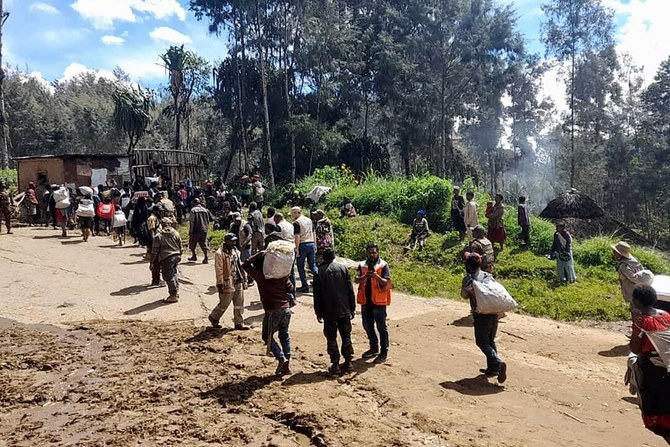
PORT MORESBY: Supplies of food and medicine began arriving at the scene of a deadly landslide in Papua New Guinea Wednesday, with aid workers discovering children rendered mute by the shock of the disaster.
Papua New Guinea’s government estimates that as many as 2,000 people may be buried underneath a massive landslide that struck a thriving highland settlement in Enga province in the early hours of May 24.
Only six bodies have so far been pulled from the mountain of churned-up earth after days of frantic digging with makeshift tools.
Difficulties getting aid and supplies to the site — and the speed of the government response — has stoked a mix of desperation and frustration on the ground.
Community leader Miok Michael said that 19 of his “family members and relatives” were missing and feared dead.
“The relief support and donations are slowly reaching the affected site,” said Michael, who recently visited the disaster zone.
“But displaced people are still crying and calling for help. There is no proper house for them to sleep, all their houses were buried.”
With rescue teams abandoning hope of finding survivors under the meters of mud and rubble, the community has started to count the emotional and physical cost.
Mourning locals have started carrying the dead away in immense “haus krai” funeral processions, collective outpourings of love and grief that can last for weeks.
Images showed a group of men carrying a wooden casket down the forested valley on their shoulders as scores of mourners trailed behind them, wailing with despair.
Aid groups fear children will bear the brunt of the catastrophe, estimating that 40 percent of residents in the area are younger than 16.
“What we are hearing is that, because of what they saw and experienced, many of the children have stopped talking,” Justine McMahon from CARE Papua New Guinea said.
Niels Kraaier from UNICEF Papua New Guinea said workers were aware of nine orphaned children.
UNICEF said it had started distributing rudimentary hygiene kits of buckets, jerrycans and soap, while World Vision said food, shelter, blankets and mosquito nets remained immediate needs.
However, full-scale rescue and relief efforts have been severely hampered by the site’s remote location, nearby tribal violence and landslide damage that has severed major road links.
The collapse of bridges along the sealed road to the site has forced lengthy detours for some aid convoys.
Papua New Guinea’s military tried for days to bring heavy earth-moving equipment to the site.
But, with a series of bridges in a state of disrepair or damaged by earlier floods, they have now abandoned that plan and will source equipment from mines and businesses.
That equipment will arrive at the landslide by Thursday at the “latest,” UN migration agency official Serhan Aktoprak said.
Provincial leaders have implored the government to declare a national emergency that would draw attention to their plight and free up resources.
“I am not equipped to deal with this tragedy,” provincial administrator Sandis Tsaka said.
Prime Minister James Marape is yet to visit the remote pocket of Enga province more than five days after the landslide.
He has stayed in the capital Port Moresby, where his government is trying to fend off a no-confidence motion that could sweep it from power.
There are concerns this political manoeuvering has drawn attention away from what could be one of the country’s worst natural disasters.
Marape told parliament on Wednesday that the village of Yambali was “no more.”
“Nature, through a disastrous landslip, submerged or covered the village and from our initial estimation over 2,000 people would have perished in this disaster.”
“In this year, we have had extraordinary rainfall that has caused flooding in river areas, sea level rise in coastal areas, and landslips in a few areas,” Marape said.
Papua New Guinea is one of the world’s most disaster-prone regions and landslides are extremely common in its highlands.
Geologists believe recent heavy rain may have contributed to the slide.
“Papua New Guinea sits right on a plate boundary, where these large, rigid parts of the earth plow into each other,” University of Adelaide geologist Alan Collins said.
“This creates mountains, steep slopes and other extreme topography.
“You have these steep slopes located in an area of heavy rainfall, and this can rot the minerals in the rocks, and gradually weaken them.”
The World Bank and others have warned that landslides were likely to increase in Papua New Guinea due to a growing population and uncontrolled land use.
Scientists have also warned that climate change will cause more extreme rainfall across most parts of the world.

Aid reaches Papua New Guinea landslide site
Short Url
https://arab.news/m5afr
Aid reaches Papua New Guinea landslide site
- Difficulties getting aid and supplies to the site has stoked a mix of desperation and frustration on the ground
- Full-scale rescue and relief efforts have been severely hampered by the site’s remote location
After accepting US deportees, South Sudan wanted sanctions relief for top official, documents show
JUBA: After agreeing to accept deportees from the United States last year, South Sudan sent a list of requests to Washington that included American support for the prosecution of an opposition leader and sanctions relief for a senior official accused of diverting over a billion dollars in public funds.
The requests, contained in a pair of diplomatic communications made public by the State Department this month, offer a glimpse into the kind of benefits that some governments may have sought as they negotiated with the US over the matter of receiving deportees.
In the documents, the US expresses “appreciation” to South Sudan for accepting the deportees and details the names, nationalities and crimes for which each individual was convicted.
In July, South Sudan became the first African country to receive third-country deportees from the US Rwanda, Eswatini, Ghana and Equatorial Guinea have since received deportees.
The eight deportees to South Sudan included nationals of Mexico, Cuba, Vietnam, Laos, Myanmar and South Sudan itself.
Contentious deportations
They arrived in the South Sudanese capital of Juba after spending weeks on a US military base in Djibouti, where they were held after a US court temporarily blocked their deportation. Six of the eight men remain at a residential facility in Juba under the supervision of security personnel.
South Sudanese national Dian Peter Domach was later freed, according to the Ministry of Foreign Affairs, while Jesus Munoz-Gutierrez, a Mexican, was repatriated in September.
South Sudanese officials have not publicly said what long-term plan is in place for those still in custody. The third-country deportations were highly contentious, criticized by rights groups and others who expressed concern South Sudan would become a dumping ground.
Details of the deal between the US and South Sudan remain murky. It is still unclear what, if anything, South Sudan may have actually received or been promised. The documents only offer a glimpse into what the South Sudanese government hoped to get in return.
In other cases, Human Rights Watch said it saw documents showing the US agreed to pay Rwanda’s government around $7.5 million to take up to 250 deportees. The US will give Eswatini $5.1 million to take up to 160 deportees, according to the group.
For South Sudan, in one communication dated May 12 and marked confidential, South Sudan’s Ministry of Foreign Affairs raised eight “matters of concern which the Government of South Sudan believes merit consideration.” These ranged from the easing of visa restrictions for South Sudanese nationals to the construction of a rehabilitation center and “support in addressing the problem of armed civilians.”
Request to lift sanctions
But an eye-catching ask was for the lifting of US sanctions against former Vice President Benjamin Bol Mel as well as Washington’s support for the prosecution of opposition leader Riek Machar, the now-suspended first vice president of South Sudan who faces treason, murder and other criminal charges in a controversial case.
The allegations against Machar stem from a violent incident in March, when an armed militia with historical ties to him attacked a garrison of government troops. Machar’s supporters and some activists describe the charges as politically motivated.
Bol Mel is accused of diverting more than a billion dollars earmarked for infrastructure projects into companies he owns or controls, according to a UN report. He wielded vast influence in the government and was touted by some as Kiir’s likely successor in the presidency until he was dismissed and placed under house arrest in November.
Bol Mel was also viewed as a key figure behind the prosecution of Machar, one of the historical leaders of South Sudan’s ultimately successful quest for independence from Sudan in 2011.
Machar was Kiir’s deputy when they fell out in 2013, provoking the start of civil war as government troops loyal to Kiir fought forces loyal to Machar.
A 2018 peace agreement brought Machar back into government as the most senior of five vice presidents. His prosecution has been widely criticized as a violation of that agreement, and has coincided with a spike in violence that the UN says killed more than 1,800 people between January and September 2025.
The UN has also warned that a resurgence of fighting has brought the country “back to the edge of a relapse into civil war.” Machar is under house arrest in Juba while his criminal trial proceeds slowly.
In its communications with the US, South Sudan also asked for sanctions to be lifted over South Sudanese oil companies “to encourage direct foreign investments,” and for the US to consider investing in other sectors including fossil fuels, minerals and agriculture.
When asked if the US government had provided or promised South Sudan anything in return for accepting the deportees, a State Department official said, “In keeping with standard diplomatic practice, we do not disclose the details of private discussions.”
A spokesman for South Sudan’s Ministry of Foreign Affairs, Thomas Kenneth Elisapana, declined to comment.
US aid cuts
Despite accepting the US request to admit deportees, relations between the two governments have been strained in recent months.
In December, the US threatened to reduce aid contributions to the country, accusing the government of imposing fees on aid groups and obstructing their operations.
The US has historically been one of the largest donors to South Sudan, providing roughly $9.5 billion in aid since 2011. Over the years, South Sudan’s government has struggled to deliver many of the basic services of a state, and years of conflict have left the country heavily reliant on foreign aid.
The requests, contained in a pair of diplomatic communications made public by the State Department this month, offer a glimpse into the kind of benefits that some governments may have sought as they negotiated with the US over the matter of receiving deportees.
In the documents, the US expresses “appreciation” to South Sudan for accepting the deportees and details the names, nationalities and crimes for which each individual was convicted.
In July, South Sudan became the first African country to receive third-country deportees from the US Rwanda, Eswatini, Ghana and Equatorial Guinea have since received deportees.
The eight deportees to South Sudan included nationals of Mexico, Cuba, Vietnam, Laos, Myanmar and South Sudan itself.
Contentious deportations
They arrived in the South Sudanese capital of Juba after spending weeks on a US military base in Djibouti, where they were held after a US court temporarily blocked their deportation. Six of the eight men remain at a residential facility in Juba under the supervision of security personnel.
South Sudanese national Dian Peter Domach was later freed, according to the Ministry of Foreign Affairs, while Jesus Munoz-Gutierrez, a Mexican, was repatriated in September.
South Sudanese officials have not publicly said what long-term plan is in place for those still in custody. The third-country deportations were highly contentious, criticized by rights groups and others who expressed concern South Sudan would become a dumping ground.
Details of the deal between the US and South Sudan remain murky. It is still unclear what, if anything, South Sudan may have actually received or been promised. The documents only offer a glimpse into what the South Sudanese government hoped to get in return.
In other cases, Human Rights Watch said it saw documents showing the US agreed to pay Rwanda’s government around $7.5 million to take up to 250 deportees. The US will give Eswatini $5.1 million to take up to 160 deportees, according to the group.
For South Sudan, in one communication dated May 12 and marked confidential, South Sudan’s Ministry of Foreign Affairs raised eight “matters of concern which the Government of South Sudan believes merit consideration.” These ranged from the easing of visa restrictions for South Sudanese nationals to the construction of a rehabilitation center and “support in addressing the problem of armed civilians.”
Request to lift sanctions
But an eye-catching ask was for the lifting of US sanctions against former Vice President Benjamin Bol Mel as well as Washington’s support for the prosecution of opposition leader Riek Machar, the now-suspended first vice president of South Sudan who faces treason, murder and other criminal charges in a controversial case.
The allegations against Machar stem from a violent incident in March, when an armed militia with historical ties to him attacked a garrison of government troops. Machar’s supporters and some activists describe the charges as politically motivated.
Bol Mel is accused of diverting more than a billion dollars earmarked for infrastructure projects into companies he owns or controls, according to a UN report. He wielded vast influence in the government and was touted by some as Kiir’s likely successor in the presidency until he was dismissed and placed under house arrest in November.
Bol Mel was also viewed as a key figure behind the prosecution of Machar, one of the historical leaders of South Sudan’s ultimately successful quest for independence from Sudan in 2011.
Machar was Kiir’s deputy when they fell out in 2013, provoking the start of civil war as government troops loyal to Kiir fought forces loyal to Machar.
A 2018 peace agreement brought Machar back into government as the most senior of five vice presidents. His prosecution has been widely criticized as a violation of that agreement, and has coincided with a spike in violence that the UN says killed more than 1,800 people between January and September 2025.
The UN has also warned that a resurgence of fighting has brought the country “back to the edge of a relapse into civil war.” Machar is under house arrest in Juba while his criminal trial proceeds slowly.
In its communications with the US, South Sudan also asked for sanctions to be lifted over South Sudanese oil companies “to encourage direct foreign investments,” and for the US to consider investing in other sectors including fossil fuels, minerals and agriculture.
When asked if the US government had provided or promised South Sudan anything in return for accepting the deportees, a State Department official said, “In keeping with standard diplomatic practice, we do not disclose the details of private discussions.”
A spokesman for South Sudan’s Ministry of Foreign Affairs, Thomas Kenneth Elisapana, declined to comment.
US aid cuts
Despite accepting the US request to admit deportees, relations between the two governments have been strained in recent months.
In December, the US threatened to reduce aid contributions to the country, accusing the government of imposing fees on aid groups and obstructing their operations.
The US has historically been one of the largest donors to South Sudan, providing roughly $9.5 billion in aid since 2011. Over the years, South Sudan’s government has struggled to deliver many of the basic services of a state, and years of conflict have left the country heavily reliant on foreign aid.
© 2026 SAUDI RESEARCH & PUBLISHING COMPANY, All Rights Reserved And subject to Terms of Use Agreement.


