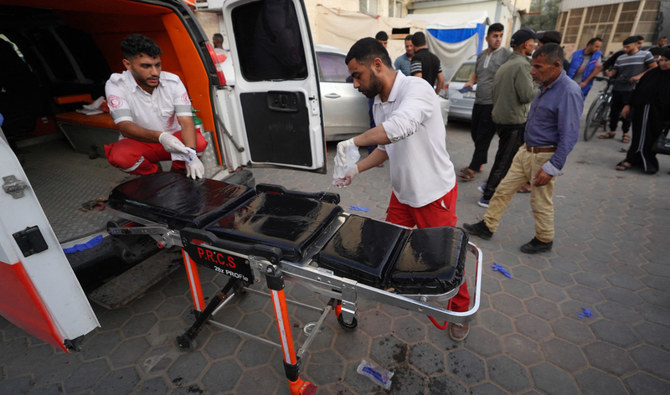
GENEVA: Desperately needed medical evacuations from Gaza — already very limited — came to a full stop when Israel launched its military offensive on Rafah three weeks ago, the World Health Organization said on Tuesday.
The United Nations health agency has long been pleading for Israeli permission to evacuate more critically ill and severely wounded people from Gaza.
Thousands of Gazans are estimated to require urgent medical evacuation but few have been able to leave the besieged Palestinian territory since war erupted there nearly eight months ago.
WHO spokeswoman Margaret Harris said that since Israel launched its military offensive in the densely crowded southern city of Rafah in early May, “there’s been an abrupt halt to all medical evacuations.”
She warned that the cut-off obviously meant more people will die waiting for treatment.
Before the war in the Gaza Strip erupted after Hamas’s October 7 attacks, around 50 to 100 people left the enclave every day with medical referrals for complex treatments that were not available in the Palestinian territory, including for cancer.
“Those people didn’t go away simply because conflict started, so they all still need a referral,” Harris told reporters in Geneva.
And since services in Gaza have been disastrously disrupted by the conflict, far more people need to leave to get services they used to access inside the strip, like chemotherapy or dialysis, she said.
In addition, thousands now need to evacuate after suffering severe trauma injuries in the war.
WHO estimates that there are now typically at any given time “around 10,000 people who need to be evacuated... to receive the much-needed medical treatment elsewhere,” Harris said.
They include more than 6,000 trauma-related patients and at least 2,000 patients with serious chronic conditions, like cancer, she said.
Since the complete halt to medical evacuations from Gaza on May 8, an additional 1,000 critically ill and wounded patients have been added to that list, Harris said.
Before the cut-off, WHO had received approval from Israel for 5,800 medical evacuations — around just half of the number it had requested since the war began.
Of those 5,800, only 4,900 patients had actually been able to leave, Harris said.
The Gaza war began after Hamas fighters attacked southern Israel on October 7, resulting in the deaths of more than 1,170 people, mostly civilians, according to an AFP tally based on Israeli official figures.
Palestinian militants also took 252 hostages, 121 of whom remain in Gaza, including 37 the Israeli army says are dead.
Israel’s relentless military retaliation has killed at least 36,096 people in Gaza, mostly civilians, according to the Hamas-run territory’s health ministry.

WHO condemns ‘abrupt halt’ to medical evacuations from Gaza
Short Url
https://arab.news/8d5cz
WHO condemns ‘abrupt halt’ to medical evacuations from Gaza
- Thousands of Gazans are estimated to require urgent medical evacuation
- WHO spokeswoman Margaret Harris warned that the cut-off obviously meant more people will die waiting for treatment
UN warns clock ticking for Sudan’s children
- UNICEF says in parts of North Darfur, more than half of all children are acutely malnourished
- UN-backed experts have said famine is spreading in Sudan’s western Darfur region
GENEVA: The United Nations warned Tuesday that time was running out for malnourished children in Sudan and urged the world to “stop looking away.”
Famine is spreading in Sudan’s western Darfur region, UN-backed experts warned last week, with the grinding war between the army and paramilitary forces leaving millions hungry, displaced and cut off from aid.
Global food security experts say famine thresholds for acute malnutrition have been surpassed in North Darfur’s contested areas of Um Baru and Kernoi.
Ricardo Pires, spokesman for the UN children’s agency UNICEF, said the situation was getting worse for children by the day, warning: “They are running out of time.”
In parts of North Darfur, more than half of all children are acutely malnourished, he told a press conference in Geneva.
“Extreme hunger and malnutrition come to children first: the youngest, the smallest, the most vulnerable, and in Sudan it’s spreading,” he said.
Fever, diarrhea, respiratory infections, low vaccination coverage, unsafe water and collapsing health systems are turning treatable illnesses “into death sentences for already malnourished children,” he warned.
“Access is shrinking, funding is desperately short and the fighting is intensifying.
“Humanitarian access must be granted and the world must stop looking away from Sudan’s children.”
Since April 2023, the conflict between Sudan’s army and the paramilitary Rapid Support Forces has killed tens of thousands, displaced 11 million and triggered what the UN calls one of the world’s worst humanitarian crises.
Shible Sahbani, the World Health Organization’s representative in Sudan, said the country was “facing multiple disease outbreaks: including cholera, malaria, dengue, measles, in addition to malnutrition.”
At the same time, health workers and health infrastructure are increasingly in the crosshairs, he told reporters.
Since the war began, the WHO has verified 205 attacks on health care, leading to 1,924 deaths.
And the attacks are growing deadlier by the year.
In 2025, 65 attacks caused 1,620 deaths, and in the first 40 days of this year, four attacks led to 66 deaths.
Fighting has intensified in the southern Kordofan region.
“We have to be proactive and to pre-position supplies, to deploy our teams on the ground to be prepared for any situation,” Sahbani said.
“But all this contingency planning... it’s a small drop in the sea.”
Famine is spreading in Sudan’s western Darfur region, UN-backed experts warned last week, with the grinding war between the army and paramilitary forces leaving millions hungry, displaced and cut off from aid.
Global food security experts say famine thresholds for acute malnutrition have been surpassed in North Darfur’s contested areas of Um Baru and Kernoi.
Ricardo Pires, spokesman for the UN children’s agency UNICEF, said the situation was getting worse for children by the day, warning: “They are running out of time.”
In parts of North Darfur, more than half of all children are acutely malnourished, he told a press conference in Geneva.
“Extreme hunger and malnutrition come to children first: the youngest, the smallest, the most vulnerable, and in Sudan it’s spreading,” he said.
Fever, diarrhea, respiratory infections, low vaccination coverage, unsafe water and collapsing health systems are turning treatable illnesses “into death sentences for already malnourished children,” he warned.
“Access is shrinking, funding is desperately short and the fighting is intensifying.
“Humanitarian access must be granted and the world must stop looking away from Sudan’s children.”
Since April 2023, the conflict between Sudan’s army and the paramilitary Rapid Support Forces has killed tens of thousands, displaced 11 million and triggered what the UN calls one of the world’s worst humanitarian crises.
Shible Sahbani, the World Health Organization’s representative in Sudan, said the country was “facing multiple disease outbreaks: including cholera, malaria, dengue, measles, in addition to malnutrition.”
At the same time, health workers and health infrastructure are increasingly in the crosshairs, he told reporters.
Since the war began, the WHO has verified 205 attacks on health care, leading to 1,924 deaths.
And the attacks are growing deadlier by the year.
In 2025, 65 attacks caused 1,620 deaths, and in the first 40 days of this year, four attacks led to 66 deaths.
Fighting has intensified in the southern Kordofan region.
“We have to be proactive and to pre-position supplies, to deploy our teams on the ground to be prepared for any situation,” Sahbani said.
“But all this contingency planning... it’s a small drop in the sea.”
© 2026 SAUDI RESEARCH & PUBLISHING COMPANY, All Rights Reserved And subject to Terms of Use Agreement.


