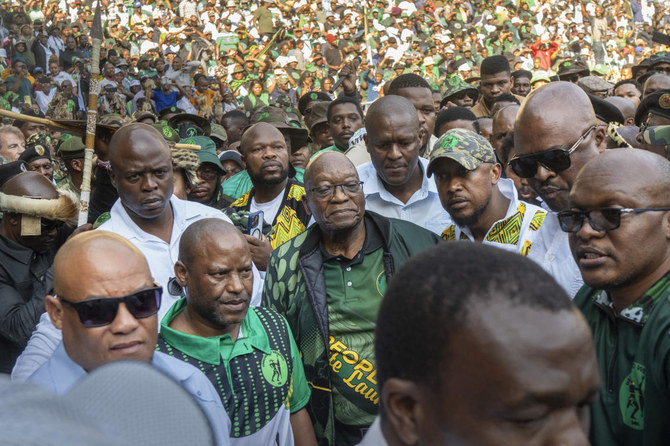
KWAXIMBA, South Africa: In a village nestled in the mountains of South Africa’s hotly-contested Kwazulu-Natal province, former President Jacob Zuma’s new party has campaigned relentlessly to win voters away from his old one, the ruling ANC.
On Monday, rival tents pitched by the two parties outside a local school serving as a polling station blasted party songs welcoming early voters they hoped to sway.
Most South Africans will vote on Wednesday but some, including the elderly and the infirm, were allowed to cast their ballots on Monday in what is expected to be the tightest election in decades.
The emergence of Zuma’s uMkhonto we Sizwe (MK), has increased tension in Kwazulu-Natal, a key election battleground already infamous for political violence.
KwaXimba, a rural area dotted by thatched “rondavel” huts outside the eastern city of Durban, has been ruled by the African National Congress (ANC) since the dawn of democracy in 1994.
But many here revere Zuma, an ethnic Zulu, who was born in the province.
“We’ve needed change for a long time in our lives,” said Thokozani Mthembu, the MK’s local coordinator in KwaXimba.
Some opinion polls suggest that MK could win the most votes in Kwazulu-Natal. This would almost certainly condemn the ANC to its worst electoral result in three decades.
It could lose its parliamentary majority for the first time and be forced to form a coalition government.
Voting proceeded smoothly in KwaXimba during the day, but in a tense atmosphere.
Mthembu claims that after Zuma, 82, held a rally with hundreds of supporters in KwaXimba in January, the party received threats of violence from ANC supporters. Some voters were also wrongly told that the MK would take away social grants and free housing, he said.
The ANC denies all wrongdoing.
“From the day we started our campaign, we’ve had one goal, which is to win the election without threatening other parties,” Sihle Gwala, a local ANC leader, told AFP.
Earlier this month, police warned against “spreading statements that have a potential of inciting violence or create a state of panic in the communities” after a voice note circulated claiming that 11 people were killed in a politically-related shooting.
Many in KwaXimba have turned to the MK, lamenting continuous water and electricity shortages, which some blame on the ANC’s poor management.
Down the road from the school, chickens clucked in 66-year-old Nicolas Ndlovu’s yard, as he walked outside, waiting for election officials to reach his home and allow him to cast his early ballot.
Having fought for the ANC during the anti-apartheid struggle and supported the party all his life, he said he now hoped to see it end up in opposition, so that “maybe they can work harder and earn the power back.”
His village’s streets, where cows roam under the sun, are plastered by campaign posters of the rival parties.
ANC volunteer Jabulile Nduna said the rift between Zuma and her party has caused divisions within her own family.
“I sat (down) my siblings and told them, ‘at the end of the day we have one mother and one father’... whether the MK wins or the ANC wins, we have to remain a family,” said the 43-year-old mother of three, as she walked on a gravel road near a voting station.
During a campaign visit to KwaXimba last month, President Cyril Ramaphosa warned voters about new parties trying to “nibble the edges” of ANC support, saying they would fail to win power.
But some like Nkazimula Makhanya are not heeding the call.
At 26 he has no job and few prospects of getting one, with youth unemployment at 45 percent.
“The old man, as old as he is, he still values our input, and he still allows us to be winners,” he said, referring to Zuma.


![]()

Zuma’s party guns for ANC stronghold in South Africa vote
Short Url
https://arab.news/g4yue
Zuma’s party guns for ANC stronghold in South Africa vote
- The emergence of uMkhonto we Sizwe, has increased tension in Kwazulu-Natal, a key election battleground already infamous for political violence


Latest updates


© 2026 SAUDI RESEARCH & PUBLISHING COMPANY, All Rights Reserved And subject to Terms of Use Agreement.