As Pakistan’s Jacobabad sizzles at 49°C, residents brace for ‘unbearable’ heat in coming months

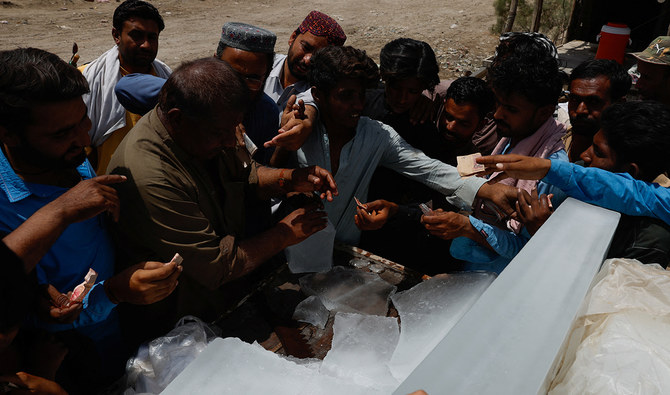
People buy ice blocks from a vendor during a hot summer day, as the heatwave continues in Jacobabad, Pakistan May 26, 2024. (REUTERS)
Short Url
Updated 27 May 2024
Follow

As Pakistan’s Jacobabad sizzles at 49°C, residents brace for ‘unbearable’ heat in coming months

  • Jacobabad in Pakistan’s southern Sindh province is counted among world’s hottest cities 
  • Residents say prolonged power crisis makes heat unbearable during summer months 

ISLAMABAD: The temperature in southern Pakistan’s Jacobabad city skyrocketed to 49° C on Sunday but residents said they feared the coming months would cause “unbearable heat” in the city, as many parts of the country remain in the grip of a heat wave. 

Jacobabad in Pakistan’s southern Sindh province is considered one of the hottest places on earth, where temperatures during the summer frequently cross 50° C. Prolonged power outages and water crisis mean the summer months are particularly harsh for the city’s roughly 300,000 residents. 

Pakistan’s disaster management authority warned earlier this month temperatures in certain areas of Pakistan’s Sindh and eastern Punjab provinces could surge to 40 degrees Celsius between May 15-30. 

But residents, however, are more concerned with what the coming months of June, July and August would bring. Zulfiqar Ali, the owner of a herbal medical shop in the city, said the breeze makes the current heat wave bearable. 

“The actual heat starts in June, July and August,” Ali told Reuters. “The winds stop totally at that time, so it becomes very humid. That heat is unbearable. We sweat so much that we cannot even work.”

Sharjil Ahmed, a school teacher, said residents consume cold drinks to beat the heat when the temperature crosses 50° C. However, power breakdowns make life difficult for the city’s residents. 

“Because of power load shedding, there is a shortage of ice most of the time,” Ahmed said. “We try to stay in the shade, under trees.”

Increased exposure to heat, and more heat waves, have been identified as one of the key impacts of climate change in Pakistan, with people experiencing extreme heat and seeing some of the highest temperatures in the world in recent years. The South Asian country of more than 241 million, one of the ten most vulnerable nations to climate change impacts, has also recently witnessed untimely downpours, flash floods and droughts.

Climate change-induced extreme heat can cause illnesses such as heat cramps, heat exhaustion, heatstroke, and hyperthermia. It can make certain chronic conditions worse, including cardiovascular, respiratory, and cerebrovascular disease and diabetes-related conditions, and can also result in acute incidents, such as hospitalizations due to strokes or renal disease.

According to the Global Climate Risk Index, nearly 10,000 Pakistanis have died while the country has suffered economic losses worth $3.8 billion due to climate change impacts between 1999 and 2018. A deadly heat wave that hit Pakistan’s largest city of Karachi, the capital of Sindh, claimed 120 lives in 2015.


Pakistan military says 12 militants killed in counter-terror operations in southwest

Updated 5 sec ago
Follow

Pakistan military says 12 militants killed in counter-terror operations in southwest

  • Pakistan military says “Indian-sponsored terrorists” were killed in southwestern Kalat district on Dec. 6
  • Development takes place day after military said it gunned down five militants in Balochistan’s Dera Bugti area

ISLAMABAD: Pakistani security forces killed 12 “Indian-sponsored terrorists” in the southwestern Balochistan province, the military’s media wing said on Sunday, vowing to purge “terrorism” from the country.

The security operation was carried out in Balochistan’s Kalat district on Dec. 6, the Inter-Services Public Relations (ISPR), the military’s media wing, said in a statement. It said the militants belonged to Indian proxy “Fitna al Hindustan.”

The military uses this term to describe ethnic Baloch militant groups who demand independence from Pakistan. Islamabad accuses New Delhi of arming and funding these separatist groups, charges India has always denied. 

“Weapons, ammunition and explosives were also recovered from the terrorists, who remained actively involved in numerous terrorist activities in the area,” the ISPR said. 

The military said that it was carrying out sanitization operations in the area to eliminate other “terrorists,” vowing it will continue with its relentless counter-terror campaign to purge militancy. 

The development took place a day after the Pakistan military said it had gunned down 14 militants in the northwestern Khyber Pakhtunkhwa (KP) and Balochistan provinces. 

Balochistan, Pakistan’s largest province by since yet its most backward by almost all social and economic indicators, has suffered from a bloody separatist insurgency for decades. 

The most ethnic Baloch militant group that has mounted attacks against law enforcement and civilians in the area is the Balochistan Liberation Army.

These militant outfits accuse the military and federal government of denying the local Baloch population a share in the province’s mineral wealth, charges Islamabad denies.