

Sirens sound in Tel Aviv for the first time in months as Hamas says it fired rockets from Gaza

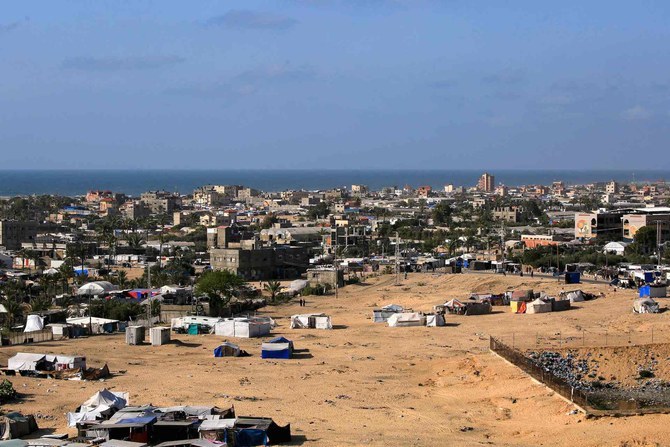
A Palestinian man walks past a destroyed building in Rafah in the southern Gaza Strip on May 26, 2024, amid the ongoing conflict between Israel and the Hamas militant group continues. (Photo by Eyad BABA / AFP)
Short Url
Updated 27 May 2024
Follow

Sirens sound in Tel Aviv for the first time in months as Hamas says it fired rockets from Gaza

  • Hamas armed wing says fired ‘large rocket barrage’ at Tel Aviv
  • Aid trucks begin entering Gaza through Kerem Shalom crossing

CAIRO/TEL AVIV: Rocket sirens blared Sunday in Israel’s commercial hub of Tel Aviv for the first time in months, with at least three blasts reported across central Israel, AFP correspondents said.

The Israeli military said sirens had been activated over central Israel as fighting raged in Gaza, including in the far-southern city of Rafah.

The armed wing of Palestinian militant group Hamas said it had launched a “large rocket barrage” on Tel Aviv.

The Ezzedine al-Qassam Brigades said in a post on Telegram that they had targeted Tel Aviv “with a large rocket barrage in response to the Zionist massacres against civilians.”

There were no immediate reports of casualties or damage from the latest barrage.

Earlier on Sunday, aid trucks entered Gaza from southern Israel through a new agreement to bypass the Rafah crossing with Egypt after Israeli forces seized the Palestinian side of it earlier this month. But was unclear if humanitarian groups would be able to access the aid because of ongoing fighting in the area.

A total of “200 trucks” had moved from the Egyptian side of the Rafah border crossing, which has been shut since early May when Israel seized the Palestinian side of the terminal, to the Kerem Shalom crossing, some 4 kilometers (2.5 miles) to the south.

Egypt has refused to coordinate aid through Rafah as long as Israeli troops control the Palestinian side.

But on Friday, Egyptian President Abdel Fattah El-Sisi agreed in a call with his US counterpart Joe Biden to allow aid through Kerem Shalom, the other entry point into southern Gaza, the White House said.

Al-Qahera News did not specify how many trucks had made their way through inspection into besieged Gaza, but said “four fuel trucks” had already crossed and were heading to hospitals.

All aid from Egypt is inspected by Israeli authorities and distributed via the United Nations.

The remainder of the 200 trucks were “expected to cross into Gaza today,” Khaled Zayed, head of the Egyptian Red Crescent in Al-Arish — where the bulk of aid arrives — said.


Algeria parliament to vote on law declaring French colonization ‘state crime’

Updated 3 sec ago
Follow

Algeria parliament to vote on law declaring French colonization ‘state crime’

ALGERIA: Algeria’s parliament is set to vote on Wednesday on a law declaring France’s colonization of the country a “state crime,” and demanding an apology and reparations.
The vote comes as the two countries are embroiled in a major diplomatic crisis, and analysts say that while Algeria’s move is largely symbolic, it could still be politically significant.
The bill states that France holds “legal responsibility for its colonial past in Algeria and the tragedies it caused,” according to a draft seen by AFP.
The proposed law “is a sovereign act,” parliament speaker Brahim Boughali was quoted by the APS state news agency as saying.
It represents “a clear message, both internally and externally, that Algeria’s national memory is neither erasable nor negotiable,” he added.
France’s colonization of Algeria from 1830 until 1962 remains a sore spot in relations between the two countries.
French rule over Algeria was marked by mass killings and large-scale deportations, all the way to the bloody war of independence from 1954-1962.
Algeria says the war killed 1.5 million people, while French historians put the death toll lower at 500,000 in total, 400,000 of them Algerian.
French President Emmanuel Macron has previously acknowledged the colonization of Algeria as a “crime against humanity,” but has stopped short of offering an apology.
Asked last week about the vote, French foreign ministry spokesman Pascal Confavreux said he would not comment on “political debates taking place in foreign countries.”
Hosni Kitouni, a researcher in colonial history at the University of Exeter in the UK, said that “legally, this law has no international scope and therefore is not binding for France.”
But “its political and symbolic significance is important: it marks a rupture in the relationship with France in terms of memory,” he said.