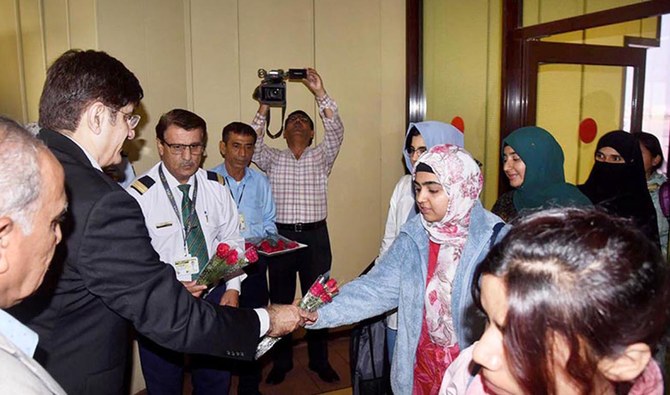
ISLAMABAD: Pakistani students evacuated from Kyrgyzstan after recent riots and violence against foreign nationals on Saturday lauded “tremendous and timely” support from their teachers and landlords, saying that they rescued and saved their lives.
Last week, violent riots erupted in the Kyrgyz capital, Bishkek, following the emergence of online videos showing a brawl between local and Egyptian students of medical sciences. The mobs mostly targeted the hostels of medical universities and private lodges of international students, including Pakistanis, in the city.
Around 10,000 Pakistani students are enrolled in different institutes in Kyrgyzstan and nearly 6,000 of them were studying in Bishkek, according to Pakistan’s diplomatic mission in the Central Asian country. The Pakistan government has evacuated thousands of students stranded in Bishkek by arranging special flights following the riots.
“We are alive today due to tremendous, effective and timely support of our teachers and landlords shortly after the violence,” Bilal Ahmad, a fourth-year medical student from Vehari district in Punjab province, told Arab News on phone. “Our teachers stayed with us in the hostel the whole night to protect us from the mob.”
Ahmad said when the situation normalized in Bishkek, local elders and officials apologized to the students for the violence. “They shared their mobile numbers with us to call them in any emergency,” he added.
Social media platforms were abuzz with different videos and photos showing the mob attacks against the international students in Bishkek. The Kyrgyz miscreants barged into hostels to attack foreign students without discrimination. Five Pakistani students were injured as a result, according to the Pakistan embassy, one of them seriously.
“We locked our doors and windows and reinforced them with cupboards, tables and chairs to prevent the miscreants from entering,” Asadullah Khan, a third-year medical student from Quetta, told Arab News.
“We switched off lights of our rooms and prayed to Allah … We called our landlord and she immediately responded and rescued us from there,” he said, adding that she took around nine students to her residence in her own car on the gloomy night.
Khan said that members of local communities, teachers and other university staff had cooperated with the students in the difficult time. “They brought us food, water and biscuits and stood by us against their own people,” he continued.
He also informed the local community and teachers had widely circulated audio and video messages of apology to international students, including Pakistanis, a day after the violence, promising to do everything to hold all the criminals accountable.
Khan said his parents were worried about his safety, fearing that they may not let him resume his studies in Bishkek after the semester break ended in September.
“My parents are pushing me to migrate to a local medical college in Pakistan to complete my studies,” he added. “I have invested my three years and a lot of money, so let’s see when the education resumes.”
Some students said the situation was completely under control in Bishkek days after the violence, as the local police and paramilitary took charge of the security of hostels and private apartments where international students were residing.
“I will go back to resume my studies since I can’t waste my time,” Anjum Rasheed, a final year medical student from Peshawar, told Arab News. “The days of the violence are over now, and local Kyrgyz community has repeatedly apologized to the students for the unfortunate incident.”
“Our teachers and other staff of the university had been extremely cooperative during the mob attack, and there is no reason for us to quit the studies,” he said, adding that one of his teachers rescued him from the hostel and took him to a shelter arranged by a human rights organization in the city.
He also noted that a local family transported him with a couple of other students to the airport for their flight back to Pakistan.


![]()
![]()

Pakistani students praise teachers, landlords for ‘timely’ rescue during Kyrgyzstan mob violence

Short Url
https://arab.news/83vmk
Pakistani students praise teachers, landlords for ‘timely’ rescue during Kyrgyzstan mob violence
- Teachers stayed with students in hostels to protect them from rioters while landlords took many to safety
- Many students say they will resume their studies in Bishkek after their semester break ends in September
Latest updates







© 2026 SAUDI RESEARCH & PUBLISHING COMPANY, All Rights Reserved And subject to Terms of Use Agreement.