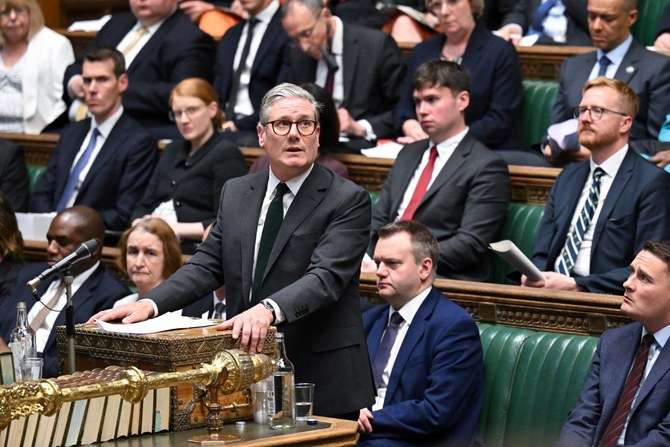
LONDON: Britain’s opposition leader Keir Starmer said on Friday he wanted to recognize a Palestinian state if he won power in an upcoming general election, but said that such a move would need to come at the right time in a peace process.
Ireland, Spain and Norway announced this week that they would recognize a Palestinian state on May 28, prompting an angry response from Israel which said this amounted to a “reward for terrorism” and recalled its ambassadors from the three capitals.
The Labour Party has been engulfed by an internal battle over its policy to the war in Gaza since the Oct. 7 attack by Hamas that led to Israel’s invasion.
Starmer has faced criticism for some traditional Labour voters for only gradually shifting the party’s position toward supporting a ceasefire in Gaza.
The party’s stance led to 10 senior party lawmakers quitting their policy roles and was blamed for a handful of disappointing results in this month’s local elections in some areas with large Muslim populations.
Asked if he thought Palestine should be a state, Starmer told the BBC: “Yes, I do, and I think recognition of Palestine is extremely important. We need a viable Palestinian state alongside a safe and secure Israel, and recognition has to be part of that.”
Starmer said recognition of a Palestinian state would need to come at the right time in a peace process, but “I absolutely believe in it,” arguing a two-state solution was essential for lasting peace in the region.
The two-state solution has long been the framework of British foreign policy and international efforts to resolve the conflict but the peace process has been moribund for years.
The current Conservative government, and other big European states such as France and Germany, have also voiced support in principle for a Palestinian state, but with the timing of recognition forming part of a broader peace process.
This week, Labour backed the independence of the International Criminal Court after it sought arrest warrants for both Hamas and Israeli officials for war crimes, opening up a divide with the governing Conservative Party.
The Conservative government said the ICC did not have the jurisdiction to request the arrest warrants and it would not help get Israeli hostages out of Gaza, get humanitarian aid in, or deliver a sustainable ceasefire.

UK Labour leader Starmer says wants to recognize Palestinian state as part of peace process
https://arab.news/6x5qd
UK Labour leader Starmer says wants to recognize Palestinian state as part of peace process
- Ireland, Spain and Norway announced this week that they would recognize a Palestinian state on May 28
- The Labour Party has been engulfed by an internal battle over its policy to the war in Gaza since the Oct. 7 attack by Hamas
Geoeconomic confrontation tops global risks in 2026: WEF report
- Also armed conflict, extreme climate, public polarization, AI
- None ‘a foregone conclusion,’ says WEF’s MD Saadia Zahidi
DUBAI: Geoeconomic confrontation has emerged as the top global risk this year, followed by state-based armed conflict, according to a new World Economic Forum report.
The Global Risks Report 2026, released on Wednesday, found that both risks climbed eight places year-on-year, underscoring a sharp deterioration in the global outlook amid increased international competition.
The top five risks are geoeconomic confrontation (18 percent of respondents), state-based armed conflict (14 percent), extreme weather events (8 percent), societal polarization (7 percent) and misinformation and disinformation (7 percent).
The WEF’s Managing Director Saadia Zahidi said the report “offers an early warning system as the age of competition compounds global risks — from geoeconomic confrontation to unchecked technology to rising debt — and changes our collective capacity to address them.
“But none of these risks are a foregone conclusion.”
The report assesses risks across three timeframes: immediate (2026); short-to-medium term (next two years); and long term (next 10 years).
Economic risks show the largest overall increase in the two-year outlook, with both economic downturn and inflation jumping eight positions.
Misinformation and disinformation rank fifth this year but rise to second place in the two-year outlook and fourth over the 10-year horizon.
The report suggests this reflects growing anxiety around the rapid adoption of artificial intelligence, with adverse outcomes linked to AI surging from 30th place in the two-year timeframe to fifth in the 10-year outlook.
Uncertainty dominates the global risk outlook, according to the report.
Surveyed leaders and experts view both the short- and long-term outlook negatively, with 50 percent expecting a turbulent or stormy global environment over the next two years, rising to 57 percent over the next decade.
A further 40 percent and 32 percent, respectively, describe the outlook as unsettled across the two- and 10-year timeframes, while just 1 percent anticipate a calm global outlook in either period.
Environmental risks ease slightly in the short-term rankings. Extreme weather fell from second to fourth place and pollution from sixth to ninth. Meanwhile, critical changes to Earth systems and biodiversity loss dropped seven and five positions, respectively.
However, over the next decade, environmental threats re-emerge as the most severe, with extreme weather, biodiversity loss, and critical changes to Earth systems topping the global risk rankings.
Looking ahead over the next decade, around 75 percent of respondents anticipate a turbulent or stormy environmental outlook, making it the most pessimistic assessment across all risk categories.
Zahidi said that “the challenges highlighted in the report underscore both the scale of the potential perils we face and our shared responsibility to shape what comes next.”
Despite the gloomy outlook, Zahidi signaled a positive shift in global cooperation.
“It is also clear that new forms of global cooperation are already unfolding even amid competition, and the global economy is demonstrating resilience in the face of uncertainty.”
Now in its 21st year, the Global Risks Report highlights a core message: global risks cannot be managed without cooperation.
As competition intensifies, rebuilding trust and new forms of collaboration will be critical, with the report stressing that today’s decisions will shape future outcomes.
The report was released ahead of WEF’s annual meeting, which will be held in Davos from Jan. 19 to 23.


