UK Labour leader Starmer says wants to recognize Palestinian state as part of peace process

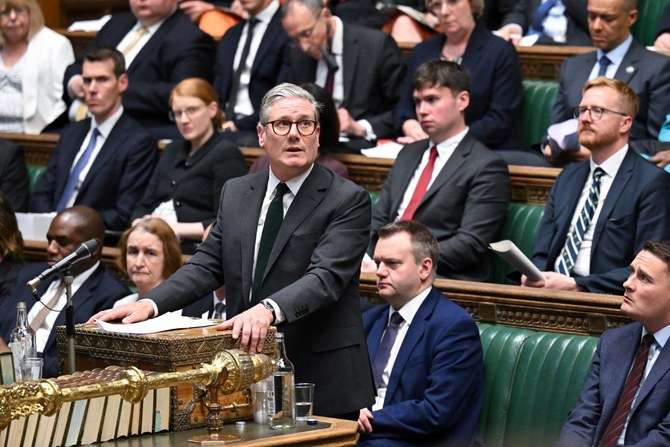
A handout photograph released by the UK Parliament shows Britain's main opposition Labour Party leader Keir Starmer (AFP)
Short Url
Updated 24 May 2024
Follow

UK Labour leader Starmer says wants to recognize Palestinian state as part of peace process

  • Ireland, Spain and Norway announced this week that they would recognize a Palestinian state on May 28
  • The Labour Party has been engulfed by an internal battle over its policy to the war in Gaza since the Oct. 7 attack by Hamas

LONDON: Britain’s opposition leader Keir Starmer said on Friday he wanted to recognize a Palestinian state if he won power in an upcoming general election, but said that such a move would need to come at the right time in a peace process.
Ireland, Spain and Norway announced this week that they would recognize a Palestinian state on May 28, prompting an angry response from Israel which said this amounted to a “reward for terrorism” and recalled its ambassadors from the three capitals.
The Labour Party has been engulfed by an internal battle over its policy to the war in Gaza since the Oct. 7 attack by Hamas that led to Israel’s invasion.
Starmer has faced criticism for some traditional Labour voters for only gradually shifting the party’s position toward supporting a ceasefire in Gaza.
The party’s stance led to 10 senior party lawmakers quitting their policy roles and was blamed for a handful of disappointing results in this month’s local elections in some areas with large Muslim populations.
Asked if he thought Palestine should be a state, Starmer told the BBC: “Yes, I do, and I think recognition of Palestine is extremely important. We need a viable Palestinian state alongside a safe and secure Israel, and recognition has to be part of that.”
Starmer said recognition of a Palestinian state would need to come at the right time in a peace process, but “I absolutely believe in it,” arguing a two-state solution was essential for lasting peace in the region.
The two-state solution has long been the framework of British foreign policy and international efforts to resolve the conflict but the peace process has been moribund for years.
The current Conservative government, and other big European states such as France and Germany, have also voiced support in principle for a Palestinian state, but with the timing of recognition forming part of a broader peace process.
This week, Labour backed the independence of the International Criminal Court after it sought arrest warrants for both Hamas and Israeli officials for war crimes, opening up a divide with the governing Conservative Party.
The Conservative government said the ICC did not have the jurisdiction to request the arrest warrants and it would not help get Israeli hostages out of Gaza, get humanitarian aid in, or deliver a sustainable ceasefire.


Modi starts Mideast-Africa tour as India-Oman free-trade pact nears completion

Updated 15 December 2025
Follow

Modi starts Mideast-Africa tour as India-Oman free-trade pact nears completion

  • Oman’s Shoura Council approved the trade deal’s draft last week
  • Modi begins trip in Amman, heading to Addis Ababa and Muscat

NEW DELHI: Prime Minister Narendra Modi left New Delhi on Monday for a tour covering Jordan, Oman and Ethiopia, as his government looks to strengthen partnerships with West Asia and Africa and finalize a free-trade deal with Muscat.

Modi’s four-day trip will start in Amman, at the invitation of King Abdullah.

“I am sure this visit will boost bilateral linkages between our nations,” Modi said on social media upon his arrival in Jordan, where he was received by Prime Minister Jafar Hassan.

On Tuesday, he is scheduled to arrive in Addis Ababa for his first state visit to Ethiopia. A day later, he will be in Muscat, where the Shoura Council last week approved the draft Comprehensive Economic Partnership Agreement with India.

“If it is signed during this visit, it will significantly deepen the economic ties between India and Oman. And it will open up a new chapter in the history of India-Oman trade and commercial relationship,” Ministry of External Affairs Secretary Arun Chatterjee told reporters ahead of Modi’s departure.

He said Modi would be accompanied by a high-level delegation for his second visit to Oman, after his last trip in February 2018. It also follows the visit of Oman’s Sultan Haitham bin Tariq to India in December 2023.

Free-trade negotiations between India and Oman began in November 2023, with the first round in New Delhi and the second in Muscat.

When the talks concluded in March 2024, Oman sought revisions on market-access terms and the final signature was postponed.

Announcements of the deal’s possible finalization have been made in the past few months by India’s Commerce and Industry Minister Piyush Goyal and the Omani ambassador to New Delhi, Issa Saleh Al-Shibani.

It would be its second with a GCC country after a 2022 trade deal with the UAE, as India has been trying to reach a similar agreement with the whole bloc.

“The framework is expected to be the same as the UAE’s, that is, a Comprehensive Economic Partnership Agreement. This is significant given that the progress on India-GCC FTA has been slow and non-consequential so far,” said Muddassir Quamar, associate professor at the School of International Studies, Jawaharlal Nehru University.

While Oman is one of Delhi’s smaller GCC trading partners — trailing behind the UAE and Saudi Arabia, with bilateral trade about $10 billion — it remains strategically important, particularly in energy and logistics.

“The FTA is likely to give a boost to India-Oman economic and trade relations, especially of goods and services. (It is) important given India has worked to enhance its trade and economic relations with the Gulf countries that are (among) the most dynamic and fast-expanding global economies,” Quamar told Arab News.

“It is also important because there is immense potential for Indian businesses and industries to partner with their Gulf and Omani partners in contributing to the diversification and economic growth plans.”