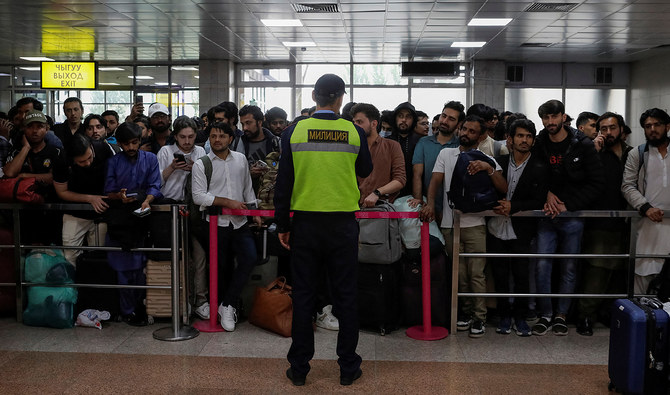
BISHKEK: Students from Pakistan and other Asian countries are leaving Kyrgyzstan by the hundreds after an angry mob attacked their living quarters this month, although some hope to return when the situation calms down.
Hundreds of Kyrgyz young men stormed a hostel in capital Bishkek in the early hours of May 17 and attacked foreign students there because of a brawl that happened between several Kyrgyz men and foreigners a few days earlier.
Police, although present, were unable to stop the violence.
“They invaded our... hostel and it was a terrifying moment for all of us and it was the worst nightmare,” said Imran Yousaf, a pathologist at the International University Kyrgyzstan.
He said that despite the students’ attempts to barricade entrances and hide, the attackers beat up and assaulted several students including some women.
“We were very much surprised and we were so much mentally traumatized at that time when people came in,” Yousaf said. “I don’t know what kind of provocateur is responsible for that kind of hatred among them.”
The government of Pakistan has arranged extra flights leaving daily from Bishkek and many students are using the opportunity to return home, at least temporarily.
Medical schools of Kyrgyzstan have over the last few decades become popular among aspiring doctors from India, Pakistan and some other Asian and Arab countries, in part thanks to relatively affordable fees and living expenses.
The Kyrgyz government has sought to allay foreign students’ fears and held meetings with their leaders, said Yousaf, who expressed hope that those who are leaving will return in a few months. Police have detained more than a dozen of the suspected attackers.
“The government of Kyrgyzstan has taken beautiful steps,.. our student council was invited to the parliament of Kyrgyzstan, along with the President, there was a one-on-one meeting, and I hope, Inshallah (God willing), with hope in my eyes and logic on my back, that this situation will dampen in the days to come,” Yousaf said.
“I am saying to all my friends, don’t think that Kyrgyzstan is bad,” said another student, Hamza Yasin.


![]()

Pakistanis among hundreds of foreign students flee Kyrgyzstan after mob attack
Short Url
https://arab.news/mz2ah
Pakistanis among hundreds of foreign students flee Kyrgyzstan after mob attack
- Hundreds of Kyrgyz men stormed a hostel in Bishkek on May 17 and attacked foreign students because of an earlier brawl
- The Pakistani government has arranged extra flights leaving daily from Bishkek and many students are using the opportunity
Latest updates





© 2026 SAUDI RESEARCH & PUBLISHING COMPANY, All Rights Reserved And subject to Terms of Use Agreement.