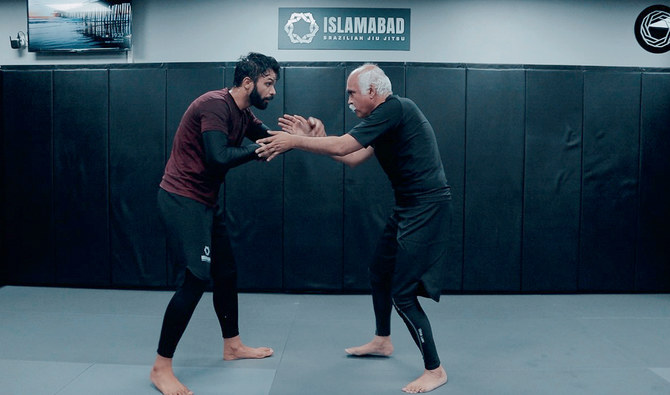
ISLAMABAD: Saqib Lateef stood out at Islamabad’s Brazilian Jiu-Jitsu (BJJ) training club this week, moving on the black mat with a grace and precision that defied his 59 years of age, and which have turned him into an inspiration for the younger athletes who train at the facility.
After retiring from the Pakistan army as a colonel in 2012 and transitioning through various jobs, Saqib Lateef discovered his passion for physical fitness and martial arts, particularly BJJ, a hybrid self-defense system based on traditional Japanese Jujitsu and Kodokan Judo and involving grappling, ground fighting, and submission holds.
“I have turned 59 and my own weight is 74 kg and I am 5 feet 10 inches in height,” Lateef told Arab News between fights. “So, I have sparred [fought] with all of them [younger athletes], people who are on the mat. They have got a lot of different weights, and I can take on anyone of them.”
BJJ revolves around the concept that a smaller, weaker person can successfully defend themselves against a bigger, stronger, heavier opponent by using leverage and weight distribution, taking the fight to the ground and using a number of holds and submissions to defeat them.
“I always test my limits, that how can I engage with younger people on the mat,” Lateeq said, explaining the fundamentals of BJJ.
“So, they are faster than me, and they are more resilient than me, and they have got more physical power. So it was a challenge for me to have a submission [defeat opponent] but in this old age, I can do submissions on them.”
“You don’t end up knocking someone off his face or drawing blood or causing a brain contusion,” added Osama Ahmed Aitzaz, who owns the Brazilian Jiu-Jitsu club, the only one in Islamabad and Rawalpindi, which he opened last year after returning from Australia.
“With this [BJJ], you just take the person to the ground. So we learn that stuff, how to take down a person and then there’s not much damage done.”
“ALL AGES, ALL SIZES”
Brazilian Jiu-Jitsu was first developed in 1925 by Brazilian brothers Carlos, Oswaldo, Gastão Jr., and Hélio Gracie, after Carlos was taught a hybrid of traditional Japanese Jujitsu and Kodokan judo by a traveling Japanese judoka, Mitsuyo Maeda, in 1917. Later on, the Gracie family developed their own self-defense system Gracie Jiu-Jitsu, changing the face of unarmed combat by turning the confused chaos of ground fighting into a dynamic science of joint locks, chokes and strangles.
“Matter of fact, the person who developed this, what we call now Brazilian Jiu-Jitsu, they were of the stature of being old and being skinny and fighting against a bigger and a stronger opponent,” Aitzaz, a blue belt, four-stripe practitioner of the discipline, told Arab News.
“So Jiu-Jitsu welcomes all ages, all sizes … It does not just give you physical strength but also mental strength.”
The trainer applauded Lateef’s commitment and skill, saying his presence in the fighting arena had a positive impact on others.
“We love him, he puts us all to shame, especially the young ones,” Aitzaz said, smiling. “He gives me a bit of a reason to say [to younger participants], ‘Hang on, look at this fella, he’s 59. You have no excuse.’ So yeah, it’s perfect. We love him.”
For Lateef, the sport is not just about self-defense or combat but also about learning patience and bringing positivity into his life, which he also advises others to do.
“People [who are] redundant, doing nothing, and sitting and watching TV, and eating, and with a bad lifestyle, [these] people should change their lifestyle, do some physical activities,” Lateef said as he prepared to tackle an opponent.
“The more physical activity there is, the less ailments there will be … You should focus on how much you give physically to your body, because once you physically engage your body, then positiveness comes out of your body.”


Pakistani retiree, 59, defies age to dominate the mat at Islamabad Brazilian Jiu-Jitsu club
https://arab.news/vgbgt
Pakistani retiree, 59, defies age to dominate the mat at Islamabad Brazilian Jiu-Jitsu club

- Saqib Lateef retired from army in 2012, had various jobs before embracing life of physical fitness and martial arts
- BJJ revolves around smaller, weaker person defending against stronger opponent through leverage, weight distribution

Pakistan says mosque data collection in Indian-administered Kashmir violates religious freedom
- Indian police distributed forms to collect details of mosques, including finances of institutions and personal details of imams
- The exercise has triggered widespread concern in the territory, with a local leader calling it ‘infringement of the religious freedom’
ISLAMABAD: Pakistan on Saturday condemned reported profiling of mosques and their management committees in Indian-administered Kashmir, calling it “blatant intrusion into religious affairs.”
Police distributed forms to local officials to collect details of mosques, seminaries in Indian-administered Kashmir, including finances of the institutions, personal details of imams and members of management committees, Hindustan Times reported this week, citing residents.
The police referred to the busting of a “white collar terror module” last year, which included an imam, as the reason for the exercise that has triggered widespread concern in the territory, with National Conference leader Aga Ruhullah Mehdi calling it “infringement of the religious freedom.”
Pakistan’s foreign office said the forcible collection of personal details, photographs and sectarian affiliations of religious functionaries amounts to systematic harassment, aimed at “instilling fear among worshippers and obstructing the free exercise of their faith.”
“This blatant intrusion into religious affairs constitutes a grave violation of the fundamental right to freedom of religion and belief, and reflects yet another coercive attempt to intimidate and marginalize the Muslim population of the occupied territory,” the Pakistani foreign office said.
There was no immediate response from New Delhi to the statement.
Kashmir has been divided between Pakistan and India since their independence from Britain in 1947. Both countries have fought two of their four wars over the disputed region, which is ruled in part but claimed in its entirety by both India and Pakistan.
The Pakistani foreign office said the people of Indian-administered Kashmir possess an inalienable right to practice their religion “without fear, coercion or discrimination.”
“Pakistan will continue to stand in solidarity with them and will persist in raising its voice against all forms of religious persecution and intolerance targeting Kashmiris,” it added.