

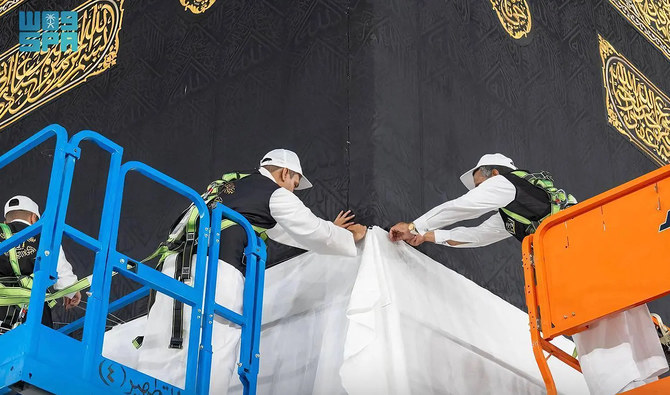
Black cloth covering Kaaba in Makkah raised ahead of Hajj

In this handout photograph, taken and released by Saudi Press Agency, specialized technicians are seen at work at the Kaaba in Makkah on May 23, 2024, raising the special cover to keep it from being soiled and damaged ahead of the annual Hajj pilgrimage. (SPA)
Short Url
Updated 23 May 2024
Follow

Black cloth covering Kaaba in Makkah raised ahead of Hajj

  • Procedure meant to keep the cover, Kiswa, free from getting soiled and tampered
  • 36 specialized technical personnel carried out procedure with aid of 10 cranes

RIYADH: In keeping with the annual tradition, officials raised the lower part of the kiswa — the elaborately designed black cloth covering the Kaaba — in Makkah on Wednesday ahead of this year’s Hajj pilgrimage.
As approved by the General Authority for the Care of the Affairs of the Two Holy Mosques, the exposed part was covered with a white cotton fabric, two-and-a-half meters wide and 54 meters long on all four sides, according to the Saudi Press Agency.
Carrying out the procedure were 36 specialized technical personnel with the aid of 10 cranes.
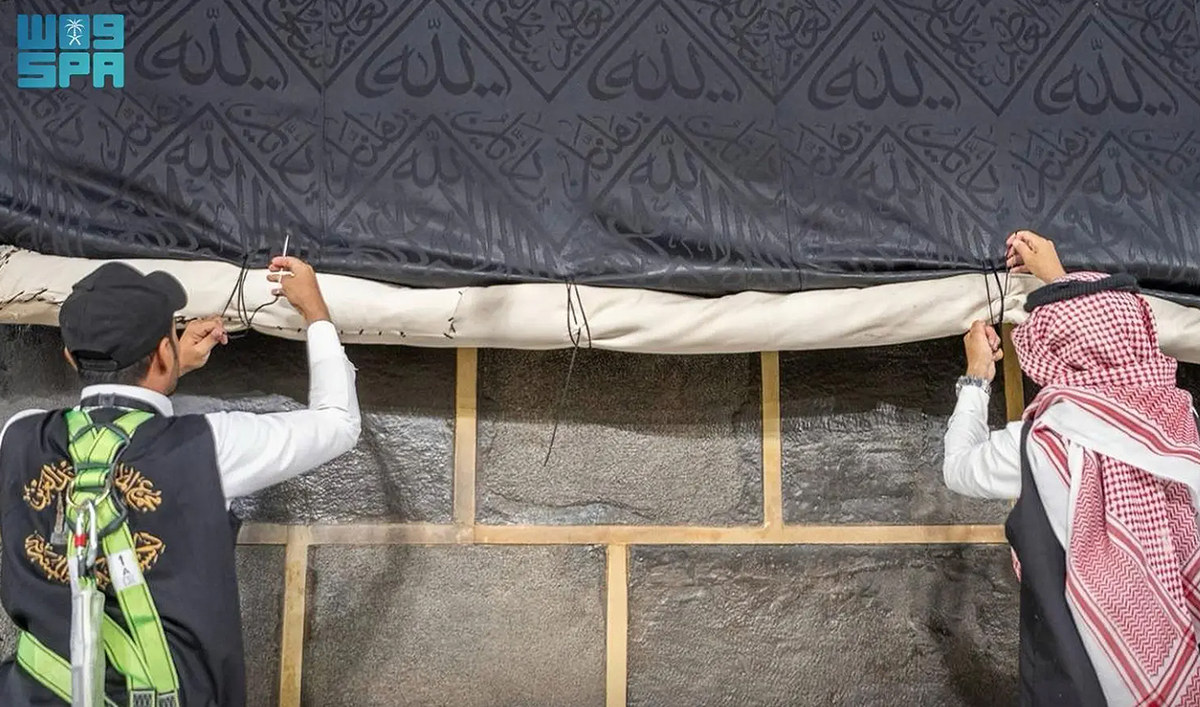


In this handout photograph, taken and released by Saudi Press Agency, specialized technicians are seen at work at the Kaaba in Makkah on May 23, 2024, raising the special cover to keep it from being soiled and damaged ahead of the annual Hajj pilgrimage. (SPA)

As described in the SPA report, the kiswa is lifted in several stages: It starts with unscrewing the bottom of the cover from all sides, separating the corners, then untying the bottom rope and removing it from the fixing rings, after which the cloth is rolled upward. The lanterns are then dismantled and the white cloth are put in place, after which the lanterns are reinstalled over the white cloth until the final stage.
The procedure is repeated every year to protect the kiswa from getting soiled and damaged as pilgrims circumambulate the Kaaba.
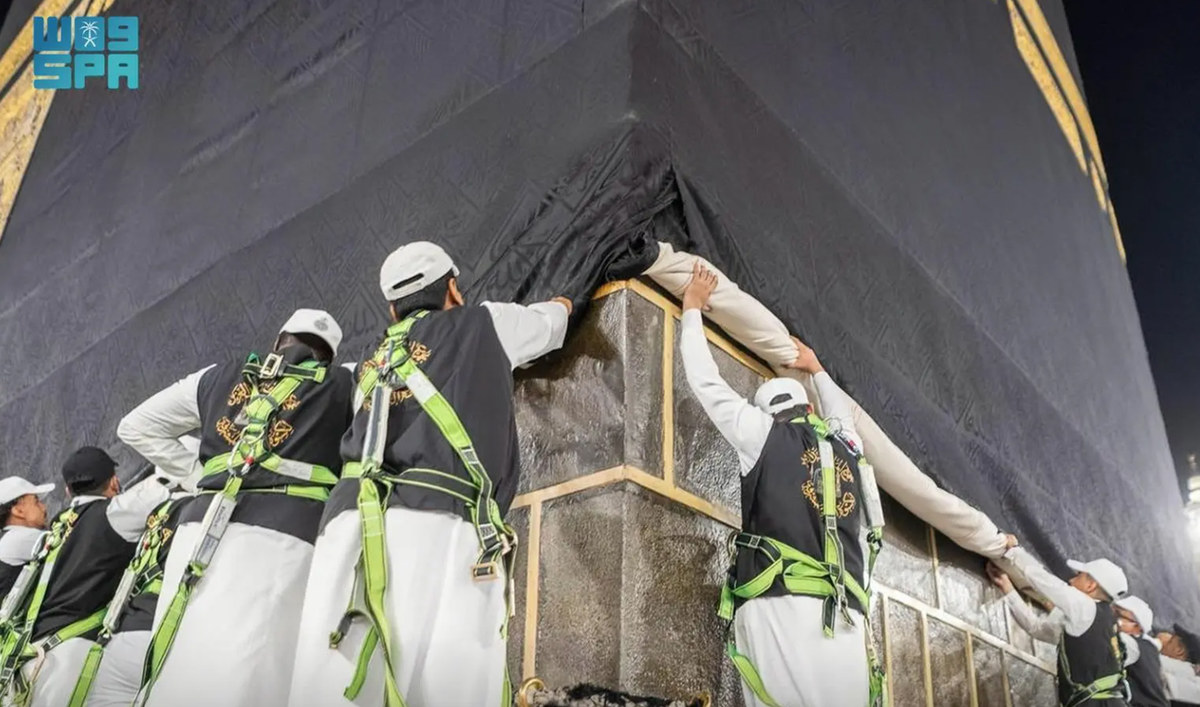


In this handout photograph, taken and released by Saudi Press Agency, specialized technicians are seen at work at the Kaaba in Makkah on May 23, 2024, raising the special cover to keep it from being soiled and damaged ahead of the annual Hajj pilgrimage. (SPA)

The annual Hajj in Saudi Arabia is considered the world’s largest human gathering, with year 2012 marking the biggest number of participants at 3.16 million.
At the height of the COVID-19 pandemic, Saudi authorities allowed only a symbolic observance of Hajj with just a thousand pilgrims. The numbers were gradually raised as the health crisis was placed under control worldwide. Last year, almost 1.84 million pilgrims performed the “once in a lifetime” journey and the figure is expected to go higher this year.
Every year, on the ninth day of the Islamic month of Dul Hijjah, the black silk cloth is removed and a new kiswa is draped in its place.


King Abdulaziz Camel Festival sees unprecedented demand

Updated 5 sec ago
Follow

King Abdulaziz Camel Festival sees unprecedented demand

  • Has become a major economic engine for the camel breeding industry in Saudi Arabia and the wider Gulf
  • Auctioneer Mubarak Al-Ghannami said that around 200 camels are entered into the daily auction

RIYADH: The 10th annual King Abdulaziz Camel Festival held in Al-Sayahid, north of Riyadh, has seen unprecedented demand this year, according to the Saudi Press Agency.

It has become a major economic engine for the camel breeding industry in Saudi Arabia and the wider Gulf, with prices reaching over SR100,000 ($27,000) at auction for the best specimens.

Auctioneer Mubarak Al-Ghannami told the SPA that around 200 camels are entered into the daily auction, with prices starting at around SR4,000.

The festival supports economic activity beyond just the auctions, however, with job opportunities in camel transportation and related auxiliary sectors.

Veteran transporter Abu Naif Al-Mutairi highlighted the potential for seasonal profit and encouraged young Saudis to engage in the industry.

Organizers Saudi Camel Club have set up a 500-meter corridor of tents and pens for breeders and buyers.

High-stakes sales take place on specialized auction platforms and main exhibition areas, drawing global attention to the quality of Saudi livestock.

Industry experts and participants have reported a significant shift in market dynamics, with attendee Dr. Daghash Al-Masradi noting that the festival attracts buyers now seeking the highest-quality camels.

He noted that the organized environment allows owners to operate with greater freedom and energy.

The festival is a key initiative of Saudi Vision 2030, aiming to promote cultural tourism and showcase Saudi heritage to an international audience.

Featuring traditional crafts and cuisine, visitors are offered a glimpse into the Kingdom’s culture.

It also serves as an important platform to highlight the significance of the camel in the history of Saudi Arabia.

This year’s festival began on Dec. 1 and runs until Jan. 3, with prices for admission starting at SR500.