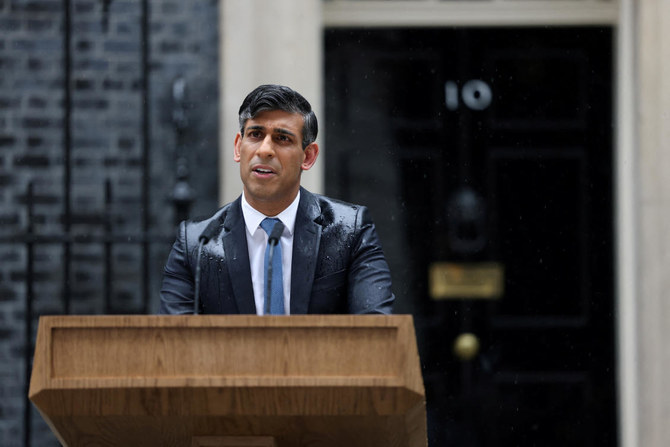
LONDON: British Prime Minister Rishi Sunak on Wednesday set July 4 as the date for a national election that will determine who governs the UK, choosing a day of good economic news to urge voters to give his governing Conservatives another chance.
“Now is the moment for Britain to choose its future,” Sunak said.
Sunak’s center-right party has seen its support dwindle steadily after 14 years in power. It has struggled to overcome a series of crises including an economic slump, ethics scandals and a revolving door of leaders in the past two years.
The center-left Labour Party is strongly favored to defeat Sunak’s party.
Speculation about an imminent election mounted after Sunak called a Cabinet meeting for Wednesday afternoon – rather than the usual Tuesday – and Foreign Secretary David Cameron flew back early from a trip to Albania to attend.
The election will be held against the backdrop of a cost-of-living crisis and deep divisions over how to deal with migrants and asylum seekers making risky English Channel crossings from Europe.
The announcement came the same day official figures showed inflation in the UK had fallen sharply to 2.3 percent, its lowest level in nearly three years on the back of big declines in domestic bills.
The drop in April marks the greatest progress to date on five pledges Sunak made in January 2023, including halving inflation, which had climbed to above 11 percent at the end of 2022. Sunak hailed the new figure as a sign his plan was working.
“Today marks a major moment for the economy, with inflation back to normal,” Sunak said Wednesday. “Brighter days are ahead, but only if we stick to the plan to improve economic security and opportunity for everyone.”
Voters across the United Kingdom will choose all 650 members of the House of Commons for a term of up to five years. The party that commands a majority in the Commons, either alone or in coalition, will form the next government and its leader will be prime minister.
Labour leader Keir Starmer, a former chief prosecutor for England and Wales, is the current favorite. The party’s momentum has built since it dealt the Conservatives heavy losses in local elections earlier this month.
The Conservatives have also lost a series of special elections for seats in Parliament this year, and two of its lawmakers recently defected to Labour.
Following on his party’s successes in the local elections, Starmer, 61, last week announced a platform focused on economic stability after years of soaring inflation as he tries to win over disillusioned voters.
He also pledged to improve border security, recruit more teachers and police and reduce lengthy waiting lists at hospitals and doctors′ clinics across the country.
Elections in the UK have to be held no more than five years apart, but the prime minister can choose the timing within that period. Sunak, 44, had until December to call an election. The last one was in December 2019.
Many political analysts had anticipated that a fall election would give Conservatives a better chance of maintaining power. That’s because economic conditions may improve further, voters could feel the effect of recent tax cuts, interest rates may come down and a controversial plan to deport some asylum-seekers to Rwanda — a key policy for Sunak — could take flight.
Sunak had been noncommittal about the election date, repeatedly saying — as late as lunchtime on Wednesday — that he expected it would be in the second half of the year.
Although inflation has fallen, Sunak’s other promises — to grow the economy, reduce debt, cut waiting lists to see a doctor at the state-run National Health Service and stop the influx of migrants crossing the English Channel — have seen less success.
He has struggled after entering office following the disastrous tenure of Liz Truss, who lasted only 49 days after her economic policies rocked financial markets. Truss had been chosen by party members after Boris Johnson was ousted over a series of ethics scandals.


![]()

British Prime Minister Rishi Sunak sets July 4 election date to determine who governs the UK
Short Url
https://arab.news/8cq5q
British Prime Minister Rishi Sunak sets July 4 election date to determine who governs the UK
- “Now is the moment for Britain to choose its future,” Sunak said
- The center-left Labour Party is strongly favored to defeat Sunak’s party


Latest updates




© 2026 SAUDI RESEARCH & PUBLISHING COMPANY, All Rights Reserved And subject to Terms of Use Agreement.