

UAE president to visit South Korea

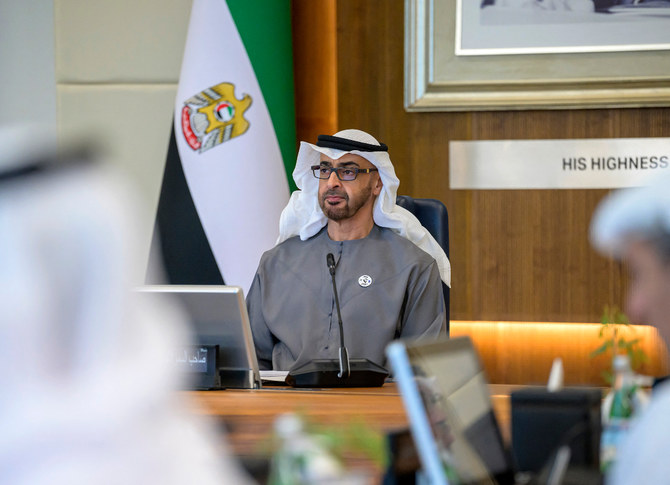
UAE President Mohamed bin Zayed Al-Nahyan will visit South Korea on Tuesday, May 28. (File/WAM)
Short Url
Updated 22 May 2024
Follow

UAE president to visit South Korea

  • The two leaders will discuss bilateral ties and explore opportunities for greater collaboration

ABU DHABI: UAE President Mohamed bin Zayed Al-Nahyan will make a two-day state visit to South Korea on May 28 at the invitation of President Yoon Suk Yeol, state news agency WAM reported on Wednesday.

The two leaders will discuss bilateral ties and explore opportunities for greater collaboration across various sectors including trade, investment, energy and technology.

They will also address regional and international developments of common interest.

“The meeting comes within the framework of strategic partnership between the UAE and South Korea in line with their vision to achieve a better and more prosperous future for the countries,” the WAM statement said.


EU urges Israel to halt NGO registration law, warns it puts aid for Gaza at risk

Updated 11 sec ago
Follow

EU urges Israel to halt NGO registration law, warns it puts aid for Gaza at risk

  • Legislation could severely restrict ability of humanitarian groups to provide aid for civilians amid one of the worst humanitarian crises in the world, officials say
  • Without nongovernmental organizations ‘humanitarian aid cannot be delivered at the scale needed to prevent further loss of life in Gaza,’ European Council warns

NEW YORK CITY: The EU on Tuesday urged Israeli authorities not to implement in its current form a new law governing the registration of international nongovernmental organizations, warning it could jeopardize life-saving humanitarian operations in Gaza and the other occupied Palestinian territories.

In a joint statement, the EU’s high representative for foreign affairs and security policy, Kaja Kallas, and Commissioners Hadja Lahbib and Dubravca Suica said the law could severely restrict the ability of international aid organizations to operate and deliver assistance to civilians amid one of the worst humanitarian crises in the world.

The European Council highlighted the need for “rapid, safe and unimpeded” delivery of aid and warned that without nongovernmental organizations, “humanitarian aid cannot be delivered at the scale needed to prevent further loss of life in Gaza.”

The new law, adopted by the Israeli government after the introduction of new registration requirements in March 2025, obliges foreign humanitarian organizations to provide detailed information about their operations, including full lists of local and foreign staff, as a condition for registering to operate in Palestinian areas.

Dozens of aid groups, including Doctors Without Borders, World Vision and Oxfam, face having their accreditation revoked or licenses suspended after failing to meet the new criteria by the Dec. 31 deadline that was set. Israeli authorities have said organizations that fail to meet the new requirements must cease all activities by March 1.

Critics say the rules risk undermining humanitarian principles and could endanger local staff. The Israeli measures drew international condemnation and warnings from UN agencies, which said international NGOs provide essential “humanitarian lifelines” in Gaza where they are delivering most of the healthcare, nutritional, water and sanitation services amid ongoing restrictions and closures of border crossings.

The humanitarian situation in Gaza remains dire, UN agencies have said, with winter conditions compounding the suffering of displaced populations living in makeshift shelters that expose them to heavy rain, flooding and cold.

Hundreds of thousands of people in the territory have received emergency food, shelter and winter supplies, and while famine conditions have eased since the ceasefire agreement in October, acute food insecurity, malnutrition and damage to infrastructure continues to take a toll.

The UN Office for the Coordination of Humanitarian Affairs said recent heavy rains have flooded tents, damaged homes and put a strain on already limited water, sanitation and health services, underscoring the need for sustained and unimpeded aid access.

The EU statement comes after the European Council on Dec. 18 welcomed a UN Security Council resolution for the establishment of a peace-building and stabilization force in Gaza, and urged all parties to implement it fully and in line with the principles of international law.