EU states give final endorsement to AI rules

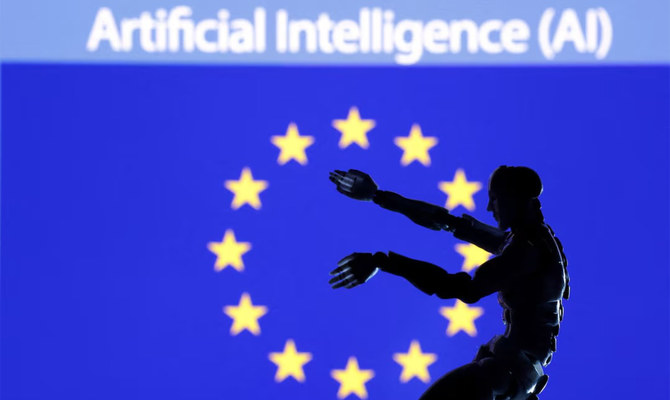
AI Artificial intelligence words, miniature of robot and EU flag are seen in this illustration. (Reuters/File)
Short Url
Updated 21 May 2024
Follow

EU states give final endorsement to AI rules

  • The EU says the law will protect citizens from AI’s dangers while harnessing the technology’s potential in Europe

RIYADH: EU states on Tuesday gave their final backing to landmark rules on artificial intelligence that will govern powerful systems like OpenAI’s ChatGPT.

The European Parliament had already approved the law in March and it will now enter into force after being published in the official EU journal in the coming days.

The EU says the law will protect citizens from AI’s dangers while harnessing the technology’s potential in Europe.

First proposed in 2021, the rules took on greater urgency after ChatGPT arrived in 2022, showing generative AI’s human-like ability to produce eloquent text within seconds.

Other examples of generative AI include Dall-E and Midjourney, which can produce images in nearly any style with a simple input in everyday language. The law known as the “AI Act” takes a risk-based approach: if a system is high-risk, a company has a tougher set of obligations to fulfill to protect citizens’ rights.

There are strict bans on using AI for predictive policing and systems that use biometric information to infer an individual’s race, religion or sexual orientation. Companies will have to comply by 2026 but rules covering AI models like ChatGPT will apply 12 months after the law becomes official.

Pledge

The world’s leading companies pledged at the start of a mini summit on AI to develop the technology safely, including pulling the plug if they can’t rein in the most extreme risks.

World leaders are expected to hammer out further agreements on artificial intelligence as they gathered virtually to discuss AI’s potential risks but also ways to promote its benefits and innovation.

The AI Seoul Summit is a low-key follow-up to November’s high-profile AI Safety Summit at Bletchley Park in the UK, where participating countries agreed to work together to contain the potentially “catastrophic” risks posed by breakneck advances in AI.

The two-day meeting — co-hosted by South Korea and the UK — also comes as major tech companies like Meta, OpenAI and Google roll out the latest versions of their AI models.

They’re among 16 AI companies that made voluntary commitments to AI safety as the talks got underway, according to a British government announcement. 

The companies, which also include Amazon, Microsoft, France’s Mistral AI, China’s Zhipu.ai, and G42 of the UAE, vowed to ensure safety of their most cutting edge AI models with promises of accountable governance and public transparency.

The pledge includes publishing safety frameworks setting out how they will measure risks of these models.


‘The future is renewables,’ Indian energy minister tells World Economic Forum

Updated 22 January 2026
Follow

‘The future is renewables,’ Indian energy minister tells World Economic Forum

  • ‘In India, I can very confidently say, affordability (of renewables) is better than fossil fuel energy,’ says Pralhad Venkatesh Joshi during panel discussion
  • Renewables are an increasingly important part of the energy mix and the technology is evolving rapidly, another expert says at session titled ‘Unstoppable March of Renewables?’

BEIRUT: “The future is renewables,” India’s minister of new and renewable energy told the World Economic Forum in Davos on Wednesday.
“In India, I can very confidently say, affordability (of renewables) is better than fossil fuel energy,” Pralhad Venkatesh Joshi said during a panel discussion titled “Unstoppable March of Renewables?”
The cost of solar power has has fallen steeply in recent years compared with fossil fuels, Joshi said, adding: “The unstoppable march of renewables is perfectly right, and the future is renewables.”
Indian authorities have launched a major initiative to install rooftop solar panels on 10 million homes, he said. As a result, people are not only saving money on their electricity bills, “they are also selling (electricity) and earning money.”
He said that this represents a “success story” in India in terms of affordability and “that is what we planned.”
He acknowledged that more work needs to be done to improve reliability and consistency of supplies, and plans were being made to address this, including improved storage.
The other panelists in the discussion, which was moderated by Godfrey Mutizwa, the chief editor of CNBC Africa, included Marco Arcelli, CEO of ACWA Power; Catherine MacGregor, CEO of electricity company ENGIE Group; and Pan Jian, co-chair of lithium-ion battery manufacturer Contemporary Amperex Technology.
Asked by the moderator whether she believes “renewables are unstoppable,” MacGregor said: “Yes. I think some of the numbers that we are now facing are just proof points in terms of their magnitude.
“In 2024, I think it was 600 gigawatts that were installed across the globe … in Europe, close to 50 percent of the energy was produced from renewables in 2024. That has tripled since 2004.”
Renewables are an increasingly important and prominent part of the energy mix, she added, and the technology is evolving rapidly.
“It’s not small projects; it’s the magnitude of projects that strikes me the most, the scale-up that we are able to deliver,” MacGregor said.
“We are just starting construction in the UAE, for example. In terms of solar size it’s 1.5 gigawatts, just pure solar technology. So when I see in the Middle East a round-the-clock project with just solar and battery, it’s coming within reach.
“The technology advance, the cost, the competitiveness, the size, the R&D, the technology behind it and the pace is very impressive, which makes me, indeed, really say (renewables) is real. It plays a key role in, obviously, the energy demand that we see growing in most of the countries.
“You know, we talk a lot about energy transition, but for a lot of regions now it is more about energy additions. And renewables are indeed the fastest to come to market, and also in terms of scale are really impressive.”
Mutizwa asked Pan: “Are we there yet, in terms of beginning to declare mission accomplished? Are renewables here to stay?”
“I think we are on the road but (its is) very promising,” Pan replied. There is “great potential for future growth,” he added, and “the technology is ready, despite the fact that there are still a lot of challenges to overcome … it is all engineering questions. And from our perspective, we have been putting in a lot of resources and we are confident all these engineering challenges will be tackled along the way.”
Responding to the same question, Arcelli said: “Yes, I think we are beyond there on power, but on other sectors we are way behind … I would argue today that the technology you install by default is renewables.
“Is it a universal truth nowadays that renewables are the cheapest?” asked Mutizwa.
“It’s the cheapest everywhere,” Arcelli said.