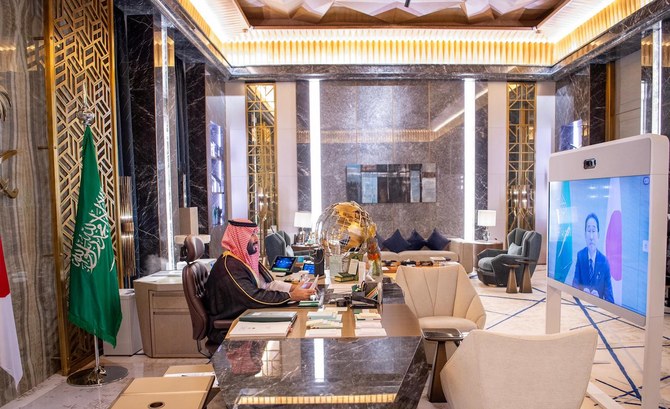
TOKYO: Japanese Prime Minister Kishida Fumio held a productive video meeting with Crown Prince Mohammed bin Salman, the prime minister of Saudi Arabia, on Tuesday.
Kishida offered his best wishes for King Salman’s health, a gesture that was appreciated by the crown prince.
The crown prince expressed his desire to visit Japan as soon as possible to further strengthen ties with Japan. Kishida expressed his wishes for King Salman’s early recovery and said that he was also looking forward to strengthening the strategic partnership between Japan and Saudi Arabia, according to the foreign ministry in Tokyo.
As the two countries approach the 70th anniversary of their diplomatic relations, the Japanese prime minister expressed his desire to work even more closely with Saudi Arabia. He emphasized the shared goal of realizing peace and stability in the Middle East, a sentiment that was echoed by the crown prince. The leaders agreed to establish a “strategic partnership council” chaired by them to further strengthen bilateral relations.
Kishida expressed gratitude for Saudi Arabia’s stable supply of crude oil to Japan over the years. He also expressed his anticipation for Saudi Arabia to continue playing a leading role in stabilizing the global oil market, including through production increases, a sentiment that was appreciated by the crown prince.
Kishida added that he would like to cooperate in establishing a global supply chain for clean energy, such as hydrogen and ammonia, and promote cooperation in the field of mineral resources while using Japanese technology under the “lighthouse initiative” agreed between the two countries in July last year.
The crown prince said that Saudi Arabia would like to cooperate with Japan in various areas, including clean energy, and the Kingdom remained committed to providing a stable supply of crude oil to Japan.
Kishida expressed interest in creating business opportunities in Saudi Arabia, and making direct investments in Japan in a wide range of fields, including construction, power transmission, hydrogen, digital fields, information and communications technology, space, health, medicine, food and agriculture.
He also said that he would like to work together to achieve an early realization of the Japan-GCC free trade agreement. This agreement, once implemented, will significantly boost trade and investment between Japan and the GCC countries, creating new business opportunities and fostering economic growth. Negotiations are scheduled to resume soon.
The crown prince said that he welcomed the resumption of negotiations for the Japan-GCC free trade agreement and cooperation with Japan in fields beyond energy.
On peace and security, Kishida explained Japan’s diplomatic efforts and contributions in Gaza, including humanitarian aid and diplomatic initiatives. The crown prince said that he envisioned continued cooperation with Japan on diplomatic efforts to realize peace and stability, appreciating Japan’s active role in the region.
Kishida said that he would be pleased to hand over the symbolic “torch” of the expo to Saudi Arabia following Expo 2025 in Osaka-Kansai. This act symbolizes the continuation of the spirit of international cooperation and cultural exchange. He added that he would like to encourage cultural exchanges in entertainment, tourism, academia and football.
The crown prince said that Japan was an outstanding country in terms of culture and that he sought to strengthen cooperation with Japan in this area.
Read More: Saudi, Japan discuss ties at Vision 2030 business forum in Tokyo


![]()

Saudi Arabia, Japan leaders exchange views in video summit meeting
Short Url
https://arab.news/g3vzv
Saudi Arabia, Japan leaders exchange views in video summit meeting
- The crown prince expressed his desire to visit Japan as soon as possible to further strengthen ties with Japan
- Kishida expressed his wishes for King Salman’s early recovery


Latest updates


© 2026 SAUDI RESEARCH & PUBLISHING COMPANY, All Rights Reserved And subject to Terms of Use Agreement.