


LIVERPOOL: When Napoleon Bonaparte was briefed on the virtues of a new general, he would apparently retort with “but is he lucky?”
Expertise was one thing, but the French emperor also understood the importance of happenstance.
In his nine years at Liverpool, which came to an emotional end on Sunday at Anfield, Jurgen Klopp has been blessed with many lucky generals.
The German’s reign is bookmarked, time and again, by getting the right man at the right time, and all played their part in a historic era for the club.
In the summer of 2016, Klopp’s debut at Anfield, Sadio Mane became the first of his new generals. Not far behind was Gini Wijnaldum and Andrew Robertson. All would go on to become pillars of his great Liverpool team.
Virgil van Dijk, in the winter of 2018, transformed Liverpool’s previously porous defense into one of the best in Europe, and even the world.
The Brazilian duo of Alisson Becker and Fabinho, in the summer of 2018, became the final pieces of the jigsaw. Klopp’s iconic team was complete.
But the greatest general of them all had arrived a year earlier. It is often forgotten now, considering what has transpired since, that when Mohamed Salah joined Liverpool from Roma in the summer of 2017, he was not considered by many pundits to be a “world class” player, whatever that means.
But from the moment he walked into Anfield, his fortunes and Klopp’s would become inextricably entwined.
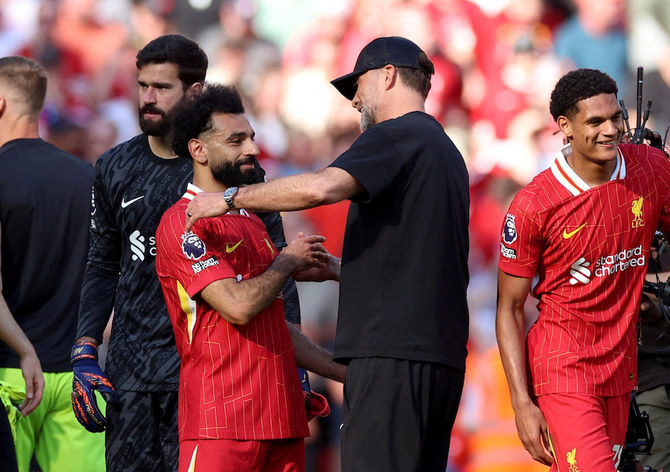
At full time on Sunday following Liverpool’s 2-0 win over Wolves, as Klopp gave Salah one of his trademark hugs, both must have realized how lucky they were to have found each other seven years earlier.
Salah, it is no exaggeration to say, was more instrumental in bringing success to Liverpool than any other player during Klopp’s time at Anfield.
And those who know best, knew that too.
Three players have been accorded the honorary title of “King” by the Kop: Kevin Keegan, Kenny Dalglish and the boy from Nagrig.
Thousands of words have been written in recent weeks about Klopp’s reign, and since it would take a book to cover the records that Salah breaks, seemingly on a weekly basis, there is little point in reproducing the facts and figures of their time together.
Viscerally, it was all about the moments, many that flirted with footballing utopia, and a few that touched the depths of despair.
Salah scored on his debut in a 3-3 Premier League draw at Watford in the summer of 2017, and has not stopped since.
The “Egyptian King” quickly established a stunning forward partnership with Mane and Roberto Firmino — the “front three,” as they would become known.
There was the breathtaking “Road Runner” goal against Arsenal on Salah’s second Anfield start; the FIFA Puskas Award-winning curler against Everton in a December snowstorm; and an even better version of it against Tottenham in February.
In particular, Salah would develop a taste for torturing the preeminent team of the age, Pep Guardiola’s magnificent Manchester City.
In his first season alone, there was a memorable chipped goal in an era-launching 4-3 Premier League win at Anfield, and a tie-settling second at the Etihad as Liverpool beat City 2-1 (5-1 on aggregate) in the Champions League quarterfinals. He had scored in the first leg too.
One performance, however, continues to stand above all others.
On April 24, 2018, Salah delivered arguably his finest match for Liverpool in a 5-2 win against Roma at Anfield in the Champions League semifinal first leg.
Against future colleague Alisson in the opposition goal, Salah scored twice, assisted twice, and for 90 minutes tore the Italian team to shreds. He was simply unplayable. It was a display that Lionel Messi would have struggled to better.
The Champions League final a few weeks later would bring the lowest of Salah’s time at Liverpool as a shoulder injury saw him leave the pitch in tears after only 31 minutes. Without their talisman, Liverpool lost 3-1.
At the time, Klopp was turning a player that had a remarkable availability record — lucky one could say — and work ethic into one of the world’s best players, technically and tactically. Salah’s pressing of the opposition and positional sense when out of possession perfectly suited Klopp’s demands and complemented the forward’s unquenchable thirst for goals.
Salah’s second season saw player and team hit new highs as they accumulated a mind-boggling 97 points in the Premier League and, incredibly, still fell one short of Manchester City.
Salah still scored one of the great Anfield goals against Chelsea in a 2-0 win as they chased down the relentless leaders.
Even on the very rare occasion he missed a match, the world watched his every move. As Liverpool, almost incredulously, overturned a three-goal deficit against Barcelona to reach the 2019 Champions League final, the injured Salah sat on the bench in a T-shirt that said: “Never Give Up.” Sales skyrocketed.
A Champions League triumph in Madrid would prove more than a consolation for the Reds, Salah scoring the opener in a 2-0 win over Tottenham to give Liverpool their sixth title, a record for an English team, naturally.
Klopp had broken his duck at Liverpool and finally become a European champion after near misses with Borussia Dortmund and Liverpool in the previous six years.
Salah, meanwhile, was rewriting the record books with his goals, and the 2019/2020 season finally brought the Premier League that Liverpool fans craved.
A traumatized fan base had previously refused to sing about the elusive league title until one January evening at Anfield when Salah scored a goosebump-inducing stoppage time goal to seal a 2-0 over Manchester United at Anfield.
“We’re gonna win the league,” Anfield bellowed in celebration. After 30 years of disappointments and false dawns, they finally believed, and the Premier League would be secured in record time, though three matches after resumption of play following the COVID-19 lockdown.
The four years since have not brought a league or Champions League title, but other trophies (two League Cups and an FA Cup) followed, seemingly always at the expense of Chelsea.
On the pitch, as Klopp’s great team splintered, no one maintained their level of consistency and brilliance quite like Salah.
Goals of all types continued to flow including one solo effort, against Manchester City at Anfield, prompting many to call Salah the best player in the world during the 2021/2022 season.
While others suffered long-term injuries, lost form or left the club (especially Mane and Firmino), Salah remained as reliable as ever — always available, always scoring, always creating.
That he is a Liverpool all-time great is no longer up for debate.
This is why, when he had an uncharacteristic and public argument with Klopp on the touchline at West Ham recently, few fans took sides. The coach may be untouchable, but Salah had earned the right to be right up there with him. And that is the greatest compliment of all, for both men.
Ultimately, it all ended in hugs, smiles and a few tears on Sunday.
Klopp and Salah were lucky to have each other. And we were lucky to have them.


