

World Water Forum opens in Bali to address resource shortage, management 

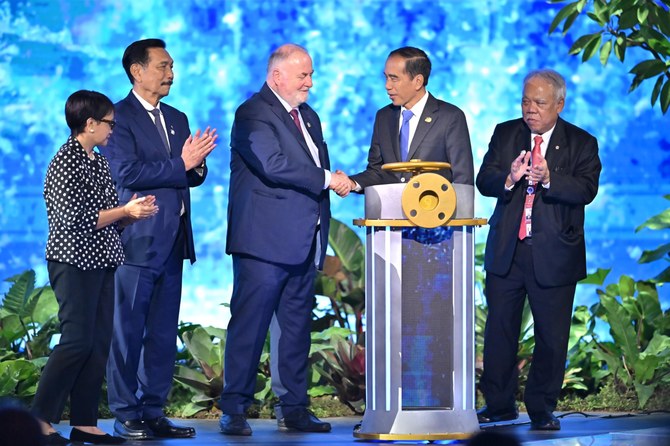
Indonesian President Joko Widodo, second from right, shakes hands with Loic Fauchon, president of the World Water Council, at the opening ceremony of the 10th World Water Forum in Bali on May 20, 2024. (Ministry of Communications and Information Technology)
Short Url
Updated 20 May 2024
Follow

World Water Forum opens in Bali to address resource shortage, management 

  • Saudi Environment Minister Abdulrahman Al-Fadhli leads Kingdom’s delegation in Bali
  • Saudi Arabia is set to host the next edition of World Water Forum in Riyadh in 2027

JAKARTA: The 10th World Water Forum, a gathering aimed at fostering international collaboration in global water management, opened on Indonesia’s island of Bali on Monday.

The World Water Forum will run until May 25, as hundreds of international participants join the conference to address global water and sanitation challenges. 

The 10th edition held under the theme “Water for Shared Prosperity” saw several heads of state and ministers in attendance, including Tajikistan Prime Minister Qohir Rasulzoda, Sri Lankan President Ranil Wickremesinghe, Fiji President Wiliame Katonivere, and Saudi Minister of Environment Water and Agriculture Abdulrahman Al-Fadhli. 

President Joko Widodo called attention to the “central role” of water for human civilizations as he opened the forum on Monday. 

“Water scarcity can also trigger war and become the source of disasters. Too much water or too little water both can turn into problems for the world,” Widodo said in his opening speech. 

“The 10th World Water Forum is very strategic to revitalize real collective action and commitment to realize an integrated management of water resources … Water isn’t merely a natural product, but a product of collaboration that unites us and therefore we must have collaborative efforts to preserve it.” 

Loic Fauchon, president of the World Water Council, also called for global action. 

“This 10th World Water Forum should mark the turning point towards concrete action,” he said. 

The World Water Forum is held every three years and organized by the World Water Council and a host country. 

This year, the multi-day event will also see Saudi Arabia participate in a special session focusing on its role as the next host of the international conference under the theme “Action for a Better Tomorrow.”

The Kingdom will host the 11th World Water Forum in 2027 in Riyadh. 


WHO appeals for $1 bn for world’s worst health crises in 2026

Updated 58 min 6 sec ago
Follow

WHO appeals for $1 bn for world’s worst health crises in 2026

  • The UN health agency estimated 239 million people would need urgent humanitarian assistance this year and the money would keep essential health services going

GENEVA: The World Health Organization on Tuesday appealed for $1 billion to tackle health crises this year across the world’s 36 most severe emergencies, including in Gaza, Sudan, Haiti and the Democratic Republic of Congo.
The UN health agency estimated 239 million people would need urgent humanitarian assistance this year and the money would keep essential health services going.
WHO health emergencies chief Chikwe Ihekweazu told reporters in Geneva: “A quarter of a billion people are living through humanitarian crises that strip away the most basic protections: safety, shelter and access to health care.
“In these settings, health needs are surging, whether due to injuries, disease outbreaks, malnutrition or untreated chronic diseases,” he warned.
“Yet access to care is shrinking.”
The agency’s emergency request was significantly lower than in recent years, given the global funding crunch for aid operations.
Washington, traditionally the UN health agency’s biggest donor, has slashed foreign aid spending under President Donald Trump, who on his first day back in office in January 2025 handed the WHO his country’s one-year withdrawal notice.
Last year, WHO had appealed for $1.5 billion but Ihekweazu said that only $900 million was ultimately made available.
Unfortunately, he said, the agency had been “recognizing ... that the appetite for resource mobilization is much smaller than it was in previous years.”
“That’s one of the reasons that we’ve calibrated our ask a little bit more toward what is available realistically, understanding the situation around the world, the constraints that many countries have,” he said.
The WHO said in 2026 it was “hyper-prioritising the highest-impact services and scaling back lower?impact activities to maximize lives saved.”
Last year, global funding cuts forced 6,700 health facilities across 22 humanitarian settings to either close or reduce services, “cutting 53 million people off from health care.” Ihekweazu said.
“Families living on the edge face impossible decisions, such as whether to buy food or medicine,” he added, stressing that “people should never have to make these choices.”
“This is why today we are appealing to the better sense of countries, and of people, and asking them to invest in a healthier, safer world.”
