

Lebanese designer Georges Chakra puts on a show at the Cannes Film Festival
Lebanese designer Georges Chakra puts on a show at the Cannes Film Festival /node/2513521/lifestyle
Lebanese designer Georges Chakra puts on a show at the Cannes Film Festival
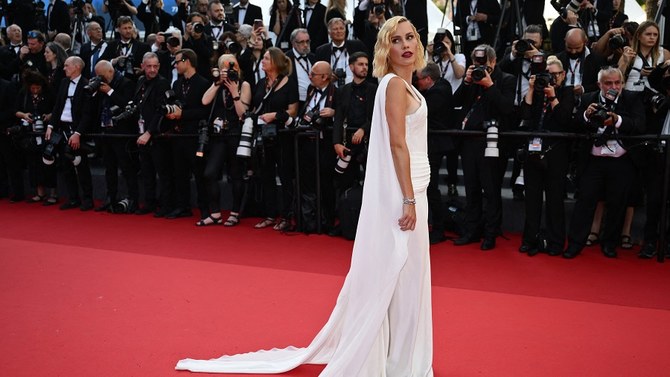
Australian actress Claire Holt hit the red carpet before the premiere of Kevin Costner’s “Horizon: An American Saga” in an all-white gown by Georges Chakra. (AFP)
Lebanese designer Georges Chakra puts on a show at the Cannes Film Festival
Updated 20 May 2024
Arab News
DUBAI: Lebanese designer Georges Chakra is making a splash at the ongoing 77th Cannes Film Festival and has so far dressed a number of stars on the red carpet.
Australian actress Claire Holt hit the red carpet before the premiere of Kevin Costner’s “Horizon: An American Saga” in an all-white gown by the designer.
The Georges Chakra Couture look was created from white satin and chiffon and featured pleated detailing across the hips and a dramatic chiffon shoulder train. The look hailed from the designer’s Spring/Summer 2024 collection.
Meanwhile, Tunisian actress Dorra Zarrouk attended the “Women in Cinema” gala dinner hosted by Saudi Arabia’s Red Sea Film Festival in a white satin bustier gown with a satin cape encrusted with hand painted gold feathers from the label’s Fall/Winter 2023-2024 line.
Dorra Zarrouk in Georges Chakra. (Getty Images)
Finally, Chinese actress and model Crystal Zhang chose a Georges Chakra Couture gold sequined gown with a draped veil from the Spring/Summer 2024 collection to attend the Marie Claire China event which took place on the sidelines of the festival.
Holt showed off her choice at the premiere of Costner’s latest film on Sunday. “Horizon: An American Saga” sees the director return to his favorite Western genre with a three-hour film that is just the first of four mooted chapters.
Costner put millions of dollars of his own fortune into the decades-long passion project.
“At a certain moment I just said OK, I'm going to do this myself. And so I mortgaged property, I raised the money,” he told AFP at the festival.
The early reviews were mixed, with The Hollywood Reporter deriding it as a “clumsy slog” while British newspaper The Telegraph said it was “earnest yet hopeful... (and) perhaps its full grandeur won't be fully realized until part two.”
Costner says he is unconcerned about risking his money.
“If they take it away from me, I still have my movie. I still have my integrity. I still listened to my heart,” he said.
Saudi traditional meal anchors Al-Balad’s culinary scene
Slow-cooked sheep’s head is drawing new generations and visitors to Jeddah’s historic district
Updated 14 December 2025
SALEH FAREED
JEDDAH: In the streets of Al-Balad, where centuries-old buildings frame one of Saudi Arabia’s most storied districts, culinary heritage continues to draw visitors as powerfully as architecture.
Among the area’s enduring attractions is Al-Shadwy for Sheep Head Meat, a family-run restaurant that has served one of the Kingdom’s most traditional dishes since 1958, turning a once-necessity meal into a symbol of Saudi food culture and hospitality.
Tucked into Baba Makkah, Al-Balad’s historic core, Al-Shadwy began as a modest corner table before becoming a landmark destination for locals, food enthusiasts and tourists seeking an authentic taste of the past.
Eating sheep’s head has long been rooted in Arab culinary traditions, shaped by the principle of using the entire animal and avoiding waste. (AN photo)
Now run by the third generation of the Al-Shadwy family, the restaurant remains devoted to a single specialty; sheep’s head, slow-roasted over charcoal using a recipe unchanged for decades.
Eating sheep’s head has long been rooted in Arab culinary traditions, shaped by the principle of using the entire animal and avoiding waste. In Saudi Arabia, the dish evolved into communal meal associated with generosity, warmth and social gathering.
Sixty-five-year-old owner Ghalib Naji Al-Shadwy, who inherited the restaurant from his grandfather and father, remains a familiar presence at the restaurant, overseeing the service and greeting customers.
FASTFACTS
• Al-Shadwy for Sheep Head Meat is a family-run restaurant in Al-Balad that has served one of the Kingdom’s most traditional dishes since 1958.
• It began as a modest corner table before becoming a landmark destination for locals, food enthusiasts and tourists seeking an authentic taste of the past.
He told Arab News that the dish has been central to Saudi culinary culture for generations.
“The sheep’s head has been a staple in Saudi Arabia and other GCC countries culinary culture for centuries,” he said. “Traditionally, it was a meal served during cold winter mornings to provide energy and warmth. In many regions of Saudi Arabia, the sheep head (is) always on the top of the main plate for guests, and families festive holidays gather in restaurants or at home to enjoy the sheep’s head, making it a social and festive occasion.”
In Saudi Arabia, the dish evolved into communal meal associated with generosity, warmth and social gathering. (AN photo)
Speaking about its significance in hospitality culture, he added: “Serving it to guests is considered an act of generosity and care.” Rich and filling, it is most commonly eaten as breakfast or an early morning meal.
Preparing sheep’s head is a slow, careful process. According to Al-Shadwy, the heads are cooked at low temperatures to soften the tendons and connective tissue, resulting in tender meat and deep flavor.
The preparation includes curing and slow cooking, a method that has remained largely unchanged at the restaurant for more than six decades.
Being a family-owned restaurant here for so many years makes us a part of Jeddah’s history.
Ghalib Naji Al-Shadwy, Al-Shadwy for Sheep Head Meat owner
“I’ve cooked many sheep heads a while back and I still enjoy it,” he said. “Most of the customers actually prefer the head and the brain.”
Despite its small size and somewhat tucked-away location, the restaurant’s popularity is unmistakable. Long queues form outside each morning, often guiding first-time visitors to its door. A sign reading “Al-Shadwy Mandi” in Arabic marks the entrance, while the steady crowd confirms its reputation.
Over the years, the restaurant has attracted officials, celebrities and social media figures, with photographs of notable guests lining the walls. Al-Shadwy said the steady attention reflections Al-Balad’s growing appeal as a cultural and culinary destination.
He said that interest in sheep’s head is no longer limited to older generations. Younger Saudis, he said, are increasingly curious about traditional dishes, while tourists often see it as an adventurous experience.
“For many visitors, trying sheep’s head is considered ‘extreme food’ or a challenging dish,” he said. “But it gives them a sense of adventure and a unique story to tell.”
Inside the lively restaurant one morning, longtime customer Abu Samer Al-Sulami, who has been dining there for 40 years, described it as a rare example of authentic Saudi cuisine.
“I am a regular customer here and always come early in the morning because when you eat the sheep’s head it really gives you energy for work,” he said.
Demand is highest in the early hours, particularly on Fridays. Al-Shadwy said the restaurant often sells out by mid-morning, making early visits essential.
“The number of sheep heads our restaurant sells daily varies but it reaches around 200 heads,” he added.
As he works alongside his two sons, Al-Shadwy says preserving the family legacy is as important as serving the fish.
“Being a family-owned restaurant here for so many years makes us a part of Jeddah’s history,” he said.