Pakistan PM visits Iranian embassy to extend condolences over President Raisi’s death

1 / 2
Pakistan Prime Minister Shehbaz Sharif (right) meets Iran’s Ambassador in Pakistan Dr. Reza Amiri Moghadam on his visit to the Iranian embassy in Islamabad on May 20, 2024, to extend condolences over the death of President Ebrahim Raisi and other officials in a helicopter crash. (Photo courtesy: Iranian embassy)
2 / 2
Iran's President Ebrahim Raisi speaks before parliament in the capital Tehran, on August 25, 2021, to defend his choices for the ministerial posts. (AFP)
Short Url
Updated 21 May 2024
Follow

Pakistan PM visits Iranian embassy to extend condolences over President Raisi’s death

  • Raisi, 63, was traveling through Iran’s East Azerbaijan province along with other officials when his helicopter crashed
  • PM Shehbaz Sharif earlier announced a ‘day of mourning’ over the death of Raisi, who had visited Pakistan in April

ISLAMABAD: Pakistan Prime Minister Shehbaz Sharif on Monday visited the Iranian embassy in Islamabad to extend condolences over the death of President Ebrahim Raisi and other officials in a helicopter crash, the Iranian embassy said.

Iranian state news agency IRNA said Raisi, the country’s foreign minister and others were found dead at the site of the crash after an hours-long search through a foggy, mountainous region in the country’s northwest.

Raisi, 63, was traveling in Iran’s East Azerbaijan province. State TV said the “hard landing” happened near Jolfa, a city on the border with Azerbaijan, some 600 kilometers (375 miles) northwest of the Iranian capital, Tehran. Later, state TV put it farther east near the village of Uzi, but details remained contradictory.


Raisi was traveling with Foreign Minister Hossein Amirabdollahian, the governor of Iran’s East Azerbaijan province and other officials and bodyguards, according to state media. One local government official used the word “crash,” but others referred to either a “hard landing” or an “incident.”

“H.E. Mohammad Shahbaz Sharif, Honourable Prime Minster of the Islamic Republic of Pakistan, along with a delegation of high-ranking Pakistani officials attended at the embassy of the Islamic Republic of Iran to express sympathy and condolences to the government and people of Islamic Republic of Iran in consequent to the martyrdom of President Seyed Ebrahim Raisi, FM Hussain Amirabdollahian and their companion,” the Iranian embassy said in a statement.
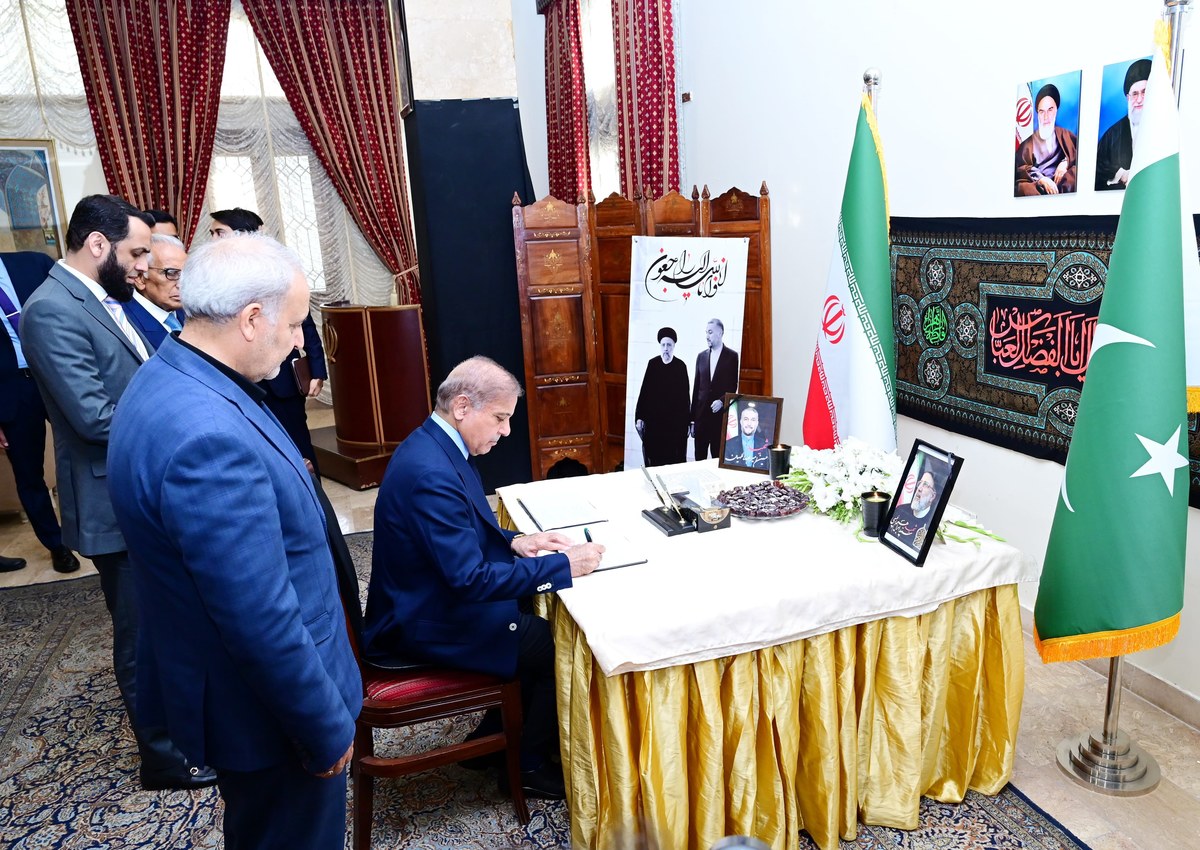


Prime Minister Shehbaz Sharif visited the Embassy of the Islamic Republic of Iran in Islamabad on May 20, 2024 to offer condolences to Iranian Ambassador Raza Amiri Mughaddam on the death of Iranian President Dr. Ibrahim Raisi. (Photo courtesy:PMO)

Earlier in a post on X, Sharif extended his “deepest condolences” and sympathies to the people of Iran, hoping they would recover from the tragedy with courage.

“Pakistan will observe a day of mourning and the flag will fly at half-mast as a mark of respect for President Raisi and his companions and in solidarity with Brotherly Iran,” Sharif said.

President Asif Ali Zardari expressed “profound shock and sorrow” over Raisi’s death, a statement from his office said.

“Today, Pakistan mourns the loss of a great friend,” Zardari said. “Just last month we had the honor of hosting him in Pakistan. During our discussions, I found him very keen on strengthening our bilateral relationship.”

Zardari’s son and Pakistan Peoples Party (PPP) Chairman Bilawal Bhutto-Zardari expressed his heartfelt condolences over Raisi’s demise.

“Every Pakistani is deeply grieved over the saddest incident and stands in solidarity with their Iranian brethren,” Bhutto-Zardari said in a statement.

Deputy Prime Minister and Foreign Minister Ishaq Dar said he was “truly aggrieved” at Raisi’s passing. “Today Ummah has lost a great statesman,” he wrote on social media platform X. “Pakistan has lost a true friend.”

Pakistan’s foreign office issued a statement, saying it was shocked at Raisi’s demise.

“President Dr. Seyyed Ebrahim Raisi and Foreign Minister Hossein Amir-Abdollahian were esteemed leaders and statesmen whose contributions to their country and reinforcing Pakistan-Iran relations and regional cooperation will always be remembered,” the foreign office said.

The development takes place as the Middle East remains unsettled by Israel’s war on Gaza, during which Raisi under Supreme Leader Ayatollah Ali Khamenei launched an unprecedented drone-and-missile attack on Israel last month. Under Raisi, Iran enriched uranium closer than ever to weapons-grade levels, further escalating tensions with the West as Tehran also supplied bomb-carrying drones to Russia for its war in Ukraine and armed militia groups across the region.

Raisi was elected president at the second attempt in 2021, and since taking office ordered a tightening of morality laws, overseen a bloody crackdown on anti-government protests and pushed hard in nuclear talks with world powers.

In Iran’s dual political system, split between the clerical establishment and the government, it is the supreme leader rather than the president who has the final say on all major policies.

In April, Raisi arrived in Islamabad on a three-day official visit to Pakistan as the two Muslim neighbors sought to mend ties after unprecedented tit-for-tat military strikes earlier this year.

The Iranian president had held delegation-level meetings in the Pakistani capital as well as one-on-one discussions with Pakistan’s prime minister, president, army chief, Senate chairman and National Assembly speaker.

During the visit, Raisi had also overseen the signing of eight agreements between the two countries that covered different fields, including trade, science technology, agriculture, health, culture, and judicial matters.
IMF warns against policy slippage amid weak recovery as it clears $1.2 billion for Pakistan

Updated 11 December 2025
Follow

IMF warns against policy slippage amid weak recovery as it clears $1.2 billion for Pakistan

  • Pakistan rebuilt reserves, cut its deficit and slowed inflation sharply over the past one year
  • Fund says climate shocks, energy debt, stalled reforms threaten stability despite recent gains

ISLAMABAD: Pakistan’s economic recovery remains fragile despite a year of painful stabilization measures that helped pull the country back from the brink of default, the International Monetary Fund (IMF) warned on Thursday, after it approved a fresh $1.2 billion disbursement under its ongoing loan program.

The approval covers the second review of Pakistan’s Extended Fund Facility (EFF) and the first review of its climate-focused Resilience and Sustainability Facility (RSF), bringing total disbursements since last year to about $3.3 billion.

Pakistan entered the IMF program in September 2024 after years of weak revenues, soaring fiscal deficits, import controls, currency depletion and repeated climate shocks left the economy close to external default. A smaller stopgap arrangement earlier that year helped avert immediate default, but the current 37-month program was designed to restore macroeconomic stability through strict monetary tightening, currency adjustments, subsidy rationalization and aggressive revenue measures.

The IMF’s new review shows that Pakistan has delivered significant gains since then. Growth recovered to 3 percent last year after shrinking the year before. Inflation fell from over 23 percent to low single digits before rising again after this year’s floods. The current account posted its first surplus in 14 years, helped by stronger remittances and a sharp reduction in imports. And the government delivered a primary budget surplus of 1.3 percent of GDP, a key program requirement. Foreign exchange reserves, which had dropped dangerously low in 2023, rose from US$9.4 billion to US$14.5 billion by June.

“Pakistan’s reform implementation under the EFF arrangement has helped preserve macroeconomic stability in the face of several recent shocks,” IMF Deputy Managing Director Nigel Clarke said in a statement after the Board meeting.

But he warned that Islamabad must “maintain prudent policies” and accelerate reforms needed for private-sector-led and sustainable growth.

The Fund noted that the 2025 monsoon floods, affecting nearly seven million people, damaging housing, livestock and key crops, and displacing more than four million, have set back the recovery. The IMF now expects GDP growth in FY26 to be slightly lower and forecasts inflation to rise to 8–10 percent in the coming months as food prices adjust.

The review warns Pakistan against relaxing monetary or fiscal discipline prematurely. It urges the State Bank to keep policy “appropriately tight,” allow exchange-rate flexibility and improve communication. Islamabad must also continue raising revenues, broadening the tax base and protecting social spending, the Fund said.

Despite the progress, Pakistan’s structural weaknesses remain severe.

Power-sector circular debt stands at about $5.7 billion, and gas-sector arrears have climbed to $11.3 billion despite tariff adjustments. Reform of state-owned enterprises has slowed, including delays in privatizing loss-making electricity distributors and Pakistan International Airlines. Key governance and anti-corruption reforms have also been pushed back.

The IMF welcomed Pakistan’s expansion of its flagship Benazir Income Support Program, which raises cash transfers for low-income families and expands coverage, saying social protection is essential as climate shocks intensify. But it warned that high public debt, about 72 percent of GDP, thin external buffers and climate exposure leave the country vulnerable if reform momentum weakens.

The Fund said Pakistan’s challenge now is to convert short-term stabilization into sustained recovery after years of economic volatility, with its ability to maintain discipline, rather than the size of external financing alone, determining the durability of its gains.