


DUBAI: Saudi Arabia is undergoing a “huge transformation” in relation to women’s empowerment thanks to comprehensive reforms to legal, civil, and social rights, Hala Al-Tuwaijri, the first woman to lead the the country’s Human Rights Commission, has said.
The Kingdom has seen rapid advances in the representation of women in positions of leadership, from Princess Reema bint Bandar Al-Saud, the first female Saudi ambassador to the US, to Sara Al-Suhaimi, the first female chair of Tadawul, the Saudi stock exchange.
Indeed, Al-Tuwaijri’s own appointment as president of the Human Rights Commission with the rank of minister back in September 2022 is proof in itself of the tectonic changes underway in Saudi Arabia.
“Those are examples of women who made it to the top. (But) that’s basically the tip of the iceberg,” Al-Tuwaijri told Katie Jensen, host of the Arab News current affairs program “Frankly Speaking.”
“What has actually happened in Saudi Arabia is a huge transformation, especially when it comes to the issue of women’s empowerment.”
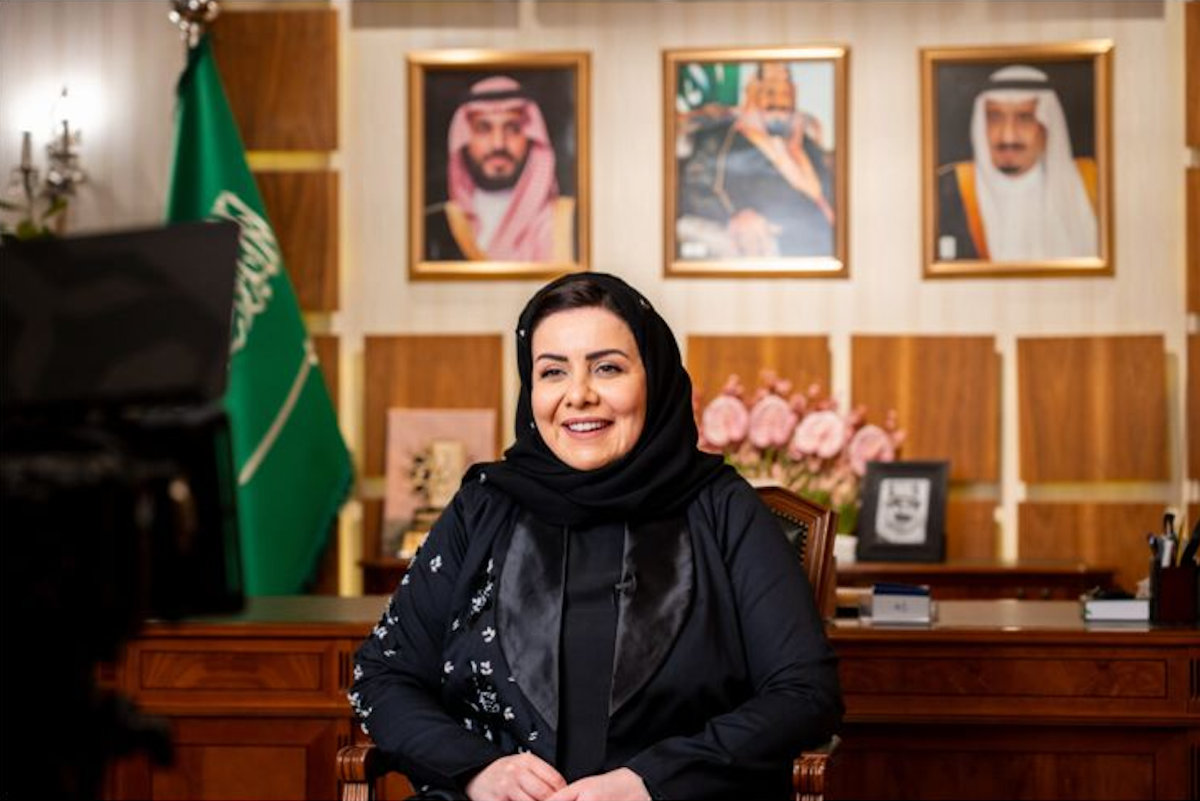
Hala Al-Tuwaijri, president of Saudi Arabia’s Human Rights Commission, said: “Yes, unfortunately, there is bias not only against the Kingdom of Saudi Arabia, but generally against people from this region.” (AN photo)
In a freewheeling interview, Al-Tuwaijri discussed the progress she has witnessed since assuming office and addressed the criticisms of Western nations that scrutinize the authenticity of Saudi Arabia’s advancements in human rights.
Nowhere is the transformation in the rights of Saudi women more obvious than in the workplace. Thanks to a slew of reforms and new legal protections, women now make up a significant portion of the labor force at every level.
“The approach was comprehensive,” said Al-Tuwaijri. “We basically expanded all the legal, civil, social rights and looked at legislation, procedures and everything that was actually obstructing women’s progress was actually moved away.
“The biggest achievement, I think, is how women’s empowerment has changed the face of the country. Now you see women everywhere working in every field. The pipelines for women to join the labor force were all unclogged and therefore you see women joining the labor force.
“And this was translated in the data about women’s empowerment and especially women’s participation in the workforce.”
Perhaps the best examples of this transformation are the Saudi women making strides in the fields of science, technology, engineering, mathematics and medicine — career paths that have traditionally been dominated by men.

Saudi scientist Rayyanah Barnawi (R) became the first Saudi female astronaut to go to space. With her in the picture is fellow Saudi astronaut Ali Alqarni. (@Astro_Rayyanah/File))
“I would use the cliche ‘the sky’s the limit,’ but after (first Saudi female astronaut) Rayyanah Barnawi went to space, I think that metaphor does not describe the ambition of Saudi women,” said Al-Tuwaijri.
“I think that Saudi women have proved to be efficient and to be up to the positions that they’ve taken.”
Since 2016, the Kingdom has implemented a raft of reforms designed to empower women, from the lifting of the ban on driving and the relaxation of the male guardianship law to measures to combat violence against women and girls.
Although it is a challenging role, Al-Tuwaijri says her appointment to lead the Human Rights Commission reflects how seriously the Kingdom takes its obligations and its commitment to the shared values of the international community.
“This task of handling the human rights file anywhere in the world is a huge responsibility, a humbling one,” she said. “And also, it comes with a package of knowing you’re doing good for the people and for mankind in general. It has its own lofty values and principles as well.

“In Saudi Arabia, it’s no different. I come to work every day knowing that, yes, I’m doing my job on the one hand. But also, I know that this job includes the promotion and protection, the rights of people living in Saudi Arabia and also contributing to the international community and the new trends and approaches to human rights.
“So, the task is not a simple one. It’s not a straightforward one. It’s not that you have a goal and you have to accomplish it at a certain period of time. No, it’s ongoing. It’s dynamic. And it’s always changing, requiring a lot of exposure, communication with others.”
In a September 2023 interview with US broadcaster Fox News, Saudi Crown Prince Mohammed bin Salman admitted to being “ashamed” of the Kingdom’s laws after a retired teacher was sentenced to death for a critical post on social media.
“Shamefully, it’s true. It’s something I don’t like,” the crown prince told Fox News, highlighting his government’s efforts to reform and modernize the judiciary.
“We are doing our best … we have already changed tens of laws in Saudi Arabia, and the list has more than 1,000 items. In the cabinet they have only 150 lawyers, so I’m trying to prioritize the change day by day.”
He added: “But we are not happy with that. We are ashamed of that. But (under) the jury system, you have to follow the laws and I cannot tell a judge (to) do that and ignore the law, because … that’s against the rule of law. But do we have bad laws? Yes. We are changing that, yes.”
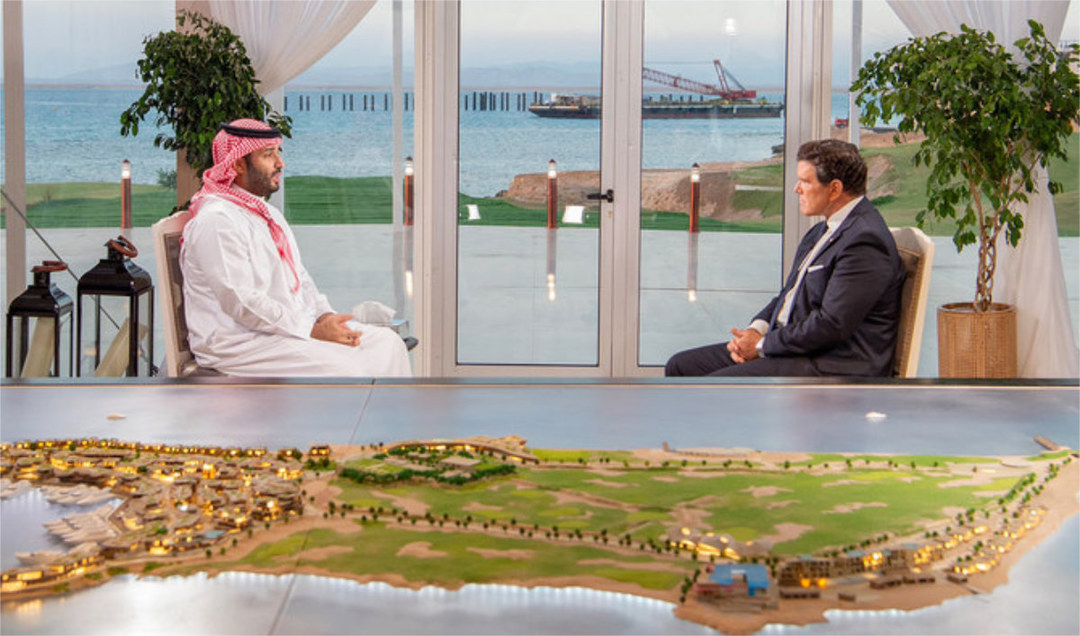
Saudi Crown Prince Mohammed bin Salman was interviewed by Fox News’ chief political correspondent Bret Baier on Sept. 21, 2023. (AN Files)
Asked about these comments, Al-Tuwaijri said the crown prince respects the authority of the Kingdom’s judiciary, but that reforms are necessary — measures that the Human Rights Commission is on board with.
“Yes, His Royal Highness the Crown Prince stated that. And I think it’s a verbal affirmation of the big initiatives that are taking place in terms of the transformation in the judicial system,” said Al-Tuwaijri.
“Three laws have been issued recently, all of them controlling the lives of people in a positive way — where by controlling we mean there is more clarity in terms of the judiciary and predictability, of course.
“The fact that all of this is taking place while we are also progressing, putting forward initiatives, is more like fixing a plane while you’re flying. And this is precisely what His Royal Highness the Crown Prince indicated.
“But in the same interview you have mentioned, he also showed so much respect for the judiciary. And I think every country that respects itself and its status has to also respect the judiciary.”
The Human Rights Commission is participating in this reform process “so the human rights lens is always applied when it comes to issuing a new law or reviewing one or giving advice on a certain procedure,” said Al-Tuwaijri.
“We have to make sure also that everything that’s happening in this journey of legal transformation is actually aligned with the human rights commitment.”
Although its reform agenda is driven by a broader domestic transformation plan under Vision 2030, the Kingdom engages with international agencies and human rights groups to ascertain where improvements can be made — provided they are based on fact rather than hearsay.
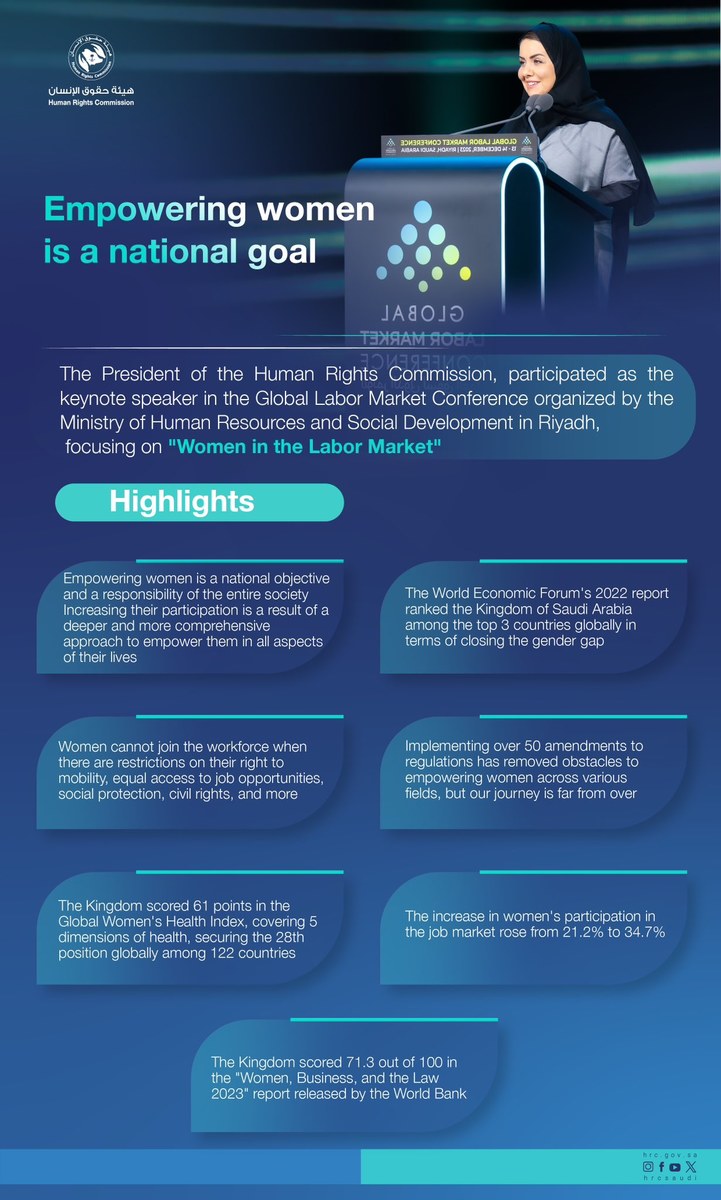
Highlights of the speech of Saudi HRC chief Hala Altuwaijri during Global Labor Market Conference, with the topic “Women in the Labor Market”. (X: @HRCSaudi_EN)
“In our mandate, we engage with all kinds of parties, whether it’s state, government organizations or non-government organizations,” said Al-Tuwaijri. “But the basis of this kind of engagement is cooperation, dialogue and constructive efforts.
“We do engage with all of these entities as long as the objective is to have a constructive dialogue that actually is on equal footing and, at the same time, understands the differences between us. This is basically how we function.”
She added: “And of course, we do monitor what the media addresses in terms of human rights issues, that includes everything. So, it depends on our relationship with these entities. We engage directly in cooperation and dialogue.
“And if we find that the reports are not based on facts but just meritless, hearsay or so, then we just focus on working on the ground and trying to continue our strategy and reach our goals and consider that (report) as one of so many reports that are actually politicizing human rights and not really engaging in a cooperative manner.”
In January, the UN held the Universal Periodic Review in Geneva, where Al-Tuwaijri emphasized Saudi Arabia’s determination to achieve the highest global standards in promoting and protecting human rights.
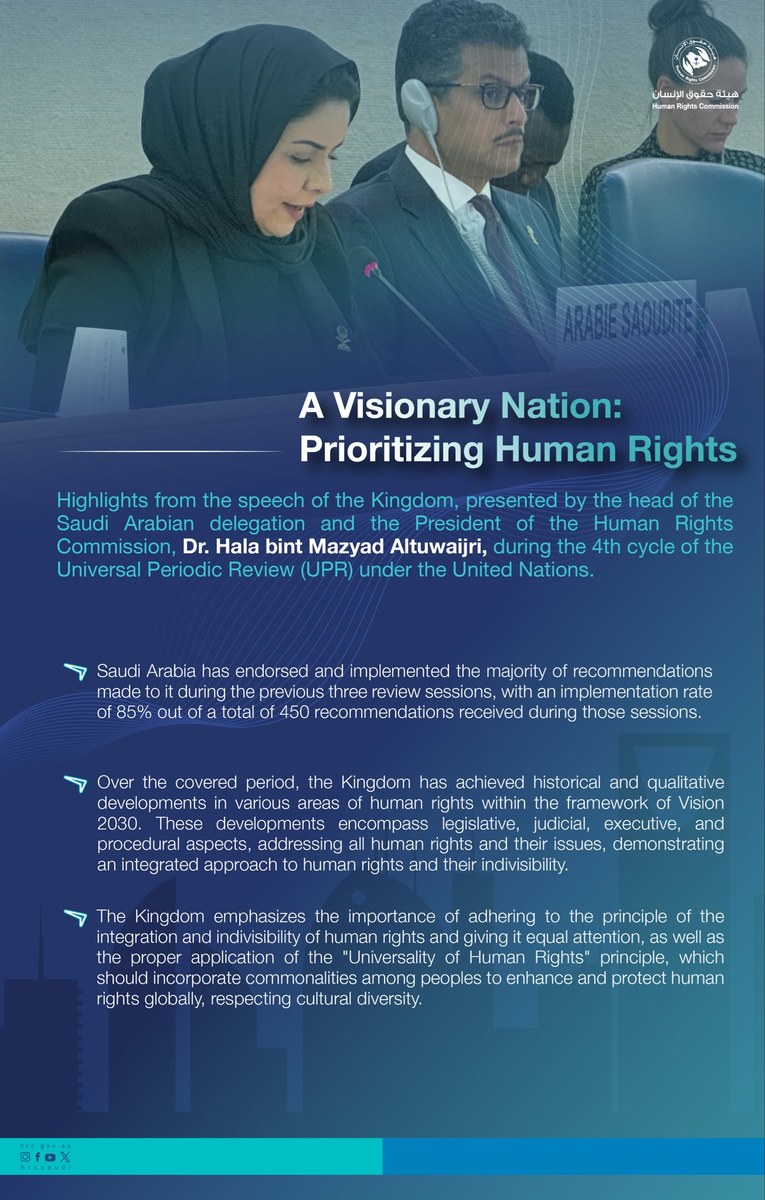
Illustration on Saudi Arabia's participation in the Universal Periodic Review in Geneva in January 2024. (X: @HRCSaudi_EN)
Despite the significant strides Saudi Arabia has made, several Western commentators have characterized this commitment as a PR stunt. Al-Tuwaijri brushed aside the criticism, pointing to the Kingdom’s positive record.
The Universal Periodic Review “covers a period where there were, on the ground, more than 100 reforms, and those reforms (have been) published,” she said. “They are supported with evidence, with data, and that is an actual manifestation of the reforms.
“Yes, some people would always criticize and some people would be cynical about what happens. But we keep open in terms of cooperation with states, government organizations, non-government organizations about addressing these issues and discussing areas of improvement.
“And for people who doubt, (who say) that it’s a stunt or that we’re not telling the truth, I invite them to come and visit the Kingdom of Saudi Arabia and meet actually with men and women from the Saudi community and listen to how much they have actually benefited from all of these improvements and changes and developments that happened on the ground.”
Asked whether the negative perception of Saudi Arabia among international rights organizations is influenced by political bias or unrealistic expectations, Al-Tuwaijri pointed to the positive feedback the Kingdom has also received.
“There were more than 135 comments given to the Saudi delegation in Geneva last January. And what was astonishing is that all 135 comments were introduced by acknowledgement of the improvement,” she said.
“It is obvious that compared to the previous report, there is great improvement that was acknowledged by the international community.”
She added: “Yes, unfortunately, there is bias not only against the Kingdom of Saudi Arabia, but generally against people from this region. But we try to overlook the negative implications of that bias and try to see the good in these approaches or reports or criticism and see what we can take from them.”
Al-Tuwaijri acknowledged that changing such attitudes would be a gradual process, but one possible to implement through continuous engagement with friends and critics alike.
“The purpose is to make people see for themselves what is happening in Saudi Arabia,” she said. “Because the narrative is never complete, actually, without people witnessing it with their own eyes.”


