Pakistan says will push for peace in Middle East if elected non-permanent UNSC member

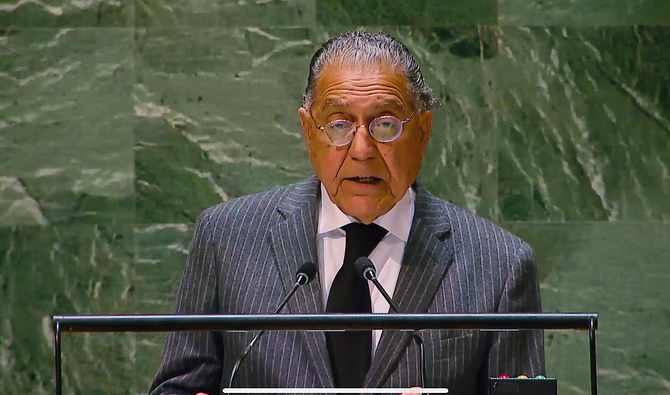
Pakistan’s Permanent Representative to the United Nations Ambassador Munir Akram speaks during a General Assembly meeting to review Palestine’s application for full membership at the United Nations in New York on May 1, 2024. (Photo courtesy: Pakistan Mission to UN)
Short Url
Updated 19 May 2024
Follow

Pakistan says will push for peace in Middle East if elected non-permanent UNSC member

  • Elections for five of 10 non-permanent seats of UNSC for 2025-26 to take place on June 6
  • Pakistan has been elected as non-permanent UNSC member seven times, most recently in 2013

ISLAMABAD: Pakistan will work for peace in the Middle East and Africa, and promote the right of self-determination of people living under foreign occupation if it gets elected as a non-permanent member of the Security Council, Pakistan’s ambassador to the UN said on Sunday. 
Elections for five of the 10 non-permanent seats on the UN Security Council for 2025-26 are set to take place on June 6. Pakistan says its candidacy has the endorsement of the 55-member Asian Group.
The South Asian country has been elected to the Security Council seven times, most recently in 2013. Other times Pakistan got elected was in 1952-1953, 1968-1969, 1976-1977, 1983-1984, 1993-1994 and 2003-2004.
Speaking to members of the US-based Pakistan Students Association Coalition (PSA Coalition) via video link, Pakistan’s Ambassador to the UN Munir Akram said election to the Security Council would require Islamabad to play a leading role in addressing Kashmir, Afghanistan and counterterrorism issues. 
“Pakistan will articulate developing countries’ aspirations, work for peace and in the Middle East and Africa as well as promote the right of self-determination for peoples under foreign occupation if elected as a non-permanent member of the UN Security Council,” Akram said, according to the state-run Associated Press of Pakistan (APP). 
Akram spoke about the current state of the world. including key global challenges amid regional conflicts. 
“He said that as the intense competition between major powers became a new reality of the world order, the world was undergoing a fast transition from its unipolar status to a bipolar plus order,” the APP said. 
The Pakistani ambassador’s comments came as Israel continues its relentless military assault on Gaza. Israel’s attacks against Hamas have killed at least 35,386 people, mostly civilians, according to the Hamas-run Gaza health ministry. 
The Jewish state’s siege has brought dire food shortages and the threat of famine to the densely populated territory.
Pakistan, which does not have diplomatic ties with Israel, has consistently called for an immediate ceasefire in the Middle East and urged world powers to work toward a two-state solution in the restive region, according to the aspirations of the people of Palestine.


In Pakistan, ‘Eternal Love’ has no place on YouTube

Updated 4 sec ago
Follow

In Pakistan, ‘Eternal Love’ has no place on YouTube

  • YouTube blocked the Urdu-language dating show after complaints that it violated cultural and religious norms
  • YouTube blocked the Urdu-language dating show after complaints that it violated cultural and religious norms

ISLAMABAD: YouTube has hit pause on a dating show that whisked eight men and women from conservative Pakistan to a sun-soaked Istanbul villa, where the strangers mingled, flirted and searched for chemistry.

What was meant to be a glittering escape into modern-day romance sparked a storm back home, turning the rose-petal drama into a cultural, traditional and religious flashpoint.

Dating and sex outside of marriage are prohibited by law in the Muslim-majority country, where public displays of affection can draw penalties.

The show “Lazawal Ishq,” or “Eternal Love,” aired 50 episodes before it was recently taken off YouTube in Pakistan, though it is still available elsewhere.

The format, reminiscent of the British reality hit “Love Island,” pushed boundaries that Pakistani entertainment typically avoids.

“Our program might not be watchable in Pakistan due to political reasons,” the show posted on its Instagram page.

It advised Pakistani viewers to use virtual private networks (VPNs) to continue watching.

YouTube did not immediately reply to an AFP request for comment on why the show was suspended.

The show’s trailer starts with the host, actress Ayesha Omer, entering the villa in a white dress, where she meets contestants who are to choose a partner of their liking and test their compatibility through 100 episodes.

Omer swiftly came under fire online for wearing a “Western dress” and hosting a show that “promotes obscene and immoral content,” an increasingly common reaction to celebrities who deviate from Pakistan’s conservative expectations.

Omer countered on Instagram that “this is not a Pakistani show... it is a Turkish production, but of course people in Pakistan can watch it.”

A LOT OF COMPLAINTS

The Urdu-language show proved popular, with the inaugural trailer getting over two million views.

The online buzz underscored a growing divide between Pakistan’s younger, digitally connected audience and traditional gatekeepers anxious about changing values.

“It was something fun to watch. A show that showed that people in Pakistan can and do date even though it is frowned upon,” said one viewer who requested anonymity to speak freely.

But someone soon filed a petition to the Pakistan Electronic Media Regulatory Authority (PEMRA), it said, seeking a ban and claiming the show goes against “Pakistan’s religious and social values by showing unmarried men and women living together.”

The regulator acknowledged receiving “a lot of complaints” about “Eternal Love” but said it did not have jurisdiction over digital platforms.

PEMRA advised petitioning the Pakistan Telecommunication Authority, which oversees online content. It did not respond to requests for comment.

It is not the first time YouTube has taken down a program deemed offensive by conservative Pakistanis.

Last year, the show “Barzakh,” a family drama that touched on topics including love and spirituality, was removed on claims it promoted LGBTQ relationships.