Argentine president begins unusual visit to Spain, snubbing officials and courting the far-right

1 / 2
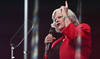
Argentina's President Javier Milei presents his new book "El Camino del Libertario" in Madrid, Spain, on May 17, 2024. (REUTERS)
2 / 2
Argentina's President Javier Milei presents his new book "El Camino del Libertario" in Madrid, Spain, on May 17, 2024. (REUTERS)
Short Url
Updated 18 May 2024
Follow

Argentine president begins unusual visit to Spain, snubbing officials and courting the far-right

  • The brash President Javier Milei has no plans to meet Spain's PM — nor any other government official
  • He will instead attend a far-right summit Sunday hosted by Sánchez’s fiercest political opponent, the Vox party

BUENOS AIRES, Argentina: Even before kicking off a three-day visit to Madrid on Friday, Argentina’s libertarian President Javier Milei stirred controversy, accusing the socialist government of bringing “poverty and death” to Spain and weighing in on corruption allegations against the prime minister’s wife.

In such circumstances, a typical visiting head of state may strive to mend fences with diplomacy.
Not Milei. The brash economist has no plans to meet Spanish Prime Minister Pedro Sánchez during his three days in the Spanish capital — nor the Spanish king, nor any other government official. Instead, he’ll attend a far-right summit Sunday hosted by Sánchez’s fiercest political opponent, the Vox party.
The unorthodox visit was business as usual for Milei, a darling of the global far right who has bonded with tech billionaire Elon Musk and praised former US President Donald Trump. Earlier this year on a trip to the United States, Milei steered clear of the White House and took the stage at the Conservative Political Action Conference, or CPAC, where he railed against abortion and socialism and shared a bear hug with Trump.
Milei presented his 2022 book, “The Way of the Libertarian,” in Madrid Friday at a literary event organized by La Razón, a conservative Spanish newspaper.
The book — withdrawn from circulation in Spain earlier this month because the back-flap biography erroneously said Milei had earned a doctorate — traces his meteoric rise in politics from eccentric TV personality to national lawmaker and outlines his radical free-market economic ideas.
To thunderous applause, Milei condemned socialism as “an intellectual fraud and a horror in human terms.”
“The good thing is that the spotlight is shining on us everywhere and we are making the reds (leftists) uncomfortable all over the world,” Milei said.
He took the opportunity to promote the results of his harsh austerity campaign in Argentina, celebrating a decline in monthly inflation in April though making no mention of the Buenos Aires subway fares that more than tripled overnight.
Repeating a campaign pledge to eliminate Argentina’s central bank — without giving further details — Milei promised to make Argentina “the country with the most economic freedom in the world.”
At the event Milei gave a huge hug to his ideological ally Santiago Abascal, the leader of the hard-right Vox party and the only politician with whom Milei has actual plans to meet in Madrid.
The Vox summit Sunday seeks to bring together far-right figures from across Europe in a bid to rally the party’s base ahead of European parliamentary elections in June. Milei described his attendance a “moral imperative.” He also has plans to meet Spanish business executives Saturday.
Tensions between Milei and Sánchez have simmered since the moment the Spanish prime minister declined to congratulate the libertarian economist on his shock election victory last November.
But hostility exploded earlier this month when one of Sánchez’s ministers suggested Milei had taken narcotics. The Argentine presidency responded with an unusually harsh official statement accusing Sánchez’s government of “endangering the middle class with its socialist policies that bring nothing but poverty and death.”
The lengthy government statement also accused Sánchez of having “more important problems to deal with, such as the corruption accusations against his wife.”
The allegations of influence peddling and corruption brought by a right-wing group against Sánchez’s wife, Begoña Gómez, had prompted Sánchez, one of Europe’s longest serving Socialist leaders, to consider stepping down.


Russia-ally Touadera seeks third term in Central African Republic

Updated 1 sec ago
Follow

Russia-ally Touadera seeks third term in Central African Republic

BANGUI: Central African Republic President Faustin-Archange Touadera is seeking a third term in an election on Sunday, campaigning on security gains after signing deals with rebel groups and enlisting support from Russian mercenaries and Rwandan ​forces.
He faces six opposition candidates including Anicet-Georges Dologuele, a former prime minister and runner-up in the 2020 election, but is likely to win in part due to his control over state institutions, analysts say.
Such a result would likely further the interests of Russia, which has traded security assistance for access to resources including gold and diamonds. Touadera is also offering access to the country’s lithium and uranium reserves to anyone interested.
The 68-year-old mathematician took power in 2016 after the worst crisis in the chronically unstable country’s history, when three years of intercommunal strife forced a fifth of the population to flee their homes, either internally or abroad.
Touadera has signed peace deals this year with several rebel groups, while ‌others have been ‌weakened in the face of Russian mercenaries and troops from Rwanda deployed to ‌shore ⁠up Touadera’s ​government as ‌well as UN peacekeepers.
“During the 10 years that we have been working together, you yourselves have seen that peace is beginning to return, starting from all our borders and reaching the capital,” Touadera told a rally at a stadium in the capital Bangui this month.
His opponents, meanwhile, have denounced a constitutional referendum in 2023 that scrapped the presidential term limit, saying it was proof Touadera wants to be president for life.
They have also accused him of failing to make significant progress toward lifting the 5.5 million population out of poverty.
“The administrative infrastructure has been destroyed and, as you know, the roads are in a ⁠very poor state of repair,” Dologuele told a recent press conference.
“In short, the Central African economy is in ruins.”
SECURITY THREATS REMAIN DESPITE PEACE DEALS
The presidential ‌contest is taking place alongside legislative, regional and municipal elections, with provisional results ‍expected to be announced by January 5.
If no ‍candidate gets more than 50 percent of the vote, a presidential runoff will take place on February 15, while legislative ‍runoffs will take place on April 5.
A smooth voting process could reinforce Touadera’s claim that stability is returning, which was buttressed last year with the UN Security Council’s lifting of an arms embargo and the lifting of a separate embargo on diamond exports.
“The fact that these measures were lifted, it shows that we’re gradually getting back to normal. Or at least that’s the narrative,” said Romain ​Esmenjaud, associate researcher at the Institut Francais de Geopolitique.
The peace deals are credited with a decline in violence in some areas and an expected boost in economic growth projections to 3 percent this ⁠year, according to the International Monetary Fund. US President Donald Trump’s administration has said the UN should hand security back to the government soon.
But serious security threats remain. Rebels have not fully disarmed, reintegration is incomplete, and incursions by combatants from neighboring Sudan fuel insecurity in the east.
Pangea-Risk, a consultancy, wrote in a note to clients that the risk of unrest after the election was high as opponents were likely to challenge Touadera’s expected victory.
“The election will take place in an atmosphere marked by heightened grievances over political marginalization, increasing repression, and allegations of electoral fraud,” said chief executive Robert Besseling.
Dologuele alleged fraud after he was recorded as winning 21.6 percent of the vote in 2020, when rebel groups still threatened the capital and prevented voting at 800 polling stations across the country, or 14 percent of the total. A court upheld Touadera’s win.
Paul-Crescent Beninga, a political analyst, said voters will be closely scrutinizing the voting and counting processes.
“If they do not go well, it gives those ‌who promote violence an excuse to mobilize violence and sow panic among the population of the Central African Republic. So that is why we must ensure that the elections take place in relatively acceptable conditions,” he said.