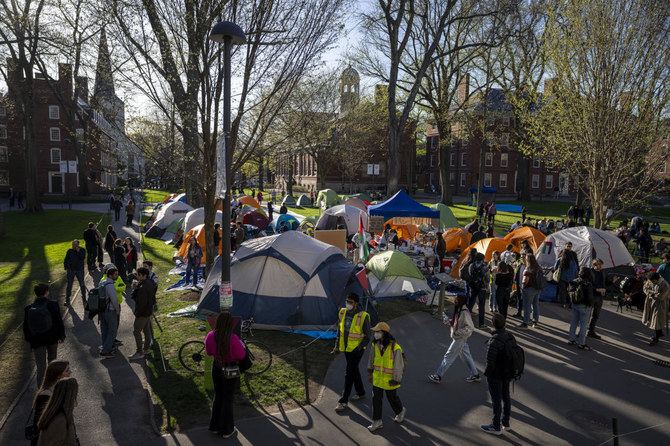
CAMBRIDGE, Massachusetts: Protesters against the war between Israel and Hamas were voluntarily taking down their tents in Harvard Yard on Tuesday after university officials agreed to discuss their questions about the endowment, bringing a peaceful end to the kinds of demonstrations that were broken up by police on other campuses.
The student protest group Harvard Out of Occupied Palestine said in a statement that the encampment “outlasted its utility with respect to our demands.” Meanwhile, Harvard University interim President Alan Garber agreed to pursue a meeting between protesters and university officials regarding the students’ questions.
Students at many college campuses this spring set up similar encampments, calling for their schools to cut ties with Israel and businesses that support it.
The latest Israel-Hamas war began when Hamas and other militants stormed into southern Israel on Oct. 7, killing around 1,200 people and taking an additional 250 hostage. Palestinian militants still hold about 100 captives, and Israel’s military has killed more than 35,000 people in Gaza, according to Gaza’s Health Ministry, which doesn’t distinguish between civilians and combatants.
Harvard said its president and the dean of the Faculty of Arts and Sciences, Hopi Hoekstra, will meet with the protesters to discuss the conflict in the Middle East.
The protesters said they worked out an agreement to meet with university officials including the Harvard Management Company, which oversees the world’s largest academic endowment, valued at about $50 billion.
The protesters’ statement said the students will set an agenda including discussions on disclosure, divestment, and reinvestment, and the creation of a Center for Palestine Studies. The students also said that Harvard has offered to retract suspensions of more than 20 students and student workers and back down on disciplinary measures faced by 60 more.
“Since its establishment three weeks ago, the encampment has both broadened and deepened Palestine solidarity organizing on campus,” a spokesperson for the protesters said. “It has moved the needle on disclosure and divestment at Harvard.”


Harvard students end protest as university agrees to discuss Middle East conflict
https://arab.news/6kfzf
Harvard students end protest as university agrees to discuss Middle East conflict

- The student protest group Harvard Out of Occupied Palestine said in a statement that the encampment “outlasted its utility with respect to our demands”
- Students at many college campuses this spring set up similar encampments


EU should consider forming combined military force: defense chief
- Kubilius floated creating a “powerful, standing ‘European military force’ of 100,000 troops” that could eventually replace US forces
- Trump has heightened fears among NATO allies over Washington’s reliability by insisting he wants to take over Greenland
BRUSSELS: EU countries should weigh whether to set up a combined military force that could eventually replace US troops in Europe, the bloc’s defense chief said Sunday.
EU defense commissioner Andrius Kubilius floated creating a “powerful, standing ‘European military force’ of 100,000 troops” as a possible option to better protect the continent.
“How will we replace the 100,000-strong American standing military force, which is the back-bone military force in Europe?” he asked in a speech in Sweden.
The suggestion comes as US President Donald Trump has heightened fears among NATO allies over Washington’s reliability by insisting he wants to take over Greenland.
Worries over Trump’s commitment to Europe have already spurred countries to step up efforts to bolster their militaries in the face of the threat posed by Russia.
Ideas about establishing a central European army have floated around for years but have largely failed to gain traction as nations are wary of relinquishing control over their militaries.
The US has pushed its European allies to increasingly take over responsibility for their own security, and raised the prospect it could shift forces from Europe to focus on China.
“In such times, we should not run away from the most pressing questions on our institutional defense readiness,” said Kubilius, a former Lithuanian prime minister.
In his speech Kubilius also advocated for the creation of a “European Security Council” of key powers — including potentially Britain — that could help the continent take decisions over its own defense quicker.
“The European Security Council could be composed of key permanent members, along with several rotational members,” he said.
“In total around 10-12 members, with the task to discuss the most important issues in defense.”
He said the first focus of such a body should be trying to change the dynamics in the war in Ukraine to ensure that Kyiv does not end up losing.
“We need to have a clear answer — how is the EU going to change that scenario?,” he said.
“This is the reason why we need to have a European Security Council now!“


