
RIYADH: Partnerships between Saudi Arabia and the UK cover over 60 initiatives across 13 sectors, with trade between the countries up a third since 2018, according to a top official.
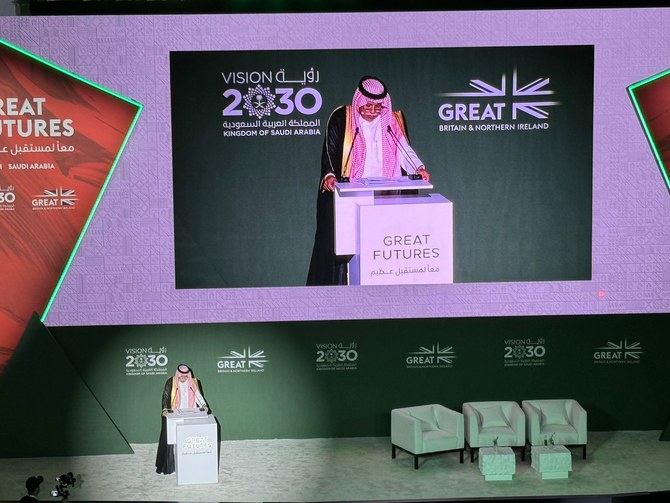
Speaking during the opening remarks of the GREAT Futures Initiative Conference held in Riyadh, the Kingdom’s Minister of Commerce, Majid Al-Qasabi, noted that bilateral trade surged between 2018 and 2023, exceeding £79 billion ($99.12 billion).
With over 1,100 active licenses for UK investors, developments such as the giga-projects in Saudi Arabia and policy reforms are strengthening business opportunities in the Kingdom.
“The growth and the inflow of trade is matched by the growth in foreign direct investment. In 2022 alone, the inflow of British investment into (the) Saudi economy reached more than £4.3 billion,” Al-Qasabi said.
He added: “Our strong bilateral economic ties are underpinned by strong educational and cultural ties. In the academic years of 2020 to 2023, 14,000 Saudi students were pursuing their higher education in the UK.”
The UK’s Deputy Prime Minister Oliver Dowden used his appearance on a panel alongside Al-Qasabi to say that he is “particularly excited about sports and tourism” when it comes to increased cooperation with the Kingdom.
“We will enhance decision-making and collaborations across various sectors, which is wonderful and amazing, enhancing our prosperity as two countries. We also look forward to these collaborations,” he said.
Highlighting the UK as the second largest exporter of services in the world, Al-Qasabi stated that Saudi Arabia is looking into new trade across the cultural, sports, and entertainment areas, as well as financial and insurance spheres.
However, Dowden noted that a few additional sectors, including technology and artificial intelligence, were not covered.
“I think there’s a lot more we can do to collaborate together because there’s huge expertise in artificial intelligence in Saudi Arabia,” Dowden said.
He also flagged up education as an area for growth, saying that by 2030 there should be 10 British schools in the Kingdom.
“Having a presence in Saudi Arabia has always been a strength to the British education system, so that’s a tremendously exciting area for us,” Dowden said, adding that healthcare is also an area for expansion.
Additionally, Saudi Minister of Investment Khalid Al-Falih highlighted that the second largest investor in Saudi Arabia is the UK, which has accumulated about $16 billion in investment stock.
He continued: “I will also mention our regional headquarters program where we have attracted over 400 global multinational companies to choose Saudi Arabia as their hub, I’d say as their home countries. I am proud and happy that 52 of those are from the UK and we are happy to offer this platform to grow and prosper.”
Al-Falih also stated that Saudi Arabia needs to develop a new economy, focusing on sectors that have been historically under-invested in, while also tackling global challenges.
The minister emphasized that the UK and Saudi Arabia, as leading G20 economies, are experiencing significant changes driven by megatrends such as energy and technological transitions, as well as challenges like AI and disruptions in global supply chains.
However, he said: “There needs to be green energy embedded in our supply chain. What we want to do is build these new supply chains that are built on … efficient logistics, technology, automation, Fourth Industrial Revolution, accessing critical materials, not only in the Kingdom but in Africa."
On a hosting front, Minister of Tourism Ahmed Al-Khatib stated that the Kingdom has witnessed a remarkable 390 percent increase in demand for tourism activity licenses, with over 165,000 British travelers visiting Saudi Arabia in the first quarter of this year.
“The issuance of 560,000 electronic visas to the UK tourists since 2019 underscores the growth in a growing interest in visiting our Kingdom. Our aim is to further increase connectivity and expand the presence of traditional sales operators,” Al-Khatib said.
Furthermore, the Secretary of State for Culture, Media and Sport of the UK, Lucy Frazer, stated that in 2022, the nation welcomed over 200,000 visitors from the Kingdom.
She quoted the UK’s national tourism agency VisitBritain’s latest forecast, which predicts 240,000 visits from Saudi Arabia this year.
“This is another area where you are testing the fundamentals. Looking up the tourism infrastructure needed to make Saudi Arabia a magnet for visitors doing what is needed to increase the number of annual travelers to the Kingdom from 14 million to 60 million in the next five years,” Frazer continued.
She also stated that many British sports stars will soon start playing in Saudi Arabia.
On the first day of the event, Red Sea Global CEO John Pagano stated that the first phase of project work will be completed in 2025, as the company is “currently working on the Red Sea International Airport project and have operated eight flights to Riyadh, Jeddah, and Dubai.”
Chemicals firm to open Saudi office
Maurits van Tol, CEO of Catalyst Technologies for Johnson Matthey, has announced that the company will open its office in Riyadh
“We traditionally have catered to the Kingdom from our offices in Bahrain and Abu Dhabi. But what we are also now, we will announce this week, is that we will open our office in Riyadh,” van Tol told Arab News.
“We just signed all the paperwork, and we will have the first people starting to work in the office very soon, and then we have a little bit of a bigger opening somewhat later in the year,” he said.
Van Tol said the office is set to open sometime between late summer and autumn with staff members from Saudi Arabia and the UK.
The company’s expansion is a part of Johnson Matthey’s aim to enhance local and regional collaboration.
Van Tol discussed the company’s expansion during a panel discussion titled “Powering a Greener Future” at the GREAT Futures event in Riyadh on May 13.
During the session, he highlighted Johnson Matthey’s technologies and their role in developing sustainable aviation fuel and other low-carbon solutions.
Van Tol said: “JM technologies will support KSA as it seeks to diversify its energy sources and reach its sustainability goals. We can and will help it make its vision to lead the world in making a circular carbon economy a reality.”
He said Johnson Matthey has been working in the region for 35 years, including collaborating with the King Abdullah University of Science and Technology.
“When you look at the Kingdom’s Vision 2030, there is a lot about reduce, reuse, recycle and remove … it’s also that place at the heart of what we do at Johnson Matthey,” Van Tol said.
“We design intrinsically energy-efficient technologies, but also we have a very broad suite of technologies that can convert renewables, including CO2, with renewable hydrogen, into synthetic aviation fuel,” he added.