Indonesia’s president-elect seeks to boost defense ties with UAE

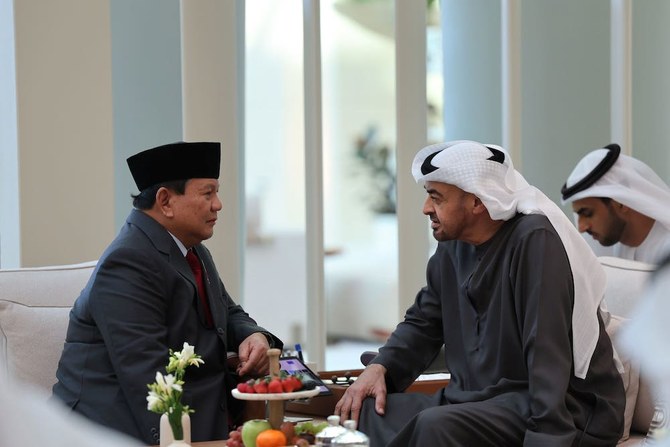
Indonesian president-elect and current defense minister Prabowo Subianto sits with UAE President Sheikh Mohamed bin Zayed Al-Nahyan in Abu Dhabi on May 13, 2024. (Ministry of Defense)
Short Url
Updated 14 May 2024
Follow

Indonesia’s president-elect seeks to boost defense ties with UAE

  • Prabowo Subianto is set to succeed President Joko Widodo in October
  • His visit to Abu Dhabi seen as a strategic move ahead of presidency

JAKARTA: Indonesia’s President-Elect Prabowo Subianto wants to boost defense ties with the UAE, his office said on Tuesday, as he made the first official trip to Abu Dhabi since winning the general vote.

Indonesia-UAE relations grew under incumbent Indonesian President Joko Widodo, who in 2021 secured an over $46 billion investment commitment from the Gulf state. A year later, the two countries signed a free trade deal, which came into force last September.

Subianto, a former special forces commander and Indonesia’s current defense minister, is set to succeed Widodo and take office in October following his landslide victory in the presidential election in February.

On Monday, he was in Abu Dhabi to receive the UAE’s highest civilian honor, the Order of Zayed, in recognition of his efforts in enhancing bilateral ties.

“I hope Indonesia-UAE relations will continue to develop and grow in accordance with the ambitions of the two countries in strengthening cooperation across various fields, including in defense,” Subianto said in a statement after meeting UAE President Sheikh Mohammed bin Zayed Al-Nahyan.

During Subianto’s time in office as minister, Indonesia and the UAE agreed to strengthen defense ties with the signing of a memorandum of understanding in 2020, followed by a protocol agreement on the development of their defense industries in 2022.

Subianto’s visit to the UAE can be seen as a strategic move ahead of his presidency.

“As we get closer to his inauguration, Prabowo has gained a boost in confidence to directly meet with MBZ and discuss strategic issues at the bilateral, regional and global level,” said Teuku Rezasyah, an international relations expert from Padjadjaran University in West Java.

“It’s only natural that Prabowo is visiting Abu Dhabi because it’s one of the world’s biggest sources of foreign investments … Certainly, Prabowo wants to seriously guarantee that investments from Abu Dhabi will be very strategic in the development of Indonesia.”


Three Afghan migrants die of cold while trying to cross into Iran

Updated 20 December 2025
Follow

Three Afghan migrants die of cold while trying to cross into Iran

  • More than 1.8 million Afghans were forced to return to Afghanistan by the Iranian authorities between January and the end of November 2025

AFGHANISTAN: Three Afghans died from exposure in freezing temperatures in the western province of Herat while trying to illegally enter Iran, a local army official said on Saturday.
“Three people who wanted to illegally cross the Iran-Afghanistan border have died because of the cold weather,” the Afghan army official told AFP on condition of anonymity.
He added that a shepherd was also found dead in the mountainous area of Kohsan from the cold.
The migrants were part of a group that attempted to cross into Iran on Wednesday and was stopped by Afghan border forces.
“Searches took place on Wednesday night, but the bodies were only found on Thursday,” the army official said.
More than 1.8 million Afghans were forced to return to Afghanistan by the Iranian authorities between January and the end of November 2025, according to the latest figures from the United Nations refugee agency (UNHCR), which said that the majority were “forced and coerced returns.”
“These mass returns in adverse circumstances have strained Afghanistan’s already overstretched resources and services” which leads to “risks of onward and new displacement, including return movements back into Pakistan and Iran and onward,” UNHCR posted on its site dedicated to Afghanistan’s situation.
This week, Amnesty International called on countries to stop forcibly returning people to Afghanistan, citing a “real risk of serious harm for returnees.”
Hit by two major earthquakes in recent months and highly vulnerable to climate change, Afghanistan faces multiple challenges.
It is subject to international sanctions particularly due to the exclusion of women from many jobs and public places, described by the UN as “gender apartheid.”
More than 17 million people in the country are facing acute food insecurity, the UN World Food Programme said Tuesday.