

Nigerian troops and village vigilantes rescue kidnapped university students

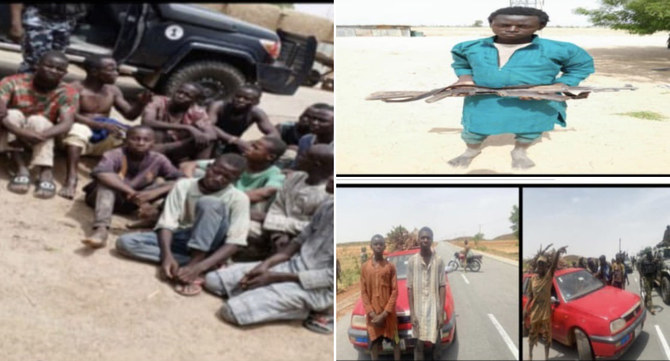
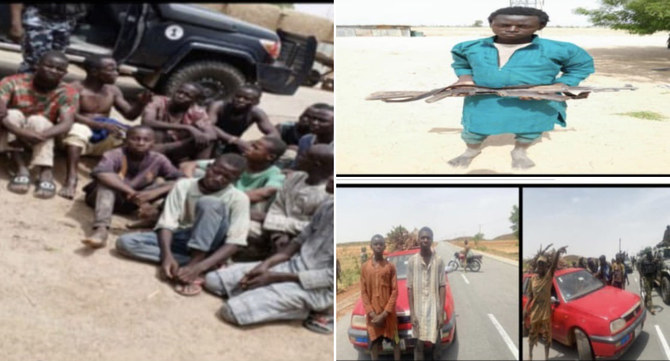
A combination of photos posted by the Nigerian Army on social media shows some of the 100 students seized by armed gangs on Thursday from the Confluence University of Science and Technology in Osara, Kogi state, after they were rescued on Sunday. (X: @HQNigerianArmy)
Short Url
Updated 13 May 2024
Follow

Nigerian troops and village vigilantes rescue kidnapped university students

  • Troops aided by local vigilantes rescued the kidnap victims after a shootout with their abductors in Kogi state, says government spokesman
  • Kidnapping has become elucrative criminal activity in Nigeria’s northwest, where roving have seize mostly young ones and demand ransom money from their relatives

MAIDUGURI, Nigeria: Nigerian security forces have rescued students kidnapped from a university in northern Kogi state, along with other victims held by the abductors, the army and state government said on Sunday.

Kogi information commissioner Kingsley Femi Fanwo said security forces were involved in a shootout with the armed gang that carried out Thursday’s abduction at Confluence University of Science and Technology.

The state had enlisted the help of local hunters who know the Kogi terrain, and a security agent and hunter were wounded.

The Nigerian army said in a separate statement that troops, other security agencies and local vigilantes were involved in “a fierce firefight” with the kidnappers.

“The superior firepower of the troops led to the kidnappers abandoning nine of the kidnapped students, who were subsequently rescued,” the army said.

Nigeria’s President Bola Tinubu has ruled out the payment of ransoms for the abducted schoolchildren. He instead directed security agencies to urgently rescue the children and “in the process to ensure that not a dime is paid for ransom.”

The victims were among more than 100 people kidnapped by gunmen during Friday night raids on three villages in northwest Nigeria, in the latest abduction of villagers in a region blighted by widespread insecurity.

Kidnapping has become endemic in Nigeria’s northwest as roving gangs of armed men abduct people from villages, highways and schools, and demand ransom money from their relatives.

AlHajji Bala, head of a district in the Birnin-Magaji local government area of Zamfara, said gunmen attacked the villages of Gora, Madomawa and Jambuzu and that 38 men and 67 women and children were missing.

“But the number of people abducted could be more than that,” he said.

Zamfara is a hotspot for kidnapping gangs who carry out attacks and retreat into forests where they have set up camps. The Nigerian military has bombed some of the camps but attacks continue.

Yezid Abubakar, Zamfara police spokesperson, could not immediately be reached for comment.

Aminu Aliyu Asha, the Madomawa village head, said gunmen arrived in his village on motorbikes and shot sporadically before kidnapping several people.

“The abduction breaches the peace agreement between us and bandits. In February this year, we made several ransom payments in order to stop them from attacking our territory,” said Asha.

Nusa Sani said his two brothers were among those abducted, while another resident, Garba Kira, added that among the abducted were 15 passengers in a lorry that was passing through the villages.

Mass kidnappings were first carried out by jihadist group Boko Haram when they seized more than 200 students a decade ago, but the practice has been adopted by armed gangs with no known ideological affiliation and has grown as Nigerians grapple with economic hardship.


Thousands in Kosovo march against war crimes trials on 18th anniversary of independence declaration

Updated 2 sec ago
Follow

Thousands in Kosovo march against war crimes trials on 18th anniversary of independence declaration

  • Protesters, many wrapped in red and black Albanian flags, braved cold and snowy weather in the capital, Pristina, to voice their opposition to the proceedings in The Hague
  • PM Albin Kurti added that ‘the KLA-led war was pure, liberation (struggle) and an anti-colonial war ... a just struggle of an occupied and oppressed people under apartheid’
PRISTINA, Kosovo: An air of defiance marked Kosovo’s independence celebrations on Tuesday as thousands of people joined a march in support of former fighters who are facing trial at a Netherlands-based court for alleged war crimes during a 1998-1999 separatist war from Serbia.
Protesters, many wrapped in red and black Albanian flags, braved cold and snowy weather in the capital, Pristina, to voice their opposition to the proceedings in The Hague against former president and rebel leader Hashim Thaci and three others accused of atrocities during and after the conflict that killed some 13,000 people.
Earlier on Tuesday, Kosovo’s security forces paraded in Pristina as part of the independence ceremonies, and Parliament held a special session.
The war started in 1998 when the rebel Kosovo Liberation Army launched its struggle for independence and Serbia responded with a brutal crackdown. The war ended after NATO bombed Serbia for 78 days in 1999, eventually forcing it to pull out its troops from the territory.
Serbia still does not recognize the 2008 declaration of independence of Kosovo and this has been a source of persistent tension in the volatile Balkan region. As both Kosovo and Serbia seek European Union membership, they have been told they must normalize ties before joining.
Prosecutors at the Kosovo Specialist Chambers in The Hague — which formally is part of Kosovo’s judicial system although seated abroad — have asked for a maximum 45-year prison sentence for Thaci and the other defendants. Thaci also faces a separate trial on charges of intimidating witnesses that will begin later this month.
Officials and protesters in Kosovo have criticized the proceedings as political and designed to strike a false balance with Serbia whose political and military leaders previously had been tried and convicted of war crimes in Kosovo by a separate UN court.
Protesters at Tuesday’s march held banners reading “History cannot be rewritten” and “Freedom for the liberators.” They arranged metal fences around a landmark independence monument and placed a sign reading ”Kosovo in Prison” on top of it.
President Vjosa Osmani said in a statement that “truth cannot be changed by attempts to rewrite history or to tarnish and devalue the struggle of Kosovo’s people for freedom.”
Prime Minister Albin Kurti added that “the KLA-led war was pure, liberation (struggle) and an anti-colonial war ... a just struggle of an occupied and oppressed people under apartheid.”
In Belgrade, a Serbian government liaison office for Kosovo described the independence declaration 18 years ago as a “flagrant violation of international law.” The statement alleged “systematic terror” and persecution against minority Serbs in Kosovo.
The United States and most EU countries are among more than 100 nations that have recognized Kosovo’s independence while Russia and China have backed Serbia’s claim on the territory.
Thaci resigned from office in 2020 to defend himself against the 10 charges of crimes against humanity and war crimes.
The court and an associated prosecutor’s office were created after a 2011 report by the Council of Europe, a human rights body, following allegations that KLA fighters trafficked human organs taken from prisoners and killed Serbs and fellow ethnic Albanians. The organ harvesting allegations haven’t been included in indictments issued by the court.