India vote to resume with Kashmir poised to oppose Modi

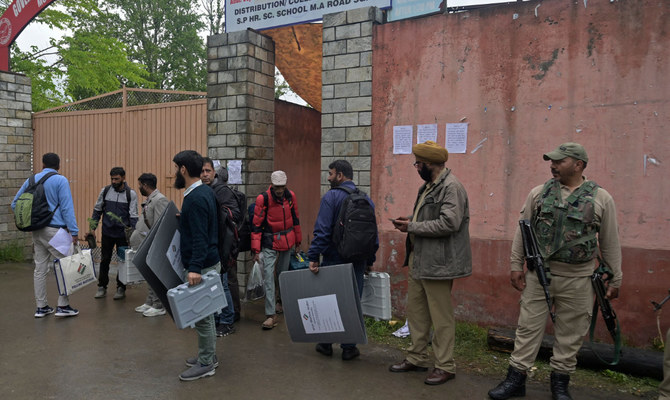
Kashmiri polling officials carry Electronic Voting Machines (EVM) ahead of the fourth phase of voting of India's general elections in Srinagar on May 12, 2024. (AFP)
Short Url
Updated 13 May 2024
Follow

India vote to resume with Kashmir poised to oppose Modi

  • Modi remains popular across much of India and his Hindu-nationalist Bharatiya Janata Party (BJP) is widely expected to win the poll when it concludes early next month

SRINAGAR, India: India’s six-week election is set to resume Monday including in Kashmir, where voters are expected to show their discontent with dramatic changes in the disputed territory under Prime Minister Narendra Modi’s government.
Modi remains popular across much of India and his Hindu-nationalist Bharatiya Janata Party (BJP) is widely expected to win the poll when it concludes early next month.
But his government’s snap decision in 2019 to bring Kashmir under direct rule by New Delhi — and the drastic security clampdown that accompanied it — have been deeply resented among the region’s residents, who will be voting for the first time since the move.
“What we’re telling voters now is that you have to make your voice heard,” said former chief minister Omar Abdullah, whose National Conference party is campaigning for the restoration of Kashmir’s former semi-autonomy.
“The point of view that we want people to send out is that what happened... is not acceptable to them,” he told AFP.
Kashmir has been divided between India and Pakistan since their independence in 1947. Both claim it in full and have fought two wars over control of the Himalayan region.
Rebel groups opposed to Indian rule have waged an insurgency since 1989 on the side of the frontier controlled by New Delhi, demanding either independence or a merger with Pakistan.
The conflict has killed tens of thousands of soldiers, rebels and civilians in the decades since, including a spate of firefights between suspected rebels and security forces in the past month.
Violence has dwindled since the Indian portion of the territory was brought under direct rule five years ago, a move that saw the mass arrest of local political leaders and a months-long telecommunications blackout to forestall expected protests.
Modi’s government says its canceling of Kashmir’s special status has brought “peace and development,” and it has consistently claimed the move was supported by Kashmiris.
But his party has not fielded any candidates in the Kashmir valley for the first time since 1996, and experts say the BJP would have been roundly defeated if it had.
“They would lose, simple as that,” political analyst and historian Sidiq Wahid told AFP last week.
The BJP has appealed to voters to instead support smaller and newly created parties that have publicly aligned with Modi’s policies.
But voters are expected to back one of two established Kashmiri political parties calling for the Modi government’s changes to be reversed.
India’s election is conducted in seven phases over six weeks to ease the immense logistical burden of staging the democratic exercise in the world’s most populous country.
More than 968 million people are eligible to vote in India’s election, with the final round of polling on June 1 and results expected three days later.
Turnout so far has declined significantly from the last national poll in 2019, according to election commission figures.
Analysts have blamed widespread expectations that Modi will easily win a third term and hotter-than-average temperatures heading into the summer.
India’s weather bureau has forecast more hot spells in May and the election commission formed a taskforce last month to review the impact of heat and humidity before each round of voting.


Moscow made an offer to France regarding a French citizen imprisoned in Russia, says Kremlin

Updated 5 sec ago
Follow

Moscow made an offer to France regarding a French citizen imprisoned in Russia, says Kremlin

  • Laurent Vinatier, an adviser for Swiss-based adviser Center for Humanitarian Dialogue, Vinatier was arrested in Moscow in June 2024
  • He is accused of failing to register as a “foreign agent” while collecting information about Russia’s “military and military-technical activities” 

The Kremlin on Thursday said it was in contact with the French authorities over the fate of a French political scholar serving a three-year sentence in Russia and reportedly facing new charges of espionage.
Kremlin spokesman Dmitry Peskov told reporters that Russia has made “an offer to the French” regarding Laurent Vinatier, arrested in Moscow last year and convicted of collecting military information, and that “the ball is now in France’s court.” He refused to provide details, citing the sensitivity of the matter.
French President Emmanuel Macron is following Vinatier’s situation closely, his office said in a statement. French Foreign Ministry spokesperson Pascal Confavreux said Thursday that all government services are fully mobilized to pay provide consular support to Vinatier and push for his liberation as soon as possible.
Peskov’s remarks come after journalist Jérôme Garro of the French TF1 TV channel asked President Vladimir Putin during his annual news conference on Dec. 19 whether Vinatier’s family could hope for a presidential pardon or his release in a prisoner exchange. Putin said he knew “nothing” about the case, but promised to look into it.
Vinatier was arrested in Moscow in June 2024. Russian authorities accused him of failing to register as a “foreign agent” while collecting information about Russia’s “military and military-technical activities” that could be used to the detriment of national security. The charges carry a maximum penalty of five years in prison.
The arrest came as tensions flared between Moscow and Paris following French President Emmanuel Macron’s comments about the possibility of deploying French troops in Ukraine.
Vinatier’s lawyers asked the court to sentence him to a fine, but the judge in October 2024 handed him a three-year prison term — a sentence described as “extremely severe” by France’s Foreign Ministry, which called for the scholar’s immediate release.
Detentions on charges of spying and collecting sensitive data have become increasingly frequent in Russia and its heavily politicized legal system since Moscow invaded Ukraine in February 2022.
In addition to criticizing his sentence, the French Foreign Ministry urged the abolition of Russia’s laws on foreign agents, which subject those carrying the label to additional government scrutiny and numerous restrictions. Violations can result in criminal prosecution. The ministry said the legislation “contributes to a systematic violation of fundamental freedoms in Russia, like the freedom of association, the freedom of opinion and the freedom of expression.”
Vinatier is an adviser for the Center for Humanitarian Dialogue, a Switzerland-based nongovernmental organization, which said in June 2024 that it was doing “everything possible to assist” him.
While asking the judge for clemency ahead of the verdict, Vinatier pointed to his two children and his elderly parents he has to take care of.
The charges against Vinatier relate to a law that requires anyone collecting information on military issues to register with authorities as a foreign agent.
Human rights activists have criticized the law and other recent legislation as part of a Kremlin crackdown on independent media and political activists intended to stifle criticism of the war in Ukraine.
In August 2025, Russian state news agency Tass reported that Vinatier was also charged with espionage, citing court records but giving no details. Those convicted of espionage in Russia face between 10 and 20 years in prison.
Russia in recent years has arrested a number of foreigners — mainly US citizens — on various criminal charges and then released them in prisoner swaps with the United States and other Western nations. The largest exchange since the Cold War took place in August 2024, when Moscow freed journalists Evan Gershkovich and Alsu Kurmasheva, fellow American Paul Whelan, and Russian dissidents in a multinational deal that set two dozen people free.