

Ex-president Alvi denies being picked to head PTI amid reports of talks with army

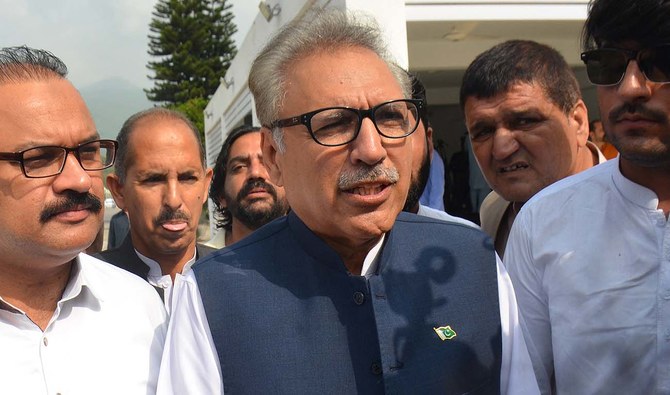
Ex-president of Pakistan arrives before the president election at the National Assembly in Islamabad on September 4, 2018. (AFP/File)
Short Url
Updated 11 May 2024
Follow

Ex-president Alvi denies being picked to head PTI amid reports of talks with army

  • The statement came amid speculation about Alvi being made PTI chairman to resolve party’s issues with establishment
  • These speculations create confusion in a party whose leadership is ‘wrongfully and unjustly incarcerated,’ Alvi says

ISLAMABAD: Arif Alvi, former president and a close aide of jailed former prime minister Imran Khan, on Saturday denied being appointed chairman of Khan’s Pakistan Tehreek-e-Insaf (PTI) opposition party.

The statement came amid widespread speculation about Alvi being made the PTI chairman to resolve the party’s issues with the powerful military establishment whom Khan has accused of sidelining him, according to some media reports.

The reports suggested the former president had been tasked with the “important” job following his meeting with Khan at Adiala jail in Rawalpindi, however, Alvi denied these reports.

“There is unnecessary speculation that Mr.@ImranKhanPTI intends to appoint me as Chairman of the party. There is no such thing being envisaged by my leader nor was it discussed in my meeting with him,” he said on X.

“These speculations create confusion in a party whose leadership is wrongfully & unjustly incarcerated.”

Alvi said the incumbent PTI chairman Gohar Khan was leading the party well. “I would like to put this inaccurate non-issue to rest with a clear denial,” he added.

Alvi’s meeting with Khan came a day after the ex-premier reportedly turned down the Pakistani military’s demand to apologize for the violent protests, allegedly staged by his supporters over his brief arrest in a graft case, that targeted military installations and public property on May 9, 2023.

Hundreds were arrested in the aftermath and some were tried by military courts after the authorities promised to bring the perpetrators and instigators of the violence to justice.

During the alleged crackdown against the PTI, Alvi, who was the then president, was said to be making efforts to bridge the gap between his party and Pakistan’s powerful military.

Khan was ousted in 2022 after falling out with Pakistan’s powerful military leaders who many say backed him into power in 2018. In opposition, he waged an unprecedented campaign of defiance against the military establishment which has directly ruled the South Asian nation for nearly half of its history.

Arguably Pakistan’s most popular politician, Khan says the cases against him are “politically motivated,” aimed at keeping him from returning to power. The military denies it.


Pakistan orders four-day workweek, shuts schools to save fuel amid Middle East oil crisis

Updated 09 March 2026
Follow

Pakistan orders four-day workweek, shuts schools to save fuel amid Middle East oil crisis

  • The development comes as ongoing US-Israeli strikes on Iran disrupt oil supplies in Strait of Hormuz, push prices past $119 a barrel
  • Islamabad bans government purchases, cuts fuel allocation for vehicles as well as workforce in public and private offices by 50 percent

ISLAMABAD: Prime Minister Shehbaz Sharif on Monday announced austerity measures, including a four-day work week, cuts in government expenditures and closure of schools, to offset the impact of rising global oil prices due to an ongoing conflict in the Middle East.

Global fuel supply lines have been disrupted in the Strait of Hormuz, which supplies nearly a fourth of world oil consumption, after Tehran blocked it following United States-Israeli strikes on Iran and counterattacks against US interests in the Gulf region.

Oil prices surged more than 25 percent globally on Monday to $119.50 a barrel, the highest levels since mid-2022, as some major producers cut supplies and fears of prolonged shipping disruptions gripped the market due to the expanding US-Israeli war with Iran.

In his televised address on Sunday night, Sharif said global oil prices were expected to rise again in the coming days but vowed not to let the people bear their brunt, announcing austerity measures to lessen the impact of fuel price hikes.

“Fifty percent staff in public and private entities will work from home,” he announced, adding this would not be applicable to essential services. “Offices will remain open for four days a week. One-day additional off is being given to conserve oil, but it would not be applicable to banks.”

Sharif didn’t specify working days of the week and the government was likely to issue a notification in this regard.

He said a decrease of 50 percent was being made in fuel allocation for government vehicles immediately for the next two months, but they would not include ambulances and public buses.

“Cabinet members, advisers and special assistants will not draw salaries for the next two months, 25 percent salaries of parliamentarians are being deducted, two-day salaries of Grade 20 and above officers, or those who are paid Rs300,000 ($1,067) a month, are being deducted for public relief,” he said.

Similarly, there will be 20 percent reduction in public department expenses and a complete ban on the purchase of cars, furniture, air conditioners and other goods, according to the prime minister.

Foreign trips of ministers and other government officials will also be banned along with government dinners and iftar buffets, while teleconferences and online meetings will be given priority.

“All schools will be off for two weeks, starting from the end of this week, and all higher education institutions should immediately begin online classes,” he said.

Sharif’s comments were aired hours after Pakistani authorities said the country had “comfortable levels” of petroleum stocks and the supply chains were functioning smoothly, despite intensifying Middle East conflict.

Petroleum Minister Ali Pervaiz Malik said three oil shipments were due to reach Pakistan this week, state media reported.

Meanwhile, Pakistan Navy (PN) launched ‘Operation Muhafiz-ul-Bahr’ to safeguard national energy shipments, the Pakistani military said on Monday, amid disruptions to critical sea lanes due to the conflict.

The navy is conducting escort operations in close coordination with the Pakistan National Shipping Corporation (PNSC), according to the Inter-Services Public Relations (ISPR), the military’s media wing. It is fully cognizant of the prevailing maritime situation and is actively monitoring and controlling the movement of merchant vessels to ensure their safe and secure transit.

“With approximately 90 percent of Pakistan’s trade conducted via sea, the operation aims to ensure that vital sea routes remain safe, secure, and uninterrupted,” the ISPR said on Monday. “Currently, PN ships are escorting 2 x Merchant Vessels, one of which is scheduled to arrive Karachi today.”