

Pope Francis prays for peace in Pakistan, voices concern over war in Gaza

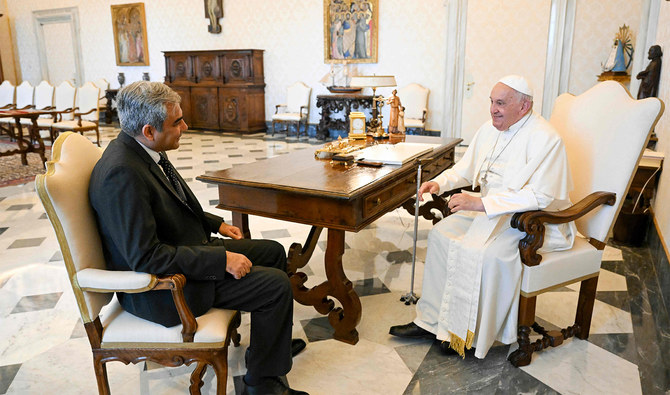
This photo taken and handout on June 3, 2024 by The Vatican Media shows Pope Francis during a meeting with Interior Minister of Pakistan, Naqvi Mohsin, in The Vatican. (AFP/VATICAN MEDIA)
Short Url
Updated 04 June 2024
Follow

Pope Francis prays for peace in Pakistan, voices concern over war in Gaza

  • The head of the Roman Catholic Church emphasizes interfaith dialogue while speaking to Pakistan’s interior minister
  • Minister Mohsin Naqvi describes the protection of religious minorities as the government’s top priority in Pakistan

ISLAMABAD: Pope Francis, the head of the Roman Catholic Church, sent a message of peace to the people of Pakistan and expressed concern over the situation in Palestine while discussing interfaith harmony during a meeting with interior minister Mohsin Naqvi, according to a statement issued Tuesday.

Pakistan’s Christian community has faced several instances of mob violence in recent years, driven by allegations of blasphemy amid societal tensions. In 2022, a mob in Jaranwala attacked and burned the homes of several Christian families as well as churches in the city, following such accusations against local residents.

Last month, the city of Sargodha witnessed similar violence when a Christian man was accused of desecrating the Holy Qur’an, leading to significant unrest and damage in a Christian neighborhood.

“My message to the people of Pakistan is one of peace,” the pope was quoted as saying in the statement. “We all must work together for peace.”
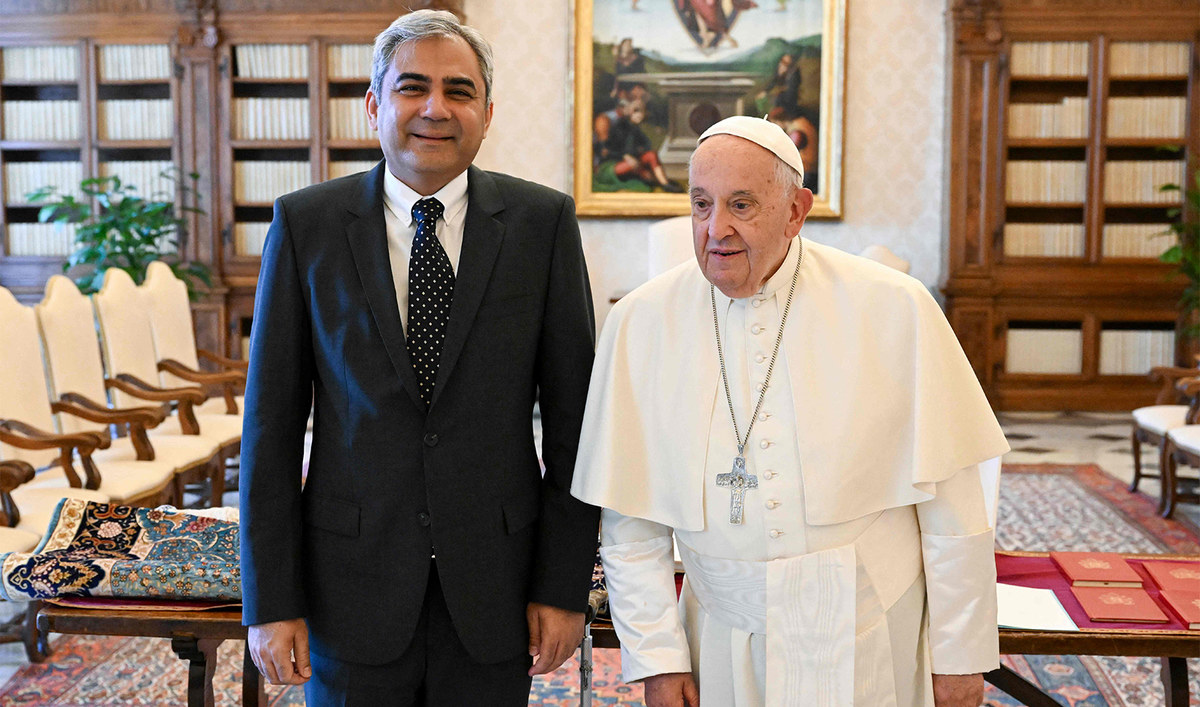


This photo taken and handout on June 3, 2024 by The Vatican Media shows Pope Francis during a meeting with Interior Minister of Pakistan, Naqvi Mohsin, in The Vatican. (AFP/VATICAN MEDIA)

The interior minister maintained the protection of minorities was the government’s top priority in Pakistan.

“Our religion, our Prophet Muhammad (PBUH), our founder Muhammad Ali Jinnah, and our constitution emphasize the protection and care of minorities,” he said. “Minorities in Pakistan have equal rights.”

Naqvi briefed Pope Francis on his country’s “sacrifices” and actions in the fight against militancy in recent years.

“The sacrifices of the Pakistani nation and its armed forces in the fight against terrorism are unparalleled,” he said.

The statement said the pope appreciated the immediate reconstruction and repair of churches after the Jaranwala incident.

He also voiced concern about Israel’s war in Gaza, saying interfaith harmony and dialogue were the solutions to such problems.

“The situation in Palestine is concerning,” he told the Pakistani minister, “and I communicate daily at 7 PM with workers involved in welfare activities there.”

Naqvi also thanked Pope Francis for adopting a firm stance on the Palestine issue.

“Your services in making the world a cradle of peace are commendable,” he said. “Your courageous stance on the Palestine issue has been praised by everyone.”

The Pakistani minister extended invitation to Pope Francis to visit the country on behalf of Prime Minister Shehbaz Sharif.

“I will make every effort to visit Pakistan,” he said in response.

The pope also prayed for the progress and prosperity of Pakistan and expressed good wishes for its people.


Pakistan’s president defends ongoing strikes in Afghanistan, urges Kabul to dismantle militants

Updated 7 sec ago
Follow

Pakistan’s president defends ongoing strikes in Afghanistan, urges Kabul to dismantle militants

  • Afghanistan on Thursday launched attacks in retaliation for Pakistani airstrikes the previous Sunday
  • Pakistan’s military says it is only targeting Afghan military installations to avoid civilian casualties

ISLAMABAD: Pakistan’s president on Monday defended his country’s ongoing military strikes in neighboring Afghanistan, saying Islamabad tried all forms of diplomacy before targeting militants operating from Afghan territory, and called on the Taliban government in Kabul to disarm groups responsible for attacks in Pakistan.

Pakistan earlier said it is in “open war” with Afghanistan, alarming the international community. The border area remains a stronghold for militant organizations including Al-Qaeda and the Daesh (Islamic State) group.

“(The Afghan Taliban) must choose to dismantle the terror groups that survive on conflict and its war economy,” Asif Ali Zardari said during a speech to lawmakers, adding that “no state accepts serial attacks on its soil.”

Afghanistan on Thursday launched attacks in retaliation for Pakistani airstrikes the previous Sunday. Since then, Pakistan has carried out operations along the border, with Information Minister Attaullah Tarar claiming the killing of 435 Afghan forces and the capture of 31 Afghan positions.

Kabul has denied such claims.

In Afghanistan, the deputy government spokesman Hamdullah Fitrat said Pakistan’s military fired mortar shells at a refugee camp in eastern Kunar province, killing three children and injuring three others.

Afghanistan’s defense ministry said Afghan forces carried out strikes targeting a Pakistani military facility near Paktia province, causing “substantial losses and heavy casualties.”

Pakistan’s military did not respond to questions. It has said Pakistan is only targeting Afghan military installations to avoid civilian casualties.

Pakistan has witnessed a surge of violence in recent months and blames it on the outlawed Pakistani Taliban, known as Tehreek-e-Taliban Pakistan or TTP. It operates both inside Pakistan and from Afghan territory.
Islamabad accuses Afghanistan’s Taliban government of providing safe havens for the TTP, which Kabul denies.

The latest cross-border fighting ended a ceasefire brokered by Qatar and Turkiye in October. The two sides failed to reach a permanent agreement during talks in Istanbul.

Zardari reiterated Pakistan’s call for talks, saying, “We have never walked away from dialogue.”

The Pakistani leader again accused Afghanistan of acting as a proxy for India by sheltering militant groups.

“Stop being used by another country as a battlefield for their ambitions,” he said.

Zardari cited a recent report from the United Nations Security Council’s monitoring team that described the presence of militant groups in Afghanistan as an extra-regional threat.