

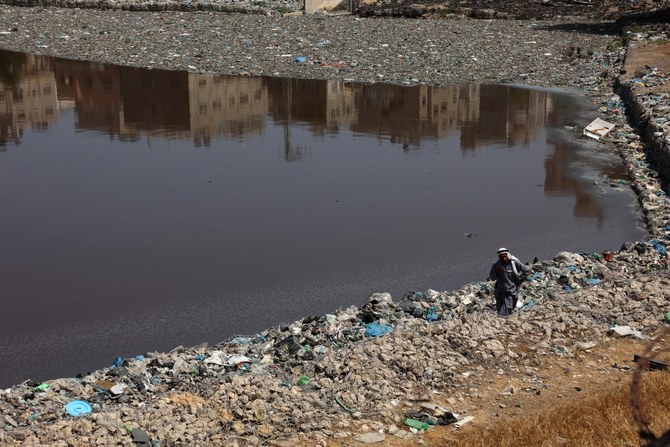
BBC investigation finds half of water facilities in Gaza have collapsed

Human rights experts argue facilities critical to civilian survival should be protected. (AFP/File)
Short Url
Updated 09 May 2024
Follow

BBC investigation finds half of water facilities in Gaza have collapsed

  • Over half of desalination plants and borehole systems have been damaged or destroyed
  • Damage to wastewater treatment plants has caused a surge of waterborne illnesses

LONDON: A BBC investigation has revealed that half of Gaza’s water and sanitation facilities have collapsed since the start of the Israel-Hamas war.

Satellite footage from BBC Verify showed just over half of the 603 desalination plants and borehole systems used to supply water to Gaza have been damaged or destroyed, along with four of the six wastewater treatment plants.

According to an aid agency cited by the BBC, the remaining two treatment plants have shut down due to lack of fuel or supplies. Repair efforts have been severely disrupted by damage to a major depot.

The collapse of facilities has led to a surge in waterborne illnesses, posing serious health risks to the population and particularly to children and pregnant women.

The number of cases of diarrheal disease, hepatitis A, and in some cases, cholera, have all spiked dramatically.

Dr. Natalie Roberts, executive director of Medecins Sans Frontieres UK, said the destruction of water and sanitation facilities had resulted in “disastrous health consequences for the population,” leading to fatalities.

She highlighted Rafah and the southern border region as particularly affected areas.

The BBC said as the exact condition of each facility could not be determined, there was no distinction between classifying them as “destroyed” or “damaged”. 

It also acknowledged that not all damage was visible from the satellite images — mostly in northern Gaza or the area around the southern city of Khan Younis — so some affected facilities could have been missed.

The situation has been exacerbated by damage to Gaza’s Coastal Municipalities Water Utility and the main service depot of UNICEF, making repairs challenging.

Human rights experts argue facilities critical to civilian survival should be protected.

Leila Sadat, a former special advisor on crimes against humanity at the International Criminal Court, suggested the pattern of destruction indicated either a “reckless approach” to civilian infrastructure or intentional targeting.

She added it was possible that “these were not all mistakes.”

In response to BBC’s findings, the Israel Defense Forces said Hamas used civilian infrastructure for military purposes, storing weapons and ammunition.

It maintains water facilities were primarily struck during airstrikes targeting Hamas fighters and denies intentionally targeting civilian infrastructure.


Foreign media group slams Israel for refusing to lift Gaza press ban

Updated 07 January 2026
Follow

Foreign media group slams Israel for refusing to lift Gaza press ban

  • Foreign Press Association expresses 'profound disappointment' with Israeli government’s response to a Supreme Court appeal
  • Israel has barred foreign journalists from independently entering the devastated territory since the war started

JERUSALEM: An international media association on Tuesday criticized the Israeli government for maintaining its ban on unrestricted media access to Gaza, calling the move disappointing.
The government had told the Supreme Court in a submission late Sunday that the ban should remain in place, citing security risks in the Gaza Strip.
The submission was in response to a petition filed by the Foreign Press Association (FPA) — which represents hundreds of journalists in Israel and Palestinian territories — seeking immediate and unrestricted access for foreign journalists to the Gaza Strip.
“The Foreign Press Association expresses its profound disappointment with the Israeli government’s latest response to our appeal for full and free access to the Gaza Strip,” the association said on Tuesday.
“Instead of presenting a plan for allowing journalists into Gaza independently and letting us work alongside our brave Palestinian colleagues, the government has decided once again to lock us out” despite the ceasefire in the territory, it added.
Since the outbreak of the Gaza war in October 2023, triggered by an attack on Israel by the Palestinian militant group Hamas, the government has barred foreign journalists from independently entering the devastated territory.
Instead, Israel has allowed only a limited number of reporters to enter Gaza on a case-by-case basis, embedded with its military inside the blockaded Palestinian territory.
The FPA filed its petition in 2024, after which the court granted the government several extensions to submit its response.
Last month, however, the court set January 4 as a final deadline for the government to present a plan for allowing media access to Gaza.
In its submission, the government maintained that the ban should remain in place.
“This is for security reasons, based on the position of the defense establishment, which maintains that a security risk associated with such entry still exists,” the government submission said.
The government also said that the search for the remains of the last hostage held in Gaza was ongoing, suggesting that allowing journalists in at this stage could hinder the operation.
The remains of Ran Gvili, whose body was taken to Gaza after he was killed during Hamas’s 2023 attack, have still not been recovered despite the ceasefire.
The FPA said it planned to submit a “robust response” to the court, and expressed hope the “judges will put an end to this charade.”
“The FPA is confident that the court will provide justice in light of the continuous infringement of the fundamental principles of freedom of speech, the public’s right to know and free press,” the association added.
The Supreme Court is expected to issue a ruling on the matter, though it is unclear when a decision will be handed down.
An AFP journalist sits on the board of the FPA.