KARACHI: Hina Mehmood Javed, a mother of three, opened the door to her second-floor apartment in Karachi earlier this week after she heard the familiar cry of ‘pani wala’ [water man] followed by a knock.
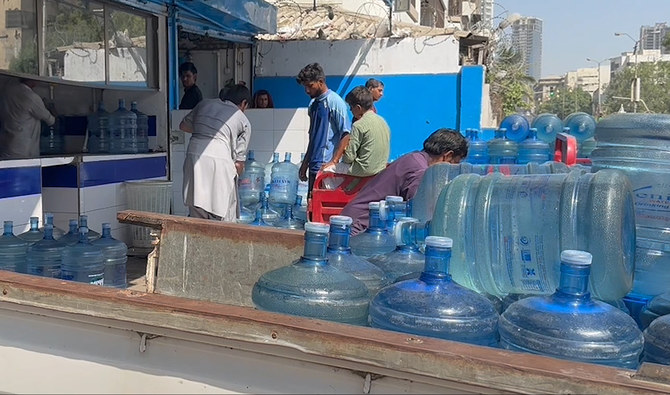
Outside, a young man stood with a heavy 19-liter water bottle, which he delivered for a fee to Javed, one among hundreds of thousands of residents in Pakistan’s commercial hub of Karachi who are buying water from plants that use reverse osmosis to separate pollutants.
A Karachi Water and Sewerage Corporation (KWSC) study conducted last year showed that 90 percent of water from samples collected from various places in Karachi was unsafe for drinking purposes, contaminated with E. coli, coliform bacteria, and other harmful pathogens. And that’s when there is water flowing through the city’s water pipes. Most residents are forced to get their water through drilled motor-operated wells (known as ‘bores’), even as ground water in the coastal city tends to be salty, and unfit for human consumption.
The only other option for residents is to either buy unfiltered water from private water tanker operators, who fill up at a network of legal and illegal water hydrants across the city, or buy from RO plants that they visit to fill up bottles or have delivered to their homes.
“We have to buy it [water] from outside and sometimes it happens that when the weekends come or when there are government holidays, and there’s no water at home, we have to use water like gold,” Javed told Arab News as she paid Rs100 ($0.36) for the water bottle, which is delivered daily.
“We have to buy and drink water because clean water is not available to us.”
The chronic shortage of drinking water is caused by a broken distribution system as well as leakages and inefficiency in the system and theft.
Dr. Muhammad Bashir Lakhani, a water and energy expert associated with a company working on the K-4, a major project that aims to address Karachi’s chronic water shortages, said the city’s daily water consumption was around 1,250 million gallons.
The megacity draws its water mainly from the Keenjhar Lake, a man-made reservoir about 150km from the city, which sources it from the Indus River. Through a network of canals and conduits, 550 million gallons of water a day (MGD) is fed into the city’s main pumping station at Dhabeji, most of which, a staggering 42 percent or 235 MGD, is either lost or stolen before it ever reaches consumers, according to KWSB data.
And the water that does manage to reach people’s homes was largely unfiltered and untreated, Dr. Lakhani told Arab News.
“Not only is it not treated but most of the time it is polluted,” he said. “It is mixed with sewage and wastewater flows.”
“FORCED TO BUY WATER”
Many, like Muhammad Adeel, are tapping into this problem of impure water by going into the filtration business, setting up small RO water plants inside their shops or homes to supply filtered water to households.
Adeel, whose plant is located in the city’s old and busy Burns Road neighborhood, explained that his system treated water through seven different processes before it became drinkable.
“It [plant] contains minerals which dissolve in it, making it mineral water,” Adeel told Arab News.
Dr. Lakhani, however, said while water provided by RO plants may be safer to drink compared to piped water, it was still not entirely safe for consumption.
“Most of these RO plants do not follow the required environmental health cleaning sanitization requirements,” he said.
But residents have no choice and there are hardly any neighborhoods in the sprawling metropolis where at least two RO plants are not operating.
“You do the math, there are thousands of plants. If at least five to six workers are working on one plant, then you can calculate how many households are being served by this,” Adeel said. “This is a good source of employment for people.”
Residents too said they had no choice, even though it was unfair to have to pay for water, which was the government’s responsibility to provide.
“We have cut down on many expenses to buy water because survival is impossible without water,” Javed the housewife said.
Dr. Lakhani agreed:
“Ten to fifteen years ago, bottled water was considered to be a luxury. But now every person is forced to buy the water from these water filtration companies.”


![]()

Amid Karachi’s chronic drinking water crisis, hundreds of thousands forced to buy from filtration companies
Short Url
https://arab.news/2kx7m
Amid Karachi’s chronic drinking water crisis, hundreds of thousands forced to buy from filtration companies
- KWSC study conducted last year showed 90% of water from samples collected across Karachi was unsafe for drinking purposes
- Impure water has forced people to spend thousands of rupees monthly on filtered water sold by reverse osmosis plants
Latest updates


© 2026 SAUDI RESEARCH & PUBLISHING COMPANY, All Rights Reserved And subject to Terms of Use Agreement.