

UNICEF warns 600,000 children face ‘catastrophe’ in Rafah

1 / 3
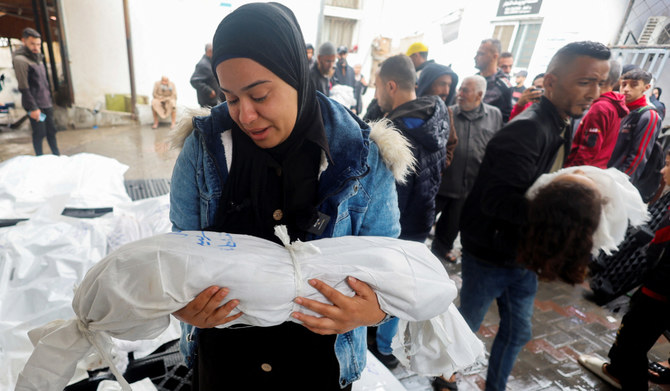
A mourner reacts holding the body of a Palestinian child killed in an Israeli strike, amid the ongoing conflict between Israel and the Palestinian Islamist group Hamas, at Abu Yousef al-Najjar hospital in Rafah, in the southern Gaza Strip, May 6, 2024. (REUTERS)
2 / 3
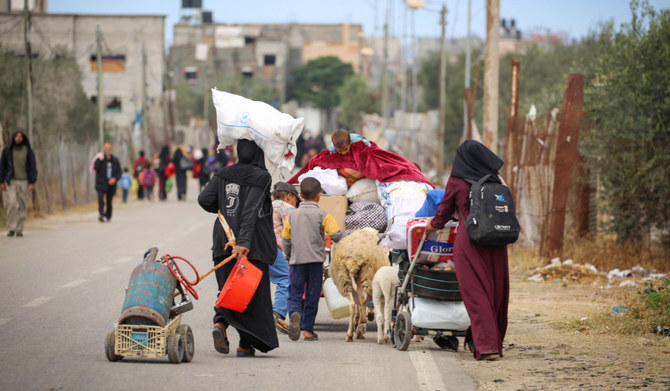
Displaced Palestinians in Rafah in the southern Gaza Strip carry their belongings as they leave following an evacuation order by the Israeli army on May 6, 2024, amid the ongoing conflict between Israel and the Palestinian Hamas movement. (AFP)
3 / 3
People flee the eastern parts of Rafah after the Israeli military began evacuating Palestinian civilians ahead of a threatened assault on the southern Gazan city, amid the ongoing conflict between Israel and Hamas, in Rafah, in the southern Gaza Strip May 6, 2024. (REUTERS)
Short Url
Updated 06 May 2024
Follow

UNICEF warns 600,000 children face ‘catastrophe’ in Rafah

  • Calling again for a ceasefire and safe access for humanitarian organizations, the agency highlighted there are some 78,000 infants under age two sheltering in the city, along with 175,000 children under five who are affected by infectious disease
  • Israel has killed more than 34,000 Palestinians in Gaza, mostly women and children, according to the health ministry in the Hamas-run territory

NEW YORK: Some 600,000 children packed into Gaza’s Rafah city face “further catastrophe,” UNICEF warned on Monday, urging against their forced relocation after Israel ordered an evacuation ahead of its long-threatened ground invasion.
“Given the high concentration of children in Rafah ... UNICEF is warning of a further catastrophe for children, with military operations resulting in very high civilian casualties and the few remaining basic services and infrastructure they need to survive being totally destroyed,” the UN children’s agency said in a statement.
It said Gaza’s youth were already “on the edge of survival,” with many in Rafah — where the agency said the population has soared to 1.2 million people, half of them children — already displaced multiple times and with nowhere else to go.
“More than 200 days of war have taken an unimaginable toll on the lives of children,” said UNICEF Executive Director Catherine Russell.
“Rafah is now a city of children, who have nowhere safe to go in Gaza,” she said, warning that a large-scale military operation by Israel would bring “chaos and panic, and at a time where (children’s) physical and mental states are already weakened.”
UNICEF estimates that Rafah’s population has swelled to nearly five times its normal figure of 250,000 residents.
Calling again for a ceasefire and safe access for humanitarian organizations, the agency highlighted there are some 78,000 infants under age two sheltering in the city, along with 175,000 children under five who are affected by infectious disease.
Gaza’s bloodiest-ever war began following Hamas’s unprecedented Oct. 7 attack on Israel.
Israel has conducted a retaliatory offensive that has killed at least 34,735 people in Gaza, according to the Hamas-run
territory’s Health Ministry.
Of that toll, more than 14,000 are children, the ministry has said.
Israeli Prime Minister Benjamin Netanyahu has vowed to send ground troops into Rafah regardless of any truce, despite concerns from the US, other countries, and aid groups.
Hamas official Izzat Al-Rashiq said in a statement that any Israeli operation in Rafah would put the truce talks in jeopardy.
Senior Hamas official Sami Abu Zuhri said the evacuation order was a “dangerous escalation” that would have consequences.
“The US administration, alongside the occupation, bears responsibility for this terrorism,” the official said.
Hamas said later in a statement that any offensive in Rafah would not be a “picnic” for Israeli forces and said it was fully prepared to defend Palestinians there.
Aid agencies have warned that the evacuation order will lead to an even worse humanitarian disaster in the crowded coastal enclave of 2.3 million people reeling from seven months of war.
“Forcing 1 million displaced Palestinians from Rafah to evacuate without a safe destination is not only unlawful but would lead to catastrophic consequences,” British charity ActionAid said.
Nick Maynard, a British surgeon trying to leave Gaza on Monday, said in a voice message from the Gaza side of the Rafah crossing into Egypt: “Two huge bombs have just gone off immediately outside the crossing. There’s a lot of gunfire as well about 100 meters from us. We are very unclear whether we will get out.”
“Driving through Rafah, the tension was palpable with people evacuating as rapidly as they could.”
Witnesses said the areas in and around Rafah where Israel wants to move people are already crowded with little room for more tents.
“The biggest genocide, the biggest catastrophe, will take place in Rafah. I call on the whole Arab world to interfere for a ceasefire — let them interfere and save us from what we are in,” said Aminah Adwan, a displaced Palestinian.
Israel has been threatening to launch incursions in Rafah, which it says harbors thousands of Hamas fighters and potentially dozens of hostages.
Victory is impossible without taking Rafah, it says.


Trump insists he struck Iran on his own terms

Updated 04 March 2026
Follow

Trump insists he struck Iran on his own terms

  • “We are now a nation divided between those who want to fight wars for Israel and those who just want peace and to be able to afford their bills and health insurance,” Marjorie Taylor Greene posted on X.
  • Rubio himself doubled down on Tuesday after meeting with US House and Senate members, while insisting that “No, I told you this had to happen anyway”

WASHINGTON, United States: President Donald Trump and his team scrambled Tuesday to reclaim the narrative on why he decided to attack Iran, after his top diplomat suggested the US struck only after learning of an imminent Israeli strike.
Secretary of State Marco Rubio alarmed Democrats — who say only Congress can declare war — as well as many of Trump’s MAGA supporters on Monday when he said: “We knew that there was going to be an Israeli action.”
“We knew that that would precipitate an attack against American forces, and we knew that if we didn’t pre-emptively go after them before they launched those attacks, we would suffer higher casualties,” Rubio told reporters.
Administration officials quickly backpedalled, insisting Trump authorized the strikes because Tehran was not seriously negotiating an accord on limiting its nuclear ambitions, and the United States needed to destroy Iran’s missile capabilities.
“No, Marco Rubio Didn’t Claim That Israel Dragged Trump into War with Iran,” White House Press Secretary Karoline Leavitt posted Tuesday on X.
At an Oval Office meeting later with Germany’s chancellor, Trump went further, saying that “Based on the way the negotiation was going, I think they (Iran) were going to attack first. And I didn’t want that to happen.”
“So, if anything, I might have forced Israel’s hand.”

- Had to happen? -

Rubio himself doubled down on Tuesday after meeting with US House and Senate members, while insisting that “No, I told you this had to happen anyway.”
“The president made a decision. The decision he made was that Iran was not going to be allowed to hide... behind this ability to conduct an attack.”
Critics seized on the muddied messaging to accuse Trump of precipitating the country into a war without a clear rationale, without informing Congress — and without a clear idea of how it might end.
They noted that just two weeks ago, Israel Prime Minister Benjamin Netanyahu pressed Trump again in Washington to take a hard line, in their seventh meeting since Trump’s return to power last year.
Some Republican allies rallied behind the president, with Senator Tom Cotton, chairman of the Senate Intelligence Committee, insisting that “No one pushes or drags Donald Trump anywhere.”
“He acts in the vital national security interest of the United States,” Cotton told the “Fox & Friends” morning show.
But as crucial US midterm elections approach that could see Republicans lose their congressional majority, Trump risks shedding supporters who had welcomed his pledge to end foreign military interventions.
“We are now a nation divided between those who want to fight wars for Israel and those who just want peace and to be able to afford their bills and health insurance,” Marjorie Taylor Greene, a top former Trump ally and a major figure in the populist and isolationist hard right, posted on X.