

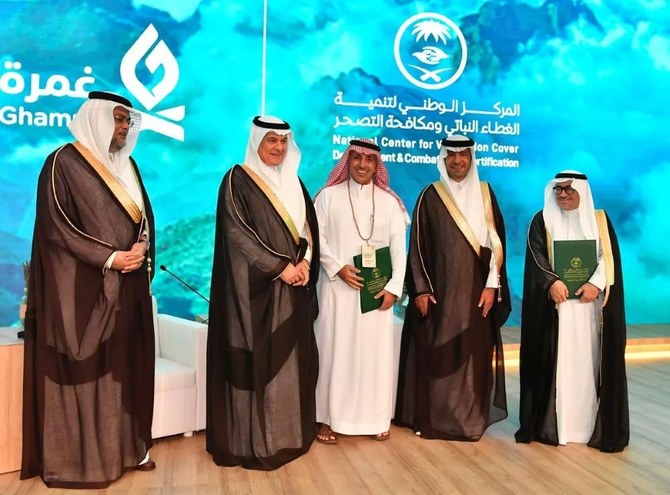
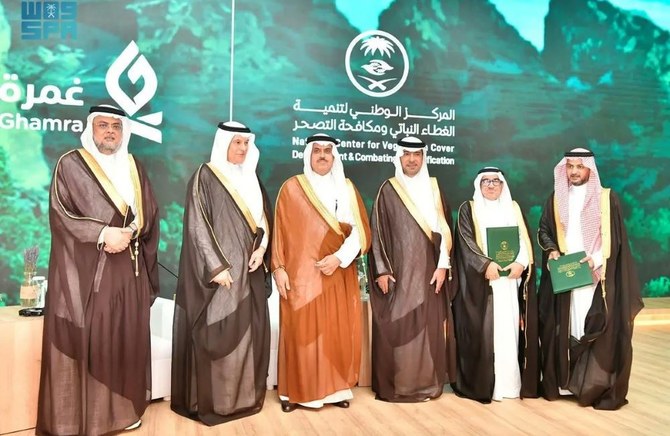
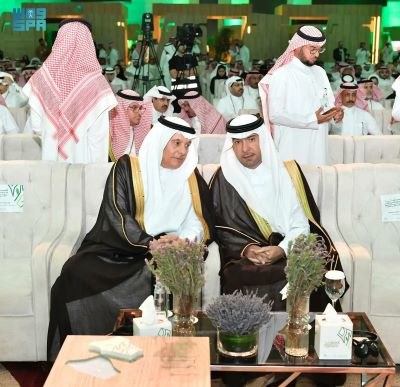

RIYADH: As countries around the world push to invest in nature-based solutions to environmental problems, experts in Saudi Arabia came together in Riyadh to discuss the most pressing issues at the inaugural National Greening Forum.
Launched under the patronage of Minister of Environment, Water and Agriculture Abdulrahman Al-Fadhli, the forum was organized by the National Center for Vegetation Cover Development and Combating Desertification and attended by Minister of Municipal, Rural Affairs and Housing Majed Al-Hogail, several other ministers, organisations and specialists from local, regional and international sectors related to the environment.
CEO of the center, Khalid Al-Abdulqader, said in his opening speech that the forum will “unify and consolidate national efforts to enhance vegetation cover and mitigate land degradation.”
Addressing the restoration of green spaces in the Kingdom, he said: “We are committed to restoring natural green spaces using sustainable irrigation methods, planting local tree species, and ensuring their protection and monitoring through advanced technologies.”
In a panel discussion titled “Nature-Based Solutions: Key to Transformation,” industry specialists and experts discussed various issues related to promoting the natural growth of trees and their environmental effect, as well as the industries tied to environmental issues and ways their institutions work to find sustainable solutions for the future.
“Vegetation and afforestation are part of nature, which includes the atmosphere, soil, and organisms. The correlation between all of these is the main element for these solutions. So, organizing and monitoring this relationship is key for sustainability and greening,” said Dr. Ahmed Al-Farhan, board member of the center and a faculty member at King Saud University.
For ages, large plumes of dust and sand sweeping across most of Saudi Arabia were a natural, seasonal occurrence, but this year there has been an unusual and noticeable decrease in sandstorms.
Jamaan Al-Qahtani, executive director of the Regional Center for Dust and Sandstorms, explained: “Sandstorms need two factors to occur: dry, load-bearing soil and winds fast enough to carry it.” A few years ago, he said, there were indications that the Kingdom was experiencing fewer sandstorms.
“This April was a 60 percent drop on the average of the past 20 years. March was 30 percent, and January was more than 60 percent. Last year, Riyadh had a record of only one sandstorm.”
Explaining the reason behind this, he said: “We attribute that firstly to rainfall and the timing of that rainfall. When rain falls during the best time for vegetation, that helps with stabilizing the soil.”
The environmental system also plays a pivotal role in preventing degradation, as well as laws that restrain individuals and other entities from tampering with the environment.
Sand and dust storms affect 11 of the UN’s 17 sustainable development goals. For example, 7 million people in total die from all sources of air pollution and degraded air quality. The Middle East and North Africa region loses $150 billion annually due to weather and climate disasters, Al-Qahtani said.
To meet the growing demand for fresh water in Saudi Arabia, authorities launched a project in 2022 that alters the structure of clouds to increase rainfall; a technique known as cloud seeding.
Ayman Al-Bar, executive director of the Regional Cloud Seeding Program, said “environmental phenomena have become much more severe and common than before.” He went on to say that one of the initiatives under the Middle East Green Initiative, the cloud seeding program, targets an increase in rainfall of between 10% and 20%.
The various initiatives under the program work to intensify vegetation cover, combat desertification, localize technology, and transfer knowledge, he said. In the fifth stage, which covers Riyadh, Hail, and southern parts such as Abha, Taif, and Asir, 1,530 flight hours were spent on precipitation efforts and 110 hours on research. “Preliminary reports indicate that precipitation exceeds 4 billion cubic meters of rainfall in the targeted area,” Al-Bar said.
Dr. Talal Al-Harigi, CEO of Imam Abdulaziz Royal Nature Reserve, said: “When it comes to carbon sequestration, which is capturing carbon through natural solutions, trees naturally grow by taking in carbon dioxide. When some soil patches deteriorate, we’ve undergone processes for soil rehabilitation and preparing them to receive rain either from rainfall or other sources.”
Nature reserves are a prime example of nature-based solutions, Al-Harigi said. Within the Imam Abdulaziz Royal Nature Reserve, the King Khalid Royal Reserve, and others, authorities found that vegetation cover was refreshed and that there was greater soil stability, as well as improved soil fertility.
Ultimately, most industries are affected by environmental deterioration and climate change, and while natural disasters are expected to increase and worsen, Saudi Arabia has taken a leading role in creating sustainable solutions for generations to come.
The forum highlighted the role of public, private and nonprofit sectors in achieving the Saudi Green Initiative target of planting 10 billion trees and providing a platform to participating organisations to engage and exchange knowledge.


