

Pakistani journalists condemn Israel’s decision to ban Al Jazeera, demand ‘earliest restoration’

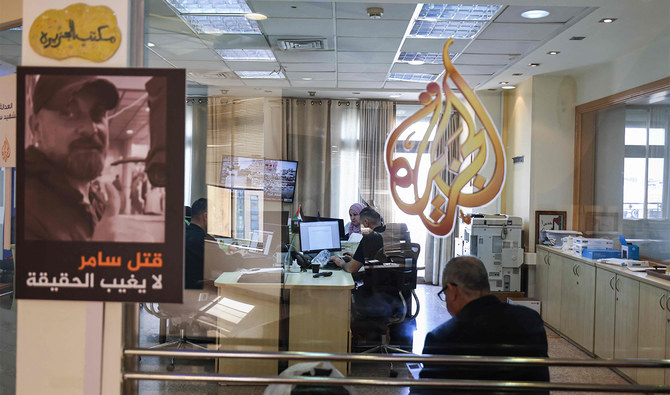
A picture shows a view of the Al Jazeera television network offices in Ramallah in the occupied West Bank on May 5, 2024. (AP)
Short Url
Updated 06 May 2024
Follow

Pakistani journalists condemn Israel’s decision to ban Al Jazeera, demand ‘earliest restoration’

  • PM Netanyahu’s cabinet shut down network for as long as Gaza war continues, saying it threatened national security
  • Pakistan Federal Union of Journalists credits Al Jazeera for reporting “independently” on Israel’s war in Gaza

KARACHI: Pakistan’s most prominent association of journalists strongly condemned Israel’s move to ban international news organization Al Jazeera on Sunday, describing it as a “brutal curb on press freedom,” urging journalist bodies around the world to raise their voices for the Qatar-based network. 

The statement comes after Israeli Prime Minister Benjamin Netanyahu’s cabinet voted unanimously to close Al Jazeera’s operations in Israel. The decision came weeks after Israel’s parliament passed a law allowing the temporary closure of foreign broadcasters considered to be a threat to its national security as the months-long war in Gaza drags on.

Later on Sunday, Israeli police raided Al Jazeera’s premises in East Jerusalem while satellite and cable providers took the broadcaster off air. 

“Workers strongly condemn the Israeli decision of banning telecast of Al Jazeera TV and demand its earliest restoration,” the Pakistan Federal Union of Journalists (PFUJ) said in a press release. “The PFUJ-Workers terms the decision a brutal curb on press freedom and demand that Israeli govt should give right to every media organization to work freely.”

PFUJ credited Al Jazeera for reporting “independently” on Israel’s war in Gaza, calling on journalist bodies around the world to raise their voices for freedom of media and support the Doha-based news channel. 

 “If we do not discharge our duty of raising voice for Al Jazeera the other will use the practice to silent voices in their regions,” the statement concluded. 

Al Jazeera criticized Israel’s decision to ban its broadcast in a report, saying that it is one of the few international media outlets to remain in Gaza throughout the war, broadcasting “bloody scenes of air attacks and overcrowded hospitals, and accusing Israel of massacres.”

“The Network vehemently rejects the allegations presented by Israeli authorities suggesting professional media standards have been violated,” Al Jazeera said in a statement. “It reaffirms its unwavering commitment to the values embodied by its Code of Ethics.”

Israel’s move can heighten the Jewish state’s tensions with Qatar, which funds Al Jazeera, especially at a time when the Gulf country is playing a key role in mediating efforts to stop the war in Gaza. 

Tim Dawson, the deputy general secretary of the International Federation of Journalists, told Al Jazeera Israel’s decision was a “retrograde and ridiculous decision.”

“Closing down media, closing down television stations is a sort of thing that despots do,” he said. 


IMF board to meet tomorrow to consider $1.2 billion disbursement for Pakistan

Updated 11 sec ago
Follow

IMF board to meet tomorrow to consider $1.2 billion disbursement for Pakistan

  • Pakistan, IMF reached a Staff-Level Agreement for second review of $7 billion loan program 
  • Economists view disbursement crucial for cash-strapped Pakistan as it tackles economic crisis

ISLAMABAD: The International Monetary Fund’s (IMF) Executive Board will meet tomorrow, Monday, to consider and approve a $1.2 billion disbursement for Pakistan, according to the global lender’s official schedule. 

The meeting takes place nearly two months after the Fund reached a Staff-Level Agreement (SLA) with Pakistan for the second review of its $7 billion Extended Fund Facility (EFF) and the first review of its $1.4 billion Resilience and Sustainability Facility (RSF). 

The SLA followed a mission led by IMF’s Iva Petrova, who held discussions with Pakistani authorities during a Sept. 24–Oct. 8 visit to Karachi, Islamabad and Washington, DC.

“The International Monetary Fund’s (IMF) Executive Board will convene on Dec. 8 to consider Pakistan’s request for a $1.2 billion disbursement under the Extended Fund Facility (EFF) and the Resilience and Sustainability Facility (RSF), according to the Fund’s updated schedule,” the state-run Pakistan TV reported on Sunday.

Economists view IMF’s bailout packages as crucial for cash-strapped Pakistan, which has relied heavily on financing from bilateral partners such as Saudi Arabia, China and the United Arab Emirates, as well as multilateral lenders including the IMF, World Bank, Asian Development Bank and Islamic Development Bank. 

The South Asian country has been grappling with a prolonged macroeconomic crisis that has drained its financial resources and triggered a balance of payments crisis. Islamabad, however, has recorded some financial gains since 2022, which include recording a surplus in its current account and bringing inflation down considerably. 

Speaking to Arab News last month, Pakistan’s former finance adviser Khaqan Najeeb said the $1.2 billion disbursement will further stabilize Pakistan’s near-term external position and unlock additional official inflows. 

“Continued engagement also reinforces macro stability, as reflected in recent improvements in inflation, the current account, and reserve buffers,” Najeeb said. 

Pakistan came close to sovereign default in mid-2023, when foreign exchange reserves fell below three weeks of import cover, inflation surged to a record 38 percent in May, and the country struggled to secure external financing after delays in its IMF program. Fuel shortages, import restrictions, and a rapidly depreciating rupee added to the pressure, while ratings agencies downgraded Pakistan’s debt and warned of heightened default risk.

The crisis eased only after Pakistan reached a last-minute Stand-By Arrangement with the IMF in June 2023, unlocking emergency support and preventing an immediate default.