Exiled Russian historian rallies fellow emigrants in dark times

1 / 2
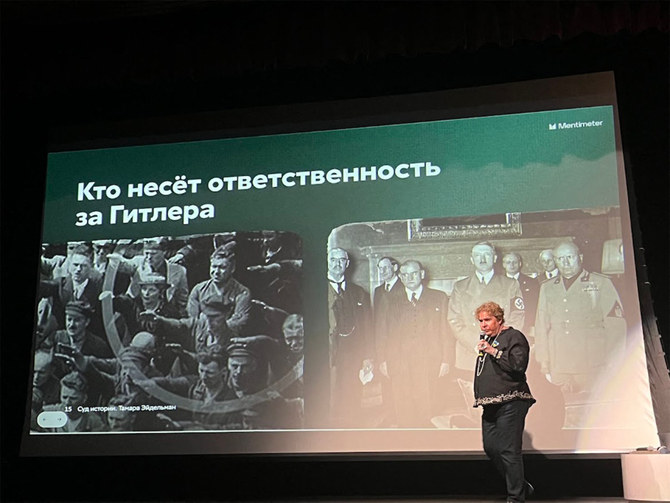
Exiled Russian historian Tamara Eidelman delivers a lecture titled “The Judgment of History” at the Bender JCC of Greater Washington community center in Rockville, Maryland, on April 25, 2024. (AFP)
2 / 2
Exiled Russian historian Tamara Eidelman delivers a lecture titled “The Judgment of History” at the Bender JCC of Greater Washington community center in Rockville, Maryland, on April 25, 2024. (AFP)
Short Url
Updated 06 May 2024
Follow

Exiled Russian historian rallies fellow emigrants in dark times

  • Tamara Eidelman is part of a group of exiled anti-war Russian public intellectuals and cultural figures who are rebuilding their careers abroad
  • More than 800,000 Russians are estimated to have left the country in just the past two years after Russia invaded Ukraine

WASHINGTON: Russian dissident historian Tamara Eidelman was on vacation in Greece when Moscow’s tanks rolled into Ukraine in February 2022 and she realized that she would not be going back to her home country.

With her single suitcase, Eidelman, 65, flew to Portugal, where her daughter had been living, and began a new life in exile.
“I am operating under the assumption that I will not return. I am building my life in Portugal,” Eidelman, who has over 1.6 million followers on her history channel on YouTube, told AFP. “I want to come back... but if I sit every day thinking ‘When will it finally happen?’ I will go mad.”
Eidelman, who was declared a “foreign agent” by the government in Moscow, is part of a group of exiled anti-war Russian public intellectuals and cultural figures who are rebuilding their careers abroad.
While they cater to a large diaspora — more than 800,000 Russians are estimated to have left the country in just the past two years — unlike the previous waves of emigration from Russia’s calamities, they are able to continue speaking to those who stayed via social media, despite growing government restrictions.
“I think it’s one of the advantages of today’s emigration, if there can be any advantages, that our ties with our homeland have not been ruptured so drastically,” Eidelman, who wore a pin in the colors of the Ukrainian flag on her black blouse, said before a lecture in a community center outside Washington.
“Today there is an opportunity to exchange ideas. And, despite all the bans, inside Russia you can still access what is being done by those who emigrated. It is extremely valuable, it must be used and cherished.”


Tamara Eidelman, who was declared a “foreign agent” by the Russian government, is part of a group of exiled anti-war Russian public intellectuals and cultural figures who are rebuilding their careers abroad. (AFP)

While exiles are unlikely to have a significant impact on political life inside Russia, “they can be the keepers of ideas, the centers of expertise and civic education,” according to Alexander Morozov, a political analyst and lecturer at Charles University in Prague.
When political change occurs, “Those who have retained trust and their symbolic capital can play a role in Russia’s renewal,” he wrote in a recent paper.

During her first few months in Portugal, Eidelman, who worked as a history teacher at a prestigious Moscow school for more than 30 years before becoming an editor, blogger and public speaker, kept herself busy looking for a place to live, reassembling her YouTube team and signing up for Portuguese lessons.
But she would catch herself thinking she was there on a brief visit and that she needed to buy a bottle of Port wine to bring back to Moscow to her mother and friends. Then it hit her.
“I felt a tremendous weight pressing on me when things had settled down a little and I realized that I am going to be in this wonderful, beautiful country for a long time,” she said. “Of course, (President Vladimir Putin’s) regime will collapse, but I don’t know if I will be around to see it.”
Since the start of Russia’s full-scale invasion, Eidelman’s YouTube channel has ballooned from some 500,000 followers to 1.63 million and a team of 30 people, with lectures on Russian, Ukrainian and world history — as well as a special presentation on Putin’s assault on democracy, which she delivered in a T-shirt that read “No Putin No War.”
“I want to express my unconditional support for Ukraine in this war and I believe that all its territories, including Crimea, must be returned to it,” Eidelman told AFP, referring to the Black Sea peninsula that Russia annexed in 2014.
During her lecture in an auditorium of several hundred Russian speakers titled “The Judgment of History,” Eidelman examined the painful questions of countries’ and societies’ culpability and responsibility for crimes from ancient Greece to Nazi Germany — with the clear undertone of Russia’s war in Ukraine.
Prosecuting those who committed direct crimes against Ukraine will not be enough, Eidelman suggested in her interview with AFP.
“I believe that there cannot be collective responsibility, that a whole people cannot be guilty,” she told AFP. “But at the same time, there must be... moral responsibility, responsibility before one’s conscience.”
Alina, a 39-year-old Russia-born quality control manager drove more than eight hours to Washington from the southern US state of Tennessee with her husband and two children to hear Eidelman speak.
To Alina, Russia’s invasion of Ukraine is “a crime against a neighboring country, but it’s also a crime against my own country because crimes are being committed in the name of people like me, who don’t agree with it.”
In these tragic times, Eidelman’s talk was a breath of fresh air, Alina said.
“When I listen to her lectures, I believe that there is — if not hope, then at least some light ahead for you to follow,” she said. “You get the feeling that you are not alone in all of this, even though physically you live apart from everyone.”
md/bgs/caw


Ahead of strikes, Trump was told Iran attack is high risk, high reward

Updated 6 sec ago
Follow

Ahead of strikes, Trump was told Iran attack is high risk, high reward

  • Experts caution that the unfolding conflict could take dangerous turns and the first official said ‌the Pentagon’s planning did not appear to guarantee the outcome of any conflict

WASHINGTON: Ahead of the US attack on Iran, President Donald Trump received briefings that not only delivered blunt assessments about the risk of major US casualties but also touted the prospect of a geopolitical shift in the Middle East in favor of US interests, ​a US official told Reuters. The launch of what the Pentagon called Operation Epic Fury on Saturday plunged the Middle East into a new and unpredictable conflict. The US and Israeli militaries struck sites across Iran, triggering retaliatory Iranian attacks against Israel and nearby Gulf Arab countries.
The official, who spoke on condition of anonymity, said the briefers described the operation to the president as a high-risk, high-reward scenario that could present a once-in-a-generation opportunity for change in the region.

HIGHLIGHTS

• Trump briefings included risks, opportunities in Middle East 

• Diplomatic efforts with Iran fail to avert ‌military confrontation 

• Iran vows retaliation, targets US and Israeli interests

Trump himself appeared to echo that sentiment when he acknowledged the stakes at the onset of the operation, saying “the lives of courageous American heroes may be lost.”
“But we’re doing this not for now, we’re doing this for the future, and it is a noble mission,” Trump said in a video address announcing the start of major combat operations.
“For 47 years, the Iranian regime has chanted death to America and waged an unending campaign of ‌bloodshed and mass murder ... We’re ‌not gonna put up with it any longer.”
The briefings from Trump’s national security team help explain ​how ‌the ⁠president decided ​to ⁠pursue arguably the riskiest US military operation since the invasion of Iraq in 2003.
Ahead of the strikes, Trump received multiple briefings from officials, including CIA Director John Ratcliffe, US General Dan Caine, the chairman of the Joint Chiefs of Staff, US Secretary of State Marco Rubio and Defense Secretary Pete Hegseth.
On Thursday, Admiral Brad Cooper, who leads US forces in the Middle East as the head of Central Command, flew to Washington to join discussions in the White House Situation Room.
A second US official said that before the strikes, the White House had been briefed on risks associated with operations against Iran, including retaliatory strikes on multiple US bases in the region by Iranian missiles that could overwhelm defenses, as well as Iranian proxies attacking US troops in Iraq and Syria.
The official said that despite the massive military ⁠buildup by the United States, there were limits to the air defense systems that had been rushed into ‌the region.
Experts caution that the unfolding conflict could take dangerous turns and the first official said ‌the Pentagon’s planning did not appear to guarantee the outcome of any conflict.
Trump called on Iranians ​to topple the government but that is easier said than done, said ‌Nicole Grajewski with the Carnegie Endowment for International Peace.
“The Iranian opposition is pretty fragmented. It’s unclear what the population is willing to do in ‌terms of rising up,” Grajewski said.
Both US officials requested anonymity due to the sensitivity of the internal discussions.
The White House did not immediately respond to requests for comment. The Pentagon declined to comment.

TRUMP’S SWEEPING GOALS

In the weeks leading up to the attack, Trump ordered a major military buildup in the Middle East. Reuters reported military planning to carry out a sustained campaign against Iran, if that is what the president chose. Plans included targeting individual officials, officials said.
An Israeli official said Iran’s Supreme Leader Ayatollah ‌Ali Khamenei and President Masoud Pezeshkian were both targeted but the result of the strikes was unclear. Speaking on Saturday, Israeli Prime Minister Benjamin Netanyahu said there were many signs indicating that Khamenei “is no longer” and ⁠called on Iranians to “take to the streets ⁠to finish the job.”
Trump made clear on Saturday that his objectives in Iran were sweeping, saying he would end the threat posed by Tehran to the United States and give Iranians a chance to topple their rulers. To accomplish this, he outlined plans to lay waste to much of Iran’s military as well as deny it the ability to build a nuclear weapon. Iran denies seeking a nuclear weapon.
“We are going to destroy their missiles and raze their missile industry to the ground... We’re going to annihilate their navy,” he said. “We’re going to ensure that the region’s terrorist proxies can no longer destabilize the region or the world and attack our forces.”
Trump’s decision demonstrates an increasing risk appetite, far greater than when he ordered US special operations forces into Venezuela last month to seize that country’s president in an audacious raid.
The unfolding campaign against Iran is also riskier than when Trump ordered US forces to bomb Iran’s nuclear sites in June.
Iran’s Revolutionary Guards threatened all US bases and interests in the region and said Iran’s retaliation would continue until “the enemy is decisively defeated.”
Experts warn that Iran has many options for retaliation, including missile strikes but also drones and cyber warfare.
Daniel Shapiro, a former senior ​Pentagon official for Middle East issues, said that despite the US ​and Israeli strikes, Tehran would still be capable of causing some pain.
“Iran has many more ballistic missiles that can reach US bases than the US has interceptors ... some Iranian weapons will get through,” said Shapiro, also a former US ambassador to Israel. “(The strikes are) a major gamble.”