

High-level Saudi business delegation arrives in Pakistan to explore investment opportunities

Pakistani federal ministers, Jam Kamal (left) and Musadiq Malik (not pictured), receive a high-level Saudi business delegation, headed by Assistant Minister of Investment Ibrahim Al-Mubarak (second, left), at Noor Khan Airbase in Rawalpindi on May 5, 2024. (Photo courtesy: Pakistan’s commerce ministry)
Short Url
Updated 05 May 2024
Follow

High-level Saudi business delegation arrives in Pakistan to explore investment opportunities

  • Saudi assistant investment minister, representatives of 30 Saudi companies are part of the delegation
  • Saudi Arabia recently reaffirmed its commitment to expedite investment for Pakistan worth $5 billion

ISLAMABAD: A high-level Saudi business delegation, led by the Kingdom’s Assistant Minister of Investment Ibrahim Al-Mubarak, arrived in Pakistan on Sunday to explore investment opportunities in various economic sectors, the Pakistani commerce ministry said.
Pakistan’s Commerce Minister Jam Kamal Khan and Petroleum Minister Musadik Malik received the 50-member Saudi delegation at the Nur Khan air base in the garrison city of Rawalpindi.
The three-day visit of the delegation is aimed at promoting trade relations between investors of the two countries with regard to various business opportunities in Pakistan, according to Khan.
The Pakistani commerce ministry has selected a large number of Pakistani companies in relevant sectors for business-to-business (B2B) meetings with their Saudi counterparts.
“Top Pakistani companies will tie up with 30 Saudi companies in various sectors,” the Pakistani commerce ministry quoted him as saying. “Business-to-business (B2B) meetings will focus on sectors such as agriculture, mining, human resources, energy, chemicals and maritime.”
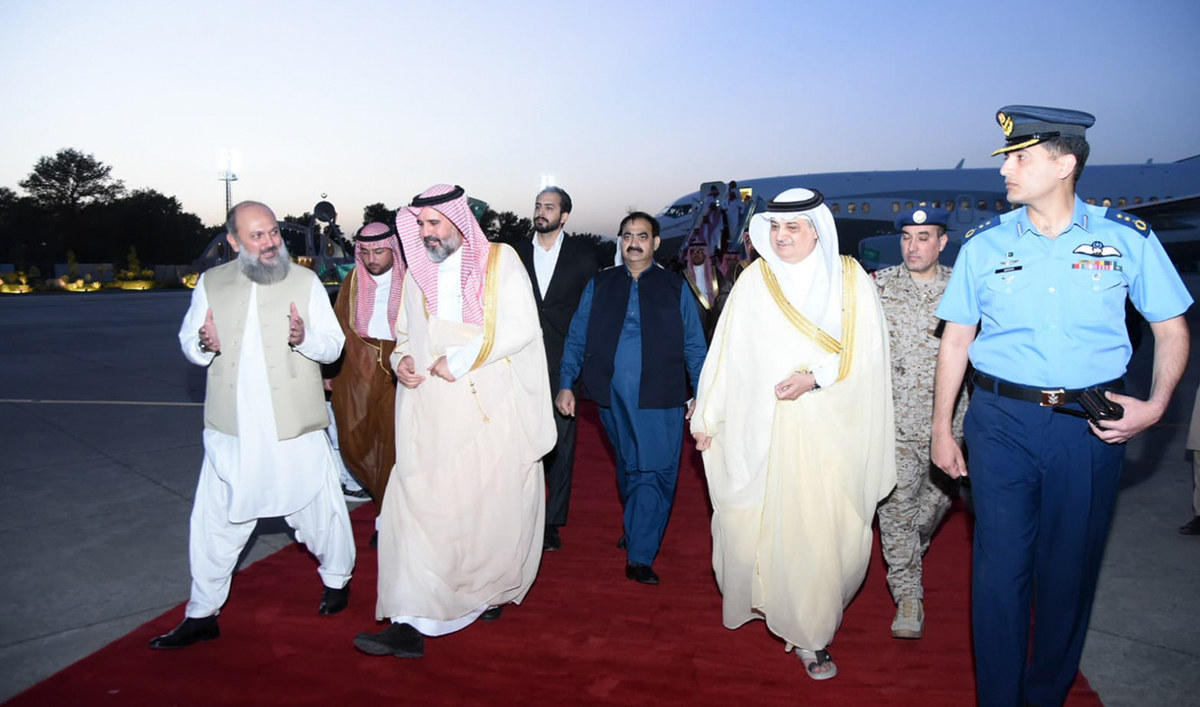


Pakistani minister Jam Kamal (left) speaks with Saudi Assistant Investment Minister Ibrahim Al-Mubarak (second, left) as a high-level Saudi business delegation arrives at Noor Khan Airbase in Rawalpindi on May 5, 2024. (Photo courtesy: Pakistan’s commerce ministry)

The two sides will also discuss opportunities in information technology (IT), religious tourism, telecommunication, aviation, construction, water and power sectors.
“Both Saudi and Pakistani companies and investors will look for investment opportunities, which will be aimed at creating jobs and promoting export opportunities in both countries,” the minister said.
Khan hoped that a number of firms would be able to make business and investment deals at B2B engagements during the visit.
Pakistan and Saudi Arabia enjoy strong ties rooted in shared culture, religion and economic cooperation, and have witnessed a flurry of official visits in recent weeks.
Saudi Arabia’s Foreign Minister Prince Faisal bin Farhan traveled to Islamabad in April before Prime Minister Shehbaz Sharif’s two-day visit to the Kingdom to attend a World Economic Forum meeting where he met top Saudi officials.
Speaking to media on Saturday, Pakistani Petroleum Minister Musadik Malik, who is also the focal person for Saudi-Pak bilateral collaboration, said Pakistan had always cherished cordial ties with the Kingdom, though it had not managed to turn this “relationship of friendship into a relationship of stability and progress.”

He said Pakistan mostly discussed its financial concerns with the Saudi authorities and requested their support, however, the present government wanted to change that by focusing its bilateral conversations on mutually beneficial progress and development, not aid and assistance.
Both Pakistan and Saudi Arabia have lately been working to increase bilateral trade and investment deals, and the Kingdom recently reaffirmed its commitment to expedite an investment package worth $5 billion.
Malik said the bilateral collaboration would primarily benefit small businesses, particularly the technology companies established by young students, who were likely to get a significant amount of investment from Saudi entrepreneurs.


Pakistan, ADB reaffirm commitment to ML-1 rail project amid economic reforms

Updated 6 sec ago
Follow

Pakistan, ADB reaffirm commitment to ML-1 rail project amid economic reforms

  • Flagship railway upgrade tied to IMF-backed stabilization, multilateral financing
  • ADB, World Bank working with Pakistan to address project delays, readiness gaps

ISLAMABAD: Pakistan and the Asian Development Bank (ADB) have reaffirmed their commitment to advancing the long-delayed Main Line-1 (ML-1) railway modernization project, a flagship infrastructure upgrade central to the country’s economic reform and connectivity agenda, the information ministry said on Thursday. 

The renewed focus on ML-1 follows meetings this week between senior Pakistani ministers and ADB officials in Islamabad, as the government seeks to revive large-scale infrastructure investment while maintaining fiscal discipline under an International Monetary Fund (IMF) program.

ML-1 is Pakistan Railways’ busiest north–south corridor, linking the southern port city of Karachi with major population and industrial centers in Punjab and Khyber Pakhtunkhwa. The project aims to modernize tracks, signaling and rolling stock to improve safety, cut travel times and lower transport costs. 

Originally envisioned as a flagship transport upgrade under the China-Pakistan Economic Corridor (CPEC), ML-1 has struggled to reach financial close amid cost concerns, debt sustainability debates and implementation challenges. Pakistan has since sought broader multilateral engagement, with institutions including the Asian Development Bank now playing a central role in project structuring, financing discussions and efforts to address execution bottlenecks.

During a meeting with Leah Gutierrez, Director General for Central and West Asia at the ADB, Federal Minister for Economic Affairs Ahad Cheema underscored the government’s reform priorities and the importance of the project’s timely execution.

“The Minister underscored the Government’s strong commitment to the timely implementation of the Main Line–1 (ML-1) railways project and emphasized that ADB’s continued support would be critical to achieving this milestone,” the information ministry said in a statement.

The ministry said Cheema also highlighted coordination with provincial governments and welcomed joint efforts by the ADB and the World Bank to identify implementation bottlenecks and improve project readiness to ensure timely disbursements.

Gutierrez commended Pakistan’s reform agenda and acknowledged the government’s focus on macroeconomic recovery and fiscal consolidation, reaffirming that ADB teams were working closely with Pakistani authorities on ML-1, according to the statement.

Separately, Federal Minister for Railways Muhammad Hanif Abbasi told Defense Secretary Lt. Gen. Muhammad Ali in a meeting that an agreement for the ML-1 project had been finalized with the ADB and that steps were being taken to move the project forward.

“Concrete steps are being taken to complete the project at the earliest,” the statement quoted Abbasi as telling Ali. “The ML-1 project will serve as a milestone in modernizing Pakistan Railways.”

Abbasi also briefed participants on parallel reform measures at Pakistan Railways, including the launch of an artificial intelligence-based monitoring system at Rawalpindi Railway Station, real-time tracking of trains and rolling stock through digital tagging, and the installation of a weigh bridge in Karachi to address overloading and improve safety.

Pakistan Railways has long struggled with aging infrastructure, safety challenges and financial losses, even as rail transport remains vital for passenger movement and freight. Multilateral lenders have repeatedly stressed the need for stronger execution capacity and governance reforms to translate infrastructure commitments into economic gains.