

Indonesia to permanently relocate 10,000 people after Ruang volcano eruptions

1 / 3
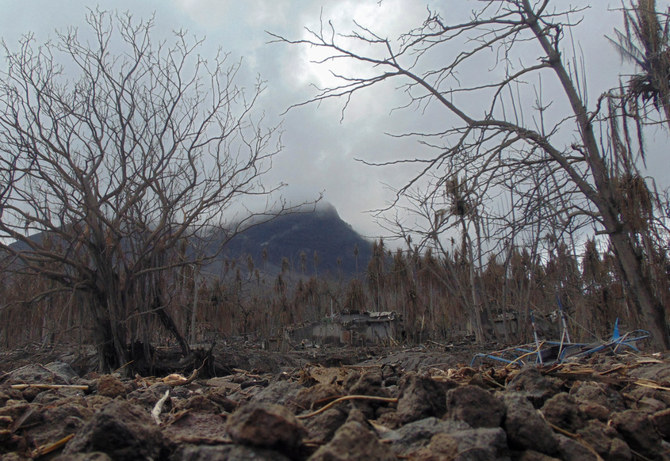
People wait to be evacuated at the port on Tagulandang Island in Sitaro, North Sulawesi, on May 2, 2024, as Mount Ruang volcano spews smoke in the background. (AFP)
2 / 3
Mount Ruang volcano spews volcanic ash as seen from Laingpatehi village in North Sulawesi province, Indonesia, on May 3, 2024. (REUTERS)
3 / 3
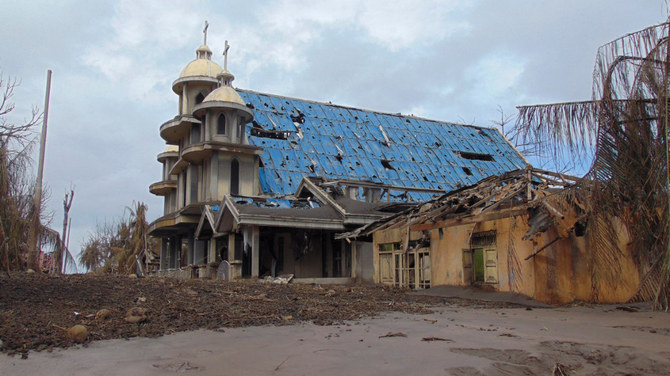
A church and house damaged following the eruption of Mount Ruang volcano are seen in Laingpatehi village, in Indonesia's North Sulawesi province, on May 3, 2024. (REUTERS)
Short Url
Updated 04 May 2024
Follow

Indonesia to permanently relocate 10,000 people after Ruang volcano eruptions

  • Authorities warned of the a possible tsunami if parts of the mountain collapse into the surrounding waters
  • Indonesia straddles the “Pacific Ring of Fire,” an area of high seismic activity where multiple tectonic plates meet

JAKARTA: The Indonesian government will permanently relocate almost 10,000 residents after a series of explosive eruptions of the Ruang volcano has raised concerns about the dangers of residing on the island in future, a minister said on Friday.

About 9,800 people live on Ruang island, in the province of North Sulawesi, but in recent weeks all residents have been forced to evacuate after the mountain has continued to spew incandescent lava and columns of ash kilometers into the sky.
Authorities this week raised the alert status of the volcano to the highest level, closed the provincial airport in Manado, and also warned of the a possible tsunami if parts of the mountain collapse into the surrounding waters.
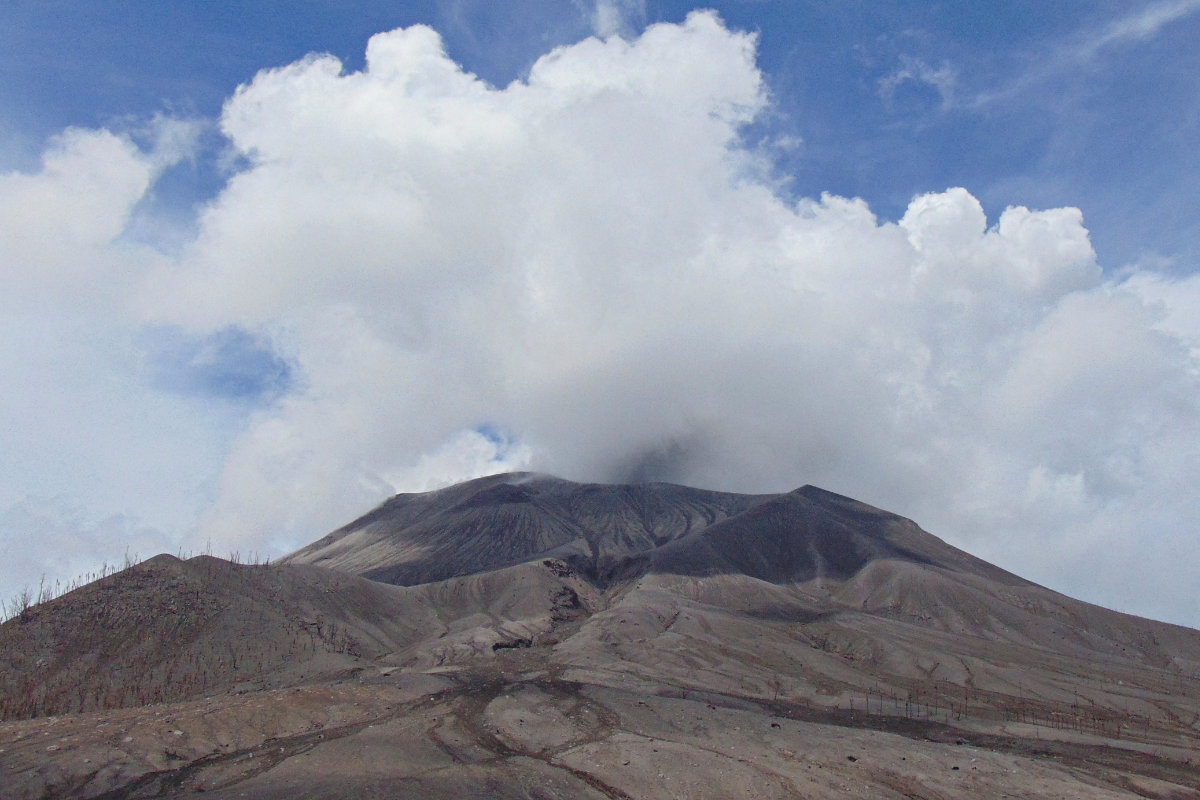


Indonesia's Mount Ruang volcano is pictured following its eruptions as seen from Laingpatehi village, Sitaro Islands Regency, North Sulawesi province, on May 3, 2024. (REUTERS)

Hundreds of “simple but permanent” homes would be built in the Bolaang Mongondow area to facilitate the relocations, said coordinating human development minister Muhadjir Effendy, after a cabinet meeting to discuss the volcano on Friday.
“As instructed by President Joko Widodo, we will build houses that meet disaster-standards,” he said, adding that the site was located about 200 km (125 miles) from Ruang island.
Mount Ruang began to dramatically erupt last month, with experts saying the eruptions were triggered by increased seismic activity, including deep sea earthquakes.
The mountain erupted again on Tuesday, causing damage to some homes and forcing residents to evacuate from the Tagulandang island, where they had initially sought refuge, to the provincial capital of Manado.
Roads and buildings on Tagulandang were blanketed in a thick layer of volcanic ash, and the roofs of some homes had collapsed, according a Reuters witness.
The volcano had not erupted on Friday but Manado’s Sam Ratulangi Airport remained closed until the evening due to the spread of volcanic ash.
Indonesia straddles the so-called “Pacific Ring of Fire,” an area of high seismic activity where multiple tectonic plates meet.


IAEA board meets over Ukraine nuclear safety concerns

Updated 30 January 2026
Follow

IAEA board meets over Ukraine nuclear safety concerns

  • The war in Ukraine “continues to pose the world’s biggest threat to nuclear safety,” Grossi said
  • The mission will assess 10 substations “crucial to nuclear safety,” according to Grossi

VIENNA: The UN nuclear watchdog’s board of governors on Friday discussed nuclear safety in Ukraine, with several countries expressing “growing concern” following Russian attacks on the power grid.
Energy supplies to Ukraine’s nuclear plants have been affected as Russia has pounded its neighbor’s power sector since the start of its 2022 invasion, prompting fears of a nuclear disaster.
The war in Ukraine “continues to pose the world’s biggest threat to nuclear safety,” Rafael Grossi, director general of the International Atomic Energy Agency (IAEA), said when opening the board meeting.
The extraordinary meeting that lasted four hours was called after 13 countries led by the Netherlands expressed in a letter seen by AFP a “growing concern about the severity and urgency of nuclear safety risks” following a series of attacks.
Ukrainian ambassador Yurii Vitrenko told reporters before the meeting that it was “high time” for the IAEA board to discuss the situation.
A weeks-long IAEA expert mission to Ukrainian substations and power plants is under way and expected to wrap up next month, Vitrenko said.
The mission will assess 10 substations “crucial to nuclear safety,” according to Grossi.
Russian Ambassador Mikhail Ulyanov dismissed the board’s gathering as “absolutely politically motivated,” adding there was “no real need to hold such a meeting today.”
Last week, Ukraine’s Chernobyl nuclear power plant temporarily lost all off-site power.
Europe’s biggest nuclear power plant, Zaporizhzhia, occupied by Russian forces since March 2022, has also been repeatedly affected by fighting.
Earlier this month, Russia and Ukraine agreed to a localized ceasefire to allow repairs on the last remaining backup power line supplying Zaporizhzhia.
The line was damaged and disconnected as a result of military activity in early January.
The Zaporizhzhia plant’s six reactors have been shut down since the occupation. But the site still needs electricity to maintain its cooling and security systems.
Moscow and Kyiv have repeatedly accused each other of risking a nuclear catastrophe by attacking the site.