MICHIGAN, USA: With student protests over the Israel-Hamas war disrupting campuses nationwide, several major universities are intent on ensuring that commencement ceremonies — joyous milestones for graduates, their families and friends — go off without a hitch this weekend.
It won’t be easy. Colleges are hiring extra security, screening attendees at venues and emphasizing that significant disruptions by pro-Palestinian protesters won’t be tolerated. At the same time, they’re pledging to honor free-speech rights by designating protest zones.
Students booed and yelled “free Palestine” while the University of Utah president spoke Thursday night at commencement. He paused his speech to ask those who were protesting to leave or be removed. Outside the ceremony in Salt Lake City, a group of about 50 people were rallying. There was one arrest.
“Milestone is a perfect word,” said Ken Burdick of Tampa, Florida, describing his daughter’s graduation Saturday at the University of Michigan. He hopes the big day goes untarnished.
“People can exercise their First Amendment rights without disrupting or creating fear,” Burdick said of protesters.
Here’s how some schools are planning to balance things:
UNIVERSITY OF MICHIGAN
More than 8,000 graduates — and 63,000 spectators — are expected for Saturday’s festivities inside Michigan Stadium, known as The Big House. There will be security screening, and disruptive protesters could be subject to removal. Public safety officers and staff who commonly monitor major events, such as fall football games, will be present. Author and historian Brad Meltzer is the featured speaker.
In March, an annual event recognizing students with high academic achievement ended early when pro-Palestinian protesters raised provocative signs and drowned out remarks by President Santa Ono, yelling, “You are funding genocide!” The university subsequently drafted a policy that could lead to student expulsions and staff dismissals for event disruptions, though it hasn’t been finalized.
“It was painful for everyone who had gathered — and especially so for members of our Jewish community,” Ono said two days later.
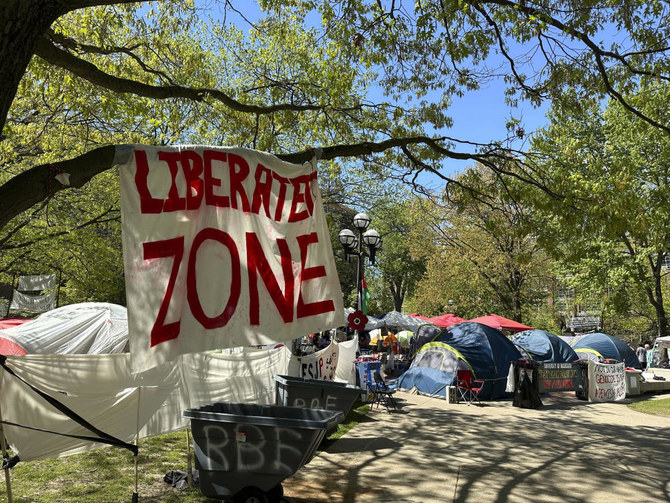
Protesters have erected dozens of tents on the Diag, a historic space for campus activism more than a mile away from the stadium. They’re demanding that Michigan cut financial ties with companies connected to Israel. There has been no effort to break up the encampment and no arrests.
“We respect and uphold the principles of free expression, and also recognize that no one is entitled to disrupt university activities,” Laurie McCauley, Michigan’s chief academic officer, said in an email to students and staff about commencement.
Blake Richards, 25, is earning a bachelor’s degree in biochemistry. Richards plans to be at the football stadium Saturday after participating in a smaller ceremony Thursday for chemistry students.
“It could take away some great feelings, muddle them,” Richards said of any disruptions. “But truth be told, I’m not bothered. I know others have different opinions; I’m just happy to be here.”
INDIANA UNIVERSITY
The Bloomington, Indiana, campus is designating protest zones outside Skjodt Assembly Hall and Memorial Stadium, where ceremonies will be held Friday for graduate students and Saturday for undergraduates. Nearly 10,000 students are eligible to attend.
A social media post circulating on Instagram urged protesters to wear “your keffiyeh along with your cap and gown” and walk out during Saturday’s remarks by President Pamela Whitten.
Roughly 20 tents set up by protesters remained in place this week in an area known as Dunn Meadow, a mile from the stadium. Dozens of protesters have been arrested there recently, according to the Indiana Daily Student.
Maya Wasserman, a 22-year-old senior in management who is Jewish, said she and her family feel uncomfortable about the prospect of pro-Palestinian protests disrupting commencement. She expressed special concern for her mother and grandmother, who are Israeli.
“It’s unfortunate because we want this event to be about graduating, not politics,” Wasserman said.
At Dunn Meadow, students in lawn chairs or on blankets worked on their final assignments. Jessica Missey, a 20-year-old protester and senior, said she boycotted final exams; some professors, she said, simply canceled them. She has enjoyed the camaraderie at the encampment.
“Commencement is kind of just taking almost a little sidestep for me,” said Missey.
NORTHEASTERN UNIVERSITY
A week after police arrested nearly 100 protesters at Northeastern University, the school is holding its commencement exercises Sunday at Fenway Park, home of the Boston Red Sox, for the fourth consecutive year.
The venue will help security officials monitor the crowd and limit what people can bring. Signs, banners, balloons and full-size flags are prohibited in the stadium, along with most bags. Renata Nyul, vice president for communications, said public safety staffing will be strengthened.
All those entering Fenway will need to pass through metal detectors. About 50,000 graduates, family and friends are expected.
Northeastern is one of several universities in the Boston area that have had pro-Palestinian encampments. Some have let the protests continue, though Northeastern’s camp was broken up.
“While we realize that issues in the world prompt passionate viewpoints, the focus this weekend should be on our graduates and their remarkable achievements,” Nyul said.


![]()

Universities take steps to prevent pro-Palestinian protest disruptions of graduation ceremonies
Short Url
https://arab.news/5avw3
Universities take steps to prevent pro-Palestinian protest disruptions of graduation ceremonies
- Students booed and yelled “free Palestine” while the University of Utah president spoke Thursday night at commencement
- “People can exercise their First Amendment rights without disrupting or creating fear,” Burdick said of protesters


Latest updates


© 2026 SAUDI RESEARCH & PUBLISHING COMPANY, All Rights Reserved And subject to Terms of Use Agreement.