’Show solidarity’: Pro-Palestinian protesters camp across Australian universities

1 / 2
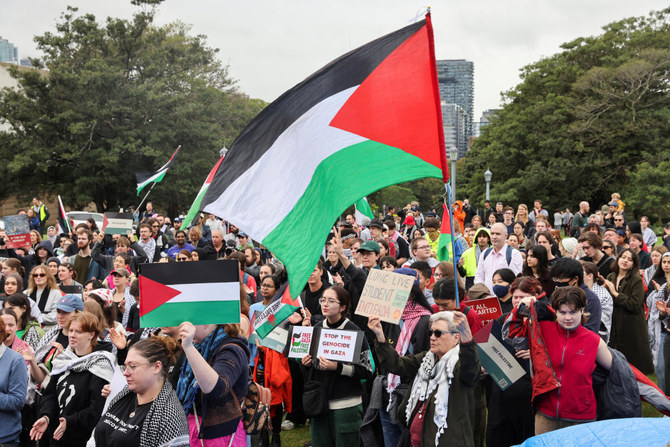
Members of the Palestine Action Group gather ahead of a rally, amid the ongoing conflict between Israel and the Palestinian Islamist group Hamas, in Sydney, Australia. (Reuters)
2 / 2
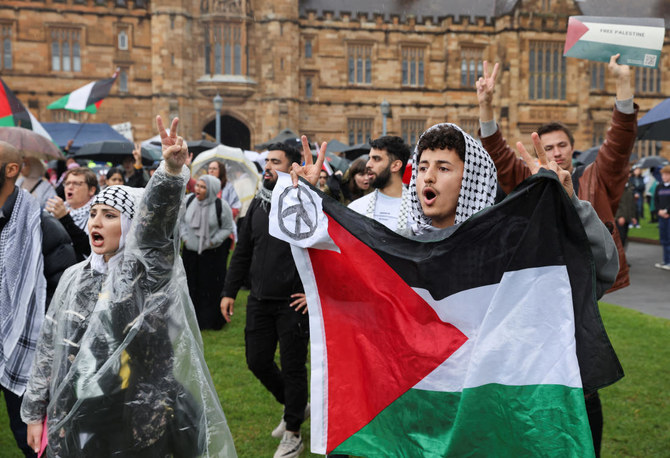
Members of the Palestine Action Group gather ahead of a rally, amid the ongoing conflict between Israel and the Palestinian Islamist group Hamas, in Sydney, Australia. (Reuters)
Short Url
Updated 03 May 2024
Follow

’Show solidarity’: Pro-Palestinian protesters camp across Australian universities

  • Pro-Palestinian activists set up an encampment last week outside the sandstone main hall at University of Sydney
  • Similar camps have sprung up at universities in Melbourne, Canberra and other Australian cities

SYDNEY: Hundreds of people protesting Israel’s war in Gaza rallied at one of Australia’s top universities on Friday demanding it divest from companies with ties to Israel, in a movement inspired by the student occupations sweeping US campuses.
Pro-Palestinian activists set up an encampment last week outside the sandstone main hall at University of Sydney, one of Australia’s largest tertiary institutions.
Similar camps have sprung up at universities in Melbourne, Canberra and other Australian cities.
Unlike in the US, where police have forcibly removed scores of defiant pro-Palestinian protesters at several colleges, protest sites in Australia have been peaceful with scant police presence.
On Friday, protesters rallied to demand University of Sydney divest from companies with ties to Israel, echoing calls from students in the US, Canada and France.
Standing in the chanting crowd of more than 300 with his two-year old son on his shoulders, Matt, 39, said he came to show it was not just students angry at Israel’s actions in Gaza.
“Once you understand what is going on you have a responsibility to try and get involved and raise awareness and show solidarity,” he told Reuters, declining to give his last name.
Several hundred meters away from the Sydney university protest and separated by lines of security guards, hundreds gathered under Australian and Israeli flags to hear speakers say the pro-Palestinian protests made Jewish students and staff feel unsafe on campus.
“There’s no space for anybody else, walking through campus chanting ‘Intifada’ and ‘from the river to the sea’ it does something, it’s scary,” said Sarah, an academic who declined to give her name for fear of repercussions.
University of Sydney vice chancellor Mark Scott told local media on Thursday the pro-Palestinian encampment could stay on campus in part because there was not the violence seen in the US
While several police cars were parked at the entrance to the university, no police were present at either protest.
Long a stalwart ally of Israel, Australia has become increasingly critical of its conduct in Gaza, where an Australian aid worker was killed in an Israeli attack last month.
Pro-Palestinian protesters said the government had not done enough to push for peace and led the crowd in chants against Prime Minister Anthony Albanese and his government.


Uganda army denies seizing opposition leader as vote result looms

Updated 5 sec ago
Follow

Uganda army denies seizing opposition leader as vote result looms

KAMPALA: Uganda’s army denied claims on Saturday that opposition leader Bobi Wine had been abducted from his home, as counting continued in an election marred by reports of at least 10 deaths amid an Internet blackout.
President Yoweri Museveni, 81, looked set to be declared winner and extend his 40-year rule later on Saturday, with a commanding lead against Wine, a former singer turned politician.
Wine said Friday that he was under house arrest, and his party later wrote on X that he had been “forcibly taken” by an army helicopter from his compound.
The army denied that claim.
“The rumors of his so-called arrest are baseless and unfounded,” army spokesman Chris Magezi told AFP.
“They are designed to incite his supporters into acts of violence,” he added.
AFP journalists said the situation was calm outside Wine’s residence early Saturday, but they were unable to contact members of the party due to continued communications interruptions.
A nearby stall-owner, 29-year-old Prince Jerard, said he heard a drone and helicopter at the home the previous night, with a heavy security presence.
“Many people have left (the area),” he said. “We have a lot of fear.”
With more than 80 percent of votes counted on Friday, Museveni was leading on 73.7 percent to Wine’s 22.7, the Electoral Commission said.
Final results were due around 1300 GMT on Saturday.
Wine, 43, whose real name is Robert Kyagulanyi, has emerged as the main challenger to Museveni in recent years, styling himself the “ghetto president” after the slum areas where he grew up in the capital, Kampala.
He has accused the government of “massive ballot stuffing” and attacking several of his party officials under cover of the Internet blackout, which was imposed ahead of Thursday’s polls and remained in place on Saturday.
His claims could not be independently verified, but the United Nations rights office said last week that the elections were taking place in an environment marked by “widespread repression and intimidation” against the opposition.

- Reports of violence -

Analysts have long viewed the election as a formality.
Museveni, a former guerrilla fighter who seized power in 1986, has total control over the state and security apparatus, and has ruthlessly crushed any challenger during his rule.
Election day was marred by significant technical problems after biometric machines — used to confirm voters’ identities — malfunctioned and ballot papers were undelivered for several hours in many areas.
There were reports of violence against the opposition in other parts of the country.
Muwanga Kivumbi, member of parliament for Wine’s party in the Butambala area of central Uganda, told AFP’s Nairobi office by phone that security forces had killed 10 of his campaign agents after storming his home.