


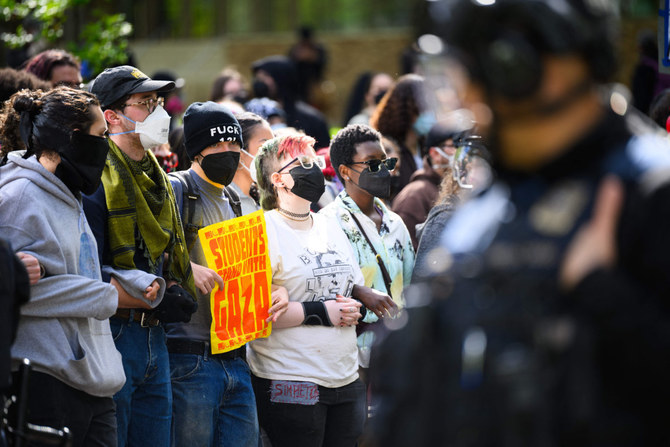

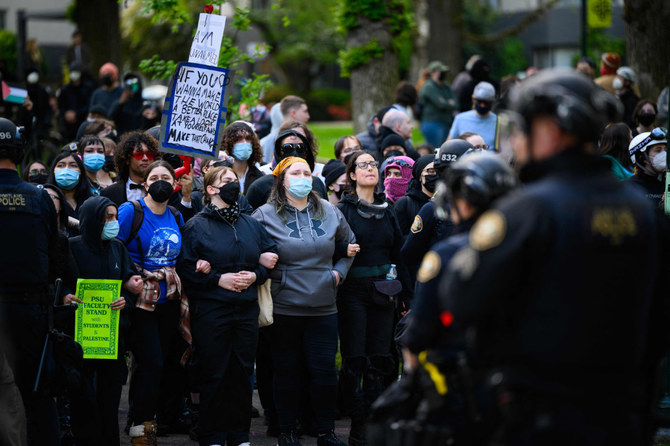

LOS ANGELES: Police have arrested more than 2,100 people during pro-Palestinian protests at college campuses across the United States in recent weeks, sometimes using riot gear, tactical vehicles and flash-bang devices to clear tent encampments and occupied buildings. One officer fired his gun inside a Columbia University administration building while clearing out protesters camped inside, a prosecutor’s office confirmed.
No one was injured by the officer’s actions late Tuesday inside Hamilton Hall on the Columbia campus, according to Doug Cohen, a spokesperson for District Attorney Alvin Bragg’s office. Cohen said Thursday that the gun did not appear to be aimed at anyone, and that there were other officers but no students in the immediate vicinity. Bragg’s office is conducting a review, a standard practice.
More than 100 people were taken into custody during the Columbia crackdown, just a fraction of the total arrests stemming from recent campus protests over the Israel-Hamas war. A tally by The Associated Press on Thursday found at least 50 incidents of arrests at 40 different US colleges or universities since April 18.
Early Thursday, officers surged against a crowd of demonstrators at University of California, Los Angeles, ultimately taking at least 200 protesters into custody after hundreds defied orders to leave, some forming human chains as police fired flash-bangs to break up the crowds. Police tore apart a fortified encampment’s barricade of plywood, pallets, metal fences and dumpsters, then pulled down canopies and tents.
Like at UCLA, tent encampments of protesters calling on universities to stop doing business with Israel or companies they say support the war in Gaza have spread across other campuses nationwide in a student movement unlike any other this century. Iranian state television carried live images of the police action at UCLA, as did Qatar’s pan-Arab Al Jazeera satellite network. Live images of Los Angeles also played across Israeli television networks.
Israel has branded the protests antisemitic, while Israel’s critics say it uses those allegations to silence opposition. Although some protesters have been caught on camera making antisemitic remarks or violent threats, protest organizers — some of whom are Jewish — call it a peaceful movement to defend Palestinian rights and protest the war.
President Joe Biden on Thursday defended the right of students to peaceful protest but decried the disorder of recent days.
Opinion
This section contains relevant reference points, placed in (Opinion field)
The demonstrations began at Columbia on April 17 with students calling for an end to the Israel-Hamas war, which has killed more than 34,000 Palestinians in the Gaza Strip, according to the Health Ministry there. Israel launched its offensive in Gaza after Hamas militants killed about 1,200 people, mostly civilians, on Oct. 7 and took roughly 250 hostages in an attack on southern Israel.
On April 18, the NYPD cleared Columbia’s initial encampment and arrested roughly 100 protesters. The demonstrators set up new tents and defied threats of suspension, and escalated their actions early Tuesday by occupying Hamilton Hall, an administration building that was similarly seized in 1968 by students protesting racism and the Vietnam War.
Roughly 20 hours later, officers stormed the hall. Video showed police with zip ties and riot shields streaming through a second-floor window. Police had said protesters inside presented no substantial resistance. At some point, the officer’s gun went off inside the building. Cohen, the DA’s spokesperson, did not provide additional details on the incident, which was first reported by news outlet The City on Thursday. The NYPD did not immediately respond to AP’s request for comment.
The confrontations at UCLA also played out over several days this week. UCLA Chancellor Gene Block told alumni on a call Thursday afternoon that the trouble started after a permitted pro-Israel rally was held on campus Sunday and fights broke out and “live mice” were tossed into the pro-Palestinian encampment later that day.
In the following days, administrators tried to find a peaceful solution with members of the encampment and expected things to remain stable, Block said.
That changed late Tuesday, he said, when counterdemonstrators attacked the pro-Palestinian encampment. Campus administrators and police did not intervene or call for backup for hours. No one was arrested that night, but at least 15 protesters were injured. The delayed response drew criticism from political leaders, including California Gov. Gavin Newsom, and officials pledged an independent review.
“We certainly weren’t thinking that we’d end up with a large number of violent people, that hadn’t happened before,” Block said on the call.
By Wednesday, the encampment had become “much more of a bunker” and there was no other solution but to have police dismantle it, he said.
The hourslong standoff went into Thursday morning as officers warned over loudspeakers that there would be arrests if the crowd — at the time more than 1,000 strong inside the encampment as well as outside of it — did not disperse. Hundreds left voluntarily, while another 200-plus remained and were ultimately taken into custody.
Meanwhile, protest encampments at other schools across the US have been cleared by police — resulting in more arrests — or closed up voluntarily. But University of Minnesota officials reached an agreement with protesters not to disrupt commencements, and similar compromises have been made at Northwestern University in suburban Chicago, Rutgers University in New Jersey and Brown University in Rhode Island.
Ariel Dardashti, a graduating UCLA senior studying global studies and sociology, said no student should feel unsafe at school.
“It should not get to the point where students are being arrested,” Dardashti said on campus Thursday.


