15 pro-government Syrian fighters killed in Daesh attacks: monitor

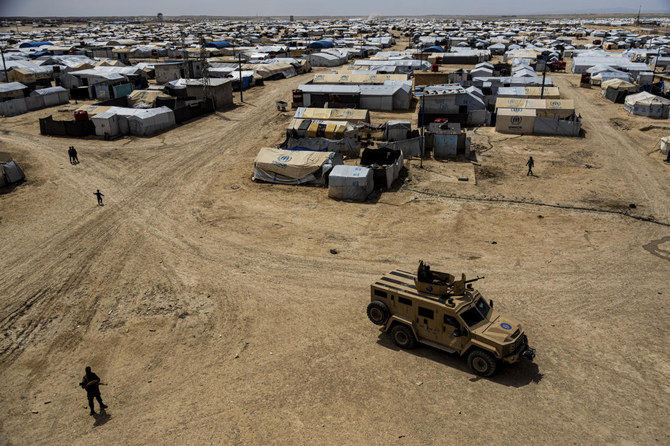
Iraq has repatriated hundreds more of its citizens linked to the Daesh group from a sprawling camp in northeastern Syria. (File/AP)
Short Url
Updated 03 May 2024
Follow

15 pro-government Syrian fighters killed in Daesh attacks: monitor

  • It is the latest attack of its kind by remnants of the jihadists

BEIRUT: Daesh group militants killed at least 15 Syrian pro-government fighters on Friday after they attacked three military positions in the Syrian desert, a war monitor said.
It is the latest attack of its kind by remnants of the jihadists.
They “attacked three military sites belonging to regime forces and fighters loyal to them... in the eastern Homs countryside, triggering armed clashes... and killing 15” pro-government fighters, the British-based Syrian Observatory for Human Rights said.
Daesh overran large swathes of Syria and Iraq in 2014, proclaiming a so-called caliphate and launching a reign of terror.
It was defeated territorially in Syria in 2019, but its remnants continue to carry out deadly attacks, particularly against pro-government forces and Kurdish-led fighters in the vast desert.
Daesh remnants are also active in neighboring Iraq.
Last month, Daesh fighters killed 28 Syrian soldiers and affiliated pro-government forces in two attacks on government-held areas of Syria, the Observatory said.
Many were members of the Quds Brigade, a group comprising Palestinian fighters that has received support from Damascus ally Moscow in recent years, according to the Observatory, which has a network of sources inside Syria.
In one of those attacks, the jihadists fired on a military bus in eastern Homs province, the Observatory said at the time.
Separately, six Syrian soldiers died in an Daesh attack against a base in eastern Syria, it added.
Syria’s war has claimed the lives of more than half a million people and displaced millions more since it erupted in March 2011 with Damascus’s brutal repression of anti-government protests.
It then pulled in foreign powers, militias and jihadists.
In late March, Daesh militants “executed” eight Syrian soldiers after an ambush, the monitor said at that time.
The jihadists also target people hunting desert truffles, a delicacy which can fetch high prices in the war-battered economy.
The Observatory in March said Daesh had killed at least 11 truffle hunters by detonating a bomb as their car passed in the desert of Raqqa province in northern Syria.
In separate unrest in the country, Syria’s defense ministry earlier on Friday said eight soldiers had been injured in Israeli air strikes near Damascus.
The Observatory said Israel had struck a government building in the Damascus countryside that has been used by Lebanon’s Iran-backed Hezbollah group since 2014.
The Israeli military has carried out hundreds of strikes in Syria since the outbreak of Syria’s civil war, mainly targeting army positions and Iran-backed fighters.


IMF approves reviews, unlocks $240m in funding for Jordan

Updated 11 sec ago
Follow

IMF approves reviews, unlocks $240m in funding for Jordan

  • The decision allows Jordan to draw about $130 million under the EFF and about $110 million under the RSF

AMMAN: The International Monetary Fund’s executive board has completed the fourth review of Jordan’s Extended Fund Facility and the first review under the Resilience and Sustainability Facility, unlocking immediate access to about $240 million to support the Kingdom’s economic program.

The decision allows Jordan to draw about $130 million under the EFF and about $110 million under the RSF, bringing total disbursements under the IMF arrangement to about $733 million.

In a statement issued on Saturday, the IMF said Jordan’s economy “remains resilient,” supported by sound macroeconomic policies and strong international backing.

Growth accelerated to 2.7 percent in the first half of 2025 and is expected to reach about 3 percent in the coming years, driven by major investment projects, deeper regional integration and continued structural reforms.

Inflation remains anchored at about 2 percent, while the current account deficit is projected to narrow to below 5 percent of GDP over the medium term. The IMF also noted that Jordan’s banking sector is stable and international reserves remain strong.

Fiscal performance continues to align with program targets, underpinned by robust revenue collection and disciplined current spending. The authorities remain committed to reducing public debt to 80 percent of GDP by 2028 through gradual fiscal consolidation, while protecting social and development spending and reducing losses at public utilities.

The IMF said progress under the RSF is ongoing, with reforms addressing vulnerabilities in the water and electricity sectors and strengthening health emergency preparedness. All reform measures scheduled for the current review have been completed.

Commenting after the board discussion, IMF Deputy Managing Director Kenji Okamura said Jordan’s continued macroeconomic stability amid persistent external headwinds reflects the authorities’ commitment to sound policies, supported by strong international assistance.

He said growth continues to recover, inflation remains low and reserve buffers are strong, stressing the importance of maintaining prudent fiscal and monetary policies amid regional tensions and global uncertainty.

Okamura added that accelerated structural reforms are essential to foster job-rich growth, improve the business environment, enhance labour market flexibility, tackle youth unemployment and low female labour force participation, and attract private investment.

He also underlined the importance of sustained donor support to help Jordan manage external challenges and the economic cost of hosting large numbers of refugees, while noting that progress under the RSF would help address long-term vulnerabilities and strengthen balance-of-payments stability.