

Pakistan inflation eases to 22-month low at 17.3% in April amid monetary tightening

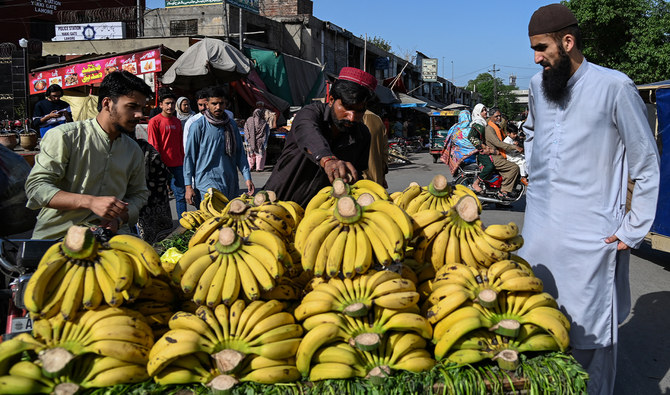
A vendor sells bananas on a cart along a street in Lahore on March 31, 2024. (AFP)
Short Url
Updated 02 May 2024
Follow

Pakistan inflation eases to 22-month low at 17.3% in April amid monetary tightening

  • Pakistan beset by inflation above 20% since May 2022, registering high of 38% in May 2023 due to high food, energy costs
  • Pakistan is currently navigating strict reforms as part of an International Monetary Fund bailout program

KARACHI: Pakistan’s inflation eased off to 17.3%, the lowest since May 2022, on a year-on-year basis in April 2024 from 20.7% recorded in March 2024 and 36.4% in April 2023, official data issued on Thursday said.

Pakistan has been beset by inflation above 20% since May 2022, registering a high of 38 percent in May 2023 mainly due to high food and energy costs. 

Pakistan’s central bank, which has kept the interest rate steady at 22% since June last year amid tight monetary tightening, had forecasted that ” inflation will continue to remain on downward trajectory further moderation.”

“Besides the coordinated tight monetary and fiscal policy response, other factors that have led to this favorable outcome include lower global commodity prices, improved food supplies and high base effect,” the central bank said in its monetary policy statement issued on Monday.

On a month-on-month basis, inflation decreased to 0.4% in April 2024 as compared to an increase of 1.7% in the previous month and a hike of 2.4% in April 2023, according to the Pakistan Bureau of Statistics (PBS). 

In April on an annual basis the prices of onions increased by 156.16%, tomatoes 126.67%, chicken 33.62% and meat 22.18%. In the non-food category, gas charges surged by 318.74%, electricity charges 71.12%, accommodation services 31.50%, transport services 26.70%, cotton cloth 23.00%, drugs and medicines 22.78%, and footwears 21.38%.

Urban core inflation measured by non-food non-energy items increased to 13.1% on an annual basis in April 2024 as compared to an increase of 12.8% in the previous month and 19.5% in April 2023.

Rural core inflation measured by non-food non-energy items increased to 19.3% on a year-on-year basis in April 2024 as compared to an increase of 20% in the previous month and 24.9% in April 2023.


Pakistan’s surgical exports slide as tax overhaul, rising costs squeeze Sialkot manufacturers

Updated 5 sec ago
Follow

Pakistan’s surgical exports slide as tax overhaul, rising costs squeeze Sialkot manufacturers

  • Industry leaders warn tax regime shift has hit SME-dominated surgical sector, reversing years of export growth
  • Rising energy costs and labor shortages add pressure on a globally competitive manufacturing hub

SIALKOT: Pakistan’s globally known surgical instruments industry, concentrated in the eastern city of Sialkot, is facing a sharp slowdown after years of steady growth, with exporters blaming a tax regime overhaul, rising energy costs and labor shortages for eroding competitiveness in one of the country’s most important export sectors.

Surgical instrument exports, which had risen consistently from about $420 million in 2021 to nearly $492 million in 2024, fell back to roughly $445 million last year, according to the Surgical Instruments Manufacturers Association of Pakistan (SIMAP). Industry leaders say the reversal reflects mounting structural pressures rather than a decline in global demand.

The slowdown has raised concerns about the future of a sector that supplies hospitals and medical distributors across Europe and North America and provides livelihoods to hundreds of thousands of skilled workers in Pakistan.

SIMAP Chairman Dr. Zeeshan Tariq said the transition from Pakistan’s long-standing Final Tax Regime (FTR) to the National Tax Regime (NTR) in 2024 had been particularly damaging for the industry, which is dominated by small and medium-sized enterprises.

Under the FTR, exporters paid a fixed tax deducted at source, with limited paperwork. The NTR requires exporters to manage full accounts, maintain balance sheets and comply with documentation requirements at every stage from production to export, a shift Tariq described as overwhelming for family-run workshops.

“As per our opinion, government policy is the main reason of decline of exports,” Tariq told Arab News in an interview at his office in Sialkot.

“We were in FTR, the final tax regime, since last 32 years. But in 2024, government ended the FTR scheme for exporters and put us in NTR, the national tax regime.”

Rising electricity prices and aggressive tax enforcement had compounded the impact of the tax overhaul, insiders say.

“The electricity cost is rising. We did not get any support from the government in any cost and there are multiple departments who are just piling up taxes and taxes on us,” Tariq said.

While Pakista historically benefited from low labor costs, exporters say energy prices and compliance costs are now eroding that advantage relative to other Asian producers.

Responding to SIMAP’s concerns, Adviser to the Finance Minister Khurram Schehzad said the shift from the final tax regime to the national tax regime was part of a broader policy decision aimed at bringing all sectors into the standard tax system, rather than allowing exporters to remain under special arrangements indefinitely. He explained that the government considered the final tax regime a temporary measure that was being phased out, with only a few sectors still covered under it for limited periods.

“Going forward, if there are sweet spots like surgical instruments, they’re exporting significantly and adding to the exchequer, so is the IT industry, so is the textile industry .... so the policy shift, if it’s there, it will be for all the sectors across the board,” Schehzad added. 

He said the government had established a dedicated tax policy office to assess sector-specific needs through data-driven analysis. This body would review proposals from industries considered “sunrise sectors,” those with growth potential and strategic importance, and evaluate whether targeted incentives or policy adjustments were justified to support value creation and long-term economic impact.

According to Schehzad, the aim was not only to support individual industries, but to ensure that tax policy contributed to broader economic growth by encouraging sectors that added value, adopted new technologies and strengthened Pakistan’s export base.

“Our tax policy office has been set up for this very purpose, to look into the specific proposals of the industry and adopt them going forward, so that the value creation can happen,” the adviser said.

A COLONIAL-ERA INDUSTRY AT RISK

Pakistan remains a recognized exporter of surgical instruments, ranking among the world’s top 40 exporters of medical instruments, though its share of the global surgical instruments trade is estimated at under 1 percent, reflecting niche specialization rather than large-scale production.

Exports are heavily concentrated in a small number of markets, particularly the United States, Germany and the United Kingdom, which together account for a significant share of Pakistan’s surgical exports. Analysts say this market concentration increases vulnerability to domestic policy shocks.

Sialkot manufacturers compete with surgical clusters in Germany’s Tuttlingen region, Malaysia, Hungary and Poland, while China has expanded its presence through scale, automation and state-backed industrial support.

Sialkot’s surgical manufacturing dates back to the British colonial era, when local craftsmen repaired medical tools for hospitals across the empire, gradually evolving into a global export industry.

The sector employs an estimated 300,000 workers, many trained through traditional apprenticeship systems.

But that workforce is aging and manufacturers say they are now also facing a structural labor crisis.

The sector relies heavily on manual craftsmanship like forging, grinding, polishing and finishing — skills that are typically learned through long apprenticeships rather than formal training. But industry leaders say fewer young workers are entering the trade, leaving factories increasingly dependent on an aging workforce.

“It’s a huge gap because 20 years ago, the average worker, average age of a worker in an industry, in our industry was 25 to 27 years, which is now 45 years,” Tariq said.

He said younger Pakistanis were increasingly reluctant to join the labor-intensive sector, opting instead for service jobs, overseas employment or technology-related work.

“The new generation does not want to come and get their hands dirty because our business, our industry is mainly hand-based and they have to get their hands dirty.”

Industry figures warn that without new entrants and structured skills development, the loss of experienced craftsmen over the next decade could weaken Pakistan’s ability to meet global demand, maintain quality standards and compete with automated manufacturers in countries such as China.

To overcome this, businesses are now seeking government-backed joint ventures with Chinese medical equipment firms to introduce automation and expand product offerings.

“Our government has promised us that they will help us facilitate doing those JVs and our companies are ready to invest if such facility comes or if there opportunity arrives because now everyone wants a one-shop solution,” Tariq said.

He also urged state support for international compliance costs, which remain prohibitively high for many SMEs.

“The fees are very high. We have asked them not to give us money but either do the MoUs [Memorandums of understanding] with the government or the certifying bodies,” he said.

“If someone is interested in getting that compliance, he should do his part and the fees should be paid by the government.”

But despite current pressures, Tariq said the industry’s long-term prospects remained strong if policy constraints were addressed.

“Let me tell you that we can. Now we are around $450 to $500 million industry and our instruments are sold at around $10 billion all over the world. So I think that we can double our exports within a couple of years if we get the proper support from the government,” he said.

Meanwhile, a proposed sector-specific industrial zone, known as “Surgical City,” remains stalled in court despite land acquisition.

“The land has been acquired but now the cases are in court and it’s still pending,” Tariq said.