NEW YORK CITY: The war on Gaza has depleted much of the physical and human capital in the enclave and severely affected the rest of the occupied territories in the West Bank and East Jerusalem, according to a newly published UN report.
It warns that in addition to the thousands of lives already lost, and the many people injured or maimed for life, the risk of “future lost generations is real.”
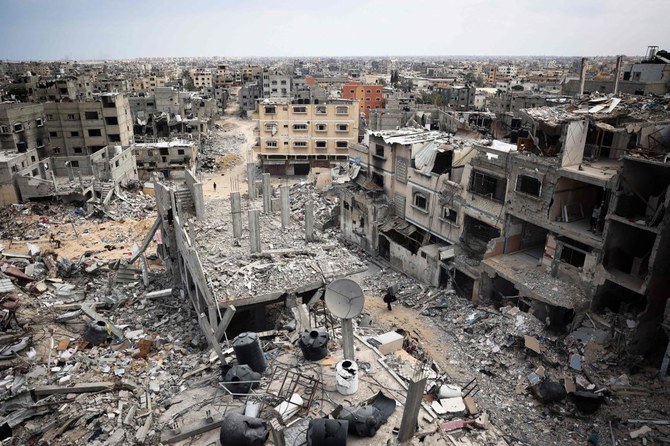
The report by the UN Development Program, titled “War in Gaza: Expected Socioeconomic Impacts on the State of Palestine,” highlights the widespread damage caused by the conflict, including: the destruction of about 80,000 homes, resulting in significant, and possibly longlasting, displacement and homelessness among the population; the depletion and pollution of natural resources; and the destruction of infrastructure such as water and sanitation systems, educational institutions and health care facilities.
It said human development in Gaza has been set back to the extent it could take 20 years to return to prewar levels, and recovery seems unlikely in the absence of a functioning economy, adequate institutional capacities, and the ability to trade.
“We haven’t seen anything like this since 1945, since the Second World War, that intensity in such a short time, that massive scale of destruction,” Abdallah Al-Dardari, the assistant administrator and director of UNDP’s Regional Bureau for Arab States, told Arab News.
“With 37 million tons of debris, compared to 2.4 million tons of debris in the 2014 war, and 72 percent of all housing in Gaza destroyed, and 90 percent of commercial and all other buildings destroyed, this is unprecedented.”
The report analyzes the devastating effects the ongoing war in Gaza has had on the Palestinian people, their economy and human development in the territory, and predicts the possible consequences based on scenarios that assume a further one to three months of conflict.
Based on official figures, by April 12 this year, at least 33,207 Palestinians had been killed in Gaza, an estimated 7,000 were missing, and 80,683 had been injured. About 70 percent of the dead were women and children. Many of the injured are likely to suffer long-term consequences, including disabilities.
These figures reveal that at least 5 percent of the population of Gaza has been killed, maimed or injured. In addition, about 500 Palestinians have been killed in the West Bank since the beginning of the war.
“No other armed conflict in the 21st century has caused such a devastating impact on a population in such a short time frame,” the report notes. It states the number of people in Gaza living in poverty has risen to 1.67 million in the six months since the conflict between Israel and Hamas began in October last year.
The report warns that the number of Gazans living in poverty will rise to 1.74 million if the duration of the war reaches seven months, and 1.86 million if it reaches nine months.
The report estimates the unemployment rate in the Occupied Palestinian Territories rose to 46.1 percent after six months of war and could reach 47.8 percent by the end of a ninth month of fighting. It estimates that six months of war set human development back 17 years, and by the ninth month this will have increased to a loss of 20 years of progress.
The analysis further reveals that the Palestinian economy lost an estimated 8.7 percent of its real gross domestic product in 2023, and will lose an estimated 25.8 percent in 2024. If the conflict continues for another three months, the loss this year could increase to 29 percent, equivalent to about $7.6 billion. All economic sectors in Gaza have been severely affected by the war, the report found, with the construction sector experiencing the most substantial decline, of 75.2 percent.
“The local economy has been eviscerated by the current war,” it states. “The devastating Gaza war will leave future generations with aggravated economic and social costs that will impede postwar recovery and development across the occupied Palestinian territory.”
Under even the most optimistic scenarios for the speed of reconstruction, the report states, it will take until 2040, and probably longer, to repair or replace the homes that have been destroyed. Revitalizing the economy will be another enormous challenge, the report warns, given that the productive basis of the economy has been destroyed.
“The required investments in infrastructure, education, public health, food security and other basic social services which are essential for accelerating economic recovery are simply massive,” it said.
The analysis underscores the urgent need for a ceasefire agreement, together with sustained efforts to address the humanitarian crisis in Gaza and rebuild the Palestinian economy and its infrastructure. Every possible effort must be made to end the war, the report said, and reach a “lasting agreement between Israel and the State of Palestine and sincerely adhere to it.”
It added: “Until such time comes, saving lives is an immediate priority and, in parallel, the provision of adequate and timely humanitarian aid, especially for essential items such as food, medicine, clean water and fuel.
“Additional measures should be taken to avoid the destruction of the remaining civilian infrastructure and disruption of services, while setting in motion the recovery of the economy and acceleration of growth, and the creation of decent employment.”


![]()

Gaza destruction on scale unseen since Second World War, will take decades to rebuild, UN says
Short Url
https://arab.news/jvyyd
Gaza destruction on scale unseen since Second World War, will take decades to rebuild, UN says
- Report by the UN Development Program highlights devastating effects of the conflict, which has set human development in the territory back by about 20 years
- It warns that in addition to the thousands of lives already lost, and the many people injured or maimed for life, the risk of ‘future lost generations is real’


Latest updates


Recommended


© 2026 SAUDI RESEARCH & PUBLISHING COMPANY, All Rights Reserved And subject to Terms of Use Agreement.