Global collaborations crucial to address global challenges, says Saudi official
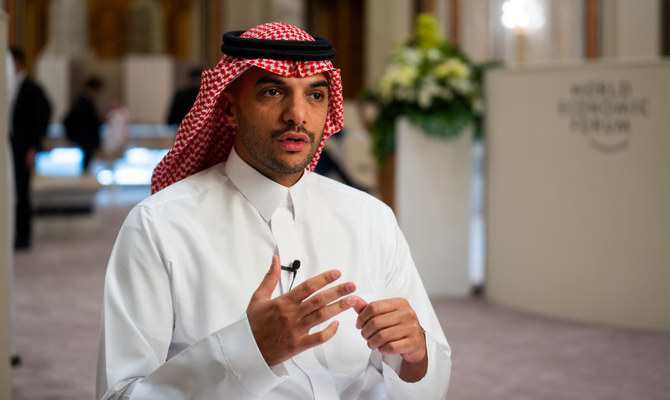
Ammar Nagadi, vice minister of economy and planning, talks to Arab News on the sidelines of World Economic Forum Special Meeting in Riyadh
Updated 30 April 2024
MOHAMMED AL-KINANI
RIYADH: Global collaborations are a crucial element in efforts to tackle economic and social challenges, especially given the current state of the world, a leading Saudi official said.
In an interview with Arab News on the sidelines of the two-day World Economic Forum Special Meeting on Global Collaboration, Growth and Energy for Development, which concluded on Monday in Riyadh, the Kingdom’s vice minister of economy and planning, Ammar Nagadi, spoke about the important role such gatherings can play in advancing economic cooperation to address global challenges.
He believes the world is going through a “unique” time, with economic and social challenges worldwide and human development at a critical stage.
“Because of this, global collaboration and the world convening together becomes more and more important,” Nagadi said.
“We have seen that over the last few years Saudi Arabia is becoming a platform that brings together different people from different parts of the world to discuss challenges and to address these challenges” and the World Economic Forum special meeting is a continuation of that process, he added.
“We have more than 1,000 leaders today from different sectors (attending the meeting). We have heads of states, private sector and public sector leaders, and entrepreneurs from more than 70 countries across the globe.
“I think this diverse group, coming together to discuss and address global challenges is a unique opportunity and we are very happy to have it here in Riyadh today.”
Describing the economic landscape in the Kingdom, Nagadi said the Saudi economy is going through a very strong period of transformation that is reflected in the progress the country has made in terms of growth and diversification.
“Last year, Saudi Arabia’s non-oil activities grew by 4.4 percent but I think the most important thing to realize is that non-oil activities, as a percentage of total gross domestic product, have reached, for the first time in history, 50 percent of the total GDP,” he added.
This represents a significant milestone that reaffirms the progress made in efforts to diversify the national economy, he added, which have created numerous benefits, including investment opportunities and improved job prospects for Saudis.
“If I take one example, you will see that unemployment last year in the last quarter has reached an all-time low of 7.7 percent and we hope to see that momentum continuing,” Nagadi said.
He believes this momentum will also continue in terms of growth and diversification.
“We target to grow around 5 percent for non-oil activities this year but we have seen recent forecasts by the IMF (International Monetary Fund) where they’re expecting Saudi Arabia to further grow in 2025 by around 6 per cent,” he added.
Saudi Arabia is also making progress toward achieving sustainability goals, which Nagadi said is another important topic.
“What we have today is Vision 2030, which is very ambitious, and sustainability is an integral part of that vision,” he added.
“We have economic goals, social goals, environmental goals. If I were just to take the environmental part of the sustainable development goals, you will see that Saudi has put in a lot of efforts as part of Vision 2030.”
The Saudi Green Initiative, announced in March 2021, is a great example of what the Kingdom is doing not only to drive economic growth but also protect the planet, Nagadi said.
“The aim is to achieve net-zero emissions by 2060, and the goals are to increase the renewable energy mix to 50 percent of the total energy mix and plant 10 billion trees by 2030 as well as protecting land and sea,” he said, adding that 50 million trees have already been planted.
Saudi Arabia looks to Swiss-led geospatial AI breakthroughs
IBM’s Zurich lab is shaping tools policymakers could use to protect ecosystems
Updated 12 December 2025
Waad Hussain
ZURICH: For Gulf countries such as Saudi Arabia, AI-powered Earth observation is quickly becoming indispensable for anticipating climate risks, modeling extreme weather and protecting critical national infrastructure.
That reality was on display inside IBM’s research lab in Zurich, where scientists are advancing geospatial AI and quantum technologies designed to help countries navigate a decade of accelerating environmental volatility.
The Zurich facility — one of IBM’s most sophisticated hubs for climate modeling, satellite analytics and quantum computing — provides a rare look into the scientific foundations shaping how nations interpret satellite imagery, track environmental change and construct long-term resilience strategies.
Entrance to IBM Research Europe in Zurich (left); inside IBM’s hardware development lab, (top, right); and IBM’s Diamondback system. (AN Photos by Waad Hussain)
For Saudi Arabia, where climate adaptation, space technologies and data-driven policy align closely with Vision 2030 ambitions, the lessons emerging from this work resonate with growing urgency.
At the heart of the lab’s research is a shift in how satellite data is understood. While traditional space programs focused largely on engineering spacecraft and amassing imagery, researchers say the future lies in extracting meaning from those massive datasets.
As Juan Bernabe-Moreno, director of IBM Research Europe for Ireland and the UK, notes, satellites ultimately “are gathering data,” but real impact only emerges when institutions can “make sense of that data” using geospatial foundation models.
r. Juan Bernabe Moreno, Director of IBM Research Europe for Ireland and the UK/(AN Photo by Waad Hussain)
These open-source models allow government agencies, researchers and local innovators to fine-tune Earth-observation AI for their own geography and environmental pressures. Their applications, Bernabe-Moreno explained, have already produced unexpected insights — identifying illegal dumping sites, measuring how mangrove plantations cool cities, and generating flood-risk maps “for places that don’t usually get floods, like Riyadh.”
The relevance for Saudi Arabia is clear. Coastal developments require precise environmental modeling; mangrove restoration along the Red Sea is a national priority under the Saudi Green Initiative; and cities such as Riyadh and Jeddah have recently faced severe rainfall that strained existing drainage systems.
Opinion
This section contains relevant reference points, placed in (Opinion field)
The ability to simulate these events before they unfold could help authorities make better decisions about zoning, infrastructure and emergency planning. Today’s satellites, Bernabe-Moreno said, provide “an almost real-time picture of what is happening on Earth,” shifting the challenge from collecting data to interpreting it.
This push toward actionable intelligence also reflects a larger transformation in research culture. Major advances in Earth observation increasingly depend on open innovation — shared data, open-source tools and transparent models that allow global collaboration. “Open innovation in this field is key,” Bernabe-Moreno said, noting that NASA, ESA and IBM rely on openness to avoid the delays caused by lengthy IP negotiations.
Scientific posters inside IBM’s research facility showcasing decades of breakthroughs in atomic-scale imaging and nanotechnology. (AN Photo by Waad Hussain)
Saudi Arabia has already embraced this direction. Through SDAIA, KAUST and national partnerships, the Kingdom is moving from consuming global research to actively contributing to it. Open geospatial AI models, researchers argue, give Saudi developers the ability to build highly localized applications adapted to the region’s climate realities and economic priorities.
Beyond Earth observation, IBM’s Zurich lab is pushing forward in another strategic frontier: quantum computing. Though still in its early stages, quantum technology could reshape sectors from logistics and materials science to advanced environmental modeling.
Alessandro Curioni, IBM Research VP for Europe and Africa and director of the Zurich lab, stressed that quantum’s value should not be judged by whether it produces artificial general intelligence. Rather, it should be viewed as a tool to expand human capability.
Dr. Alessandro Curioni, VP of IBM Research Europe and Africa & Director of IBM Research Zurich/ (AN Photo by Waad Hussain)
“The value of computing is not to create a second version of myself,” he said, “it’s to create an instrument that allows me to be super-human at the things I cannot do.”
Curioni sees quantum not as a replacement for classical computing but as an extension capable of solving problems too complex for traditional machines — from simulating fluid dynamics to optimizing vast, interdependent systems. But he cautioned that significant challenges remain, including the need for major advances in hardware stability and tight integration with classical systems. Once these layers mature, he said, “the sky is the limit.”
DID YOU KNOW?
• Modern satellites deliver near real-time views of Earth’s surface.
• Geospatial foundation models transform vast satellite datasets into clear, actionable insights.
• These tools can produce flood-risk maps for cities such as Riyadh, analyze how mangroves cool urban areas, and even detect illegal dumping sites.
Saudi Arabia’s investments in digital infrastructure, sovereign cloud systems and advanced research institutions position the Kingdom strongly for the quantum era when enterprise-ready systems begin to scale. Curioni noted that Saudi Arabia is already “moving in the right direction” on infrastructure, ecosystem development and talent — the three essentials he identifies for deep research collaboration.
His perspective underscores a broader shift underway: the Kingdom is building not only advanced AI applications but a scientific ecosystem capable of sustaining long-term innovation. National programs now include talent development, regulatory frameworks, high-performance computing, and strategic partnerships with global research centers. Researchers argue that this integrated approach distinguishes nations that merely adopt technology from those that ultimately lead it.
Inside IBM’s hardware development lab, where researchers prototype and test experimental computing components. (AN Photo by Waad Hussain)
For individuals as much as institutions, the message from Zurich is clear. As Curioni put it, those who resist new tools risk being outpaced by those who embrace them. Generative AI already handles tasks — from literature reviews to data processing — that once required days of manual analysis. “If you don’t adopt new technologies, you will be overtaken by those who do adopt them,” he said, adding that the goal is to use these tools “to make yourself better,” not to fear them.
From geospatial AI to emerging quantum platforms, the work underway at IBM’s Zurich lab reflects technologies that will increasingly inform national planning and environmental resilience.
For a country like Saudi Arabia — balancing rapid development with climate uncertainty — such scientific insight may prove essential. As researchers in Switzerland design the tools of tomorrow, the Kingdom is already exploring how these breakthroughs can translate into sustainability, resilience and strategic advantage at home.