

No peace in world without ceasefire in Gaza, Pakistani PM says at WEF 

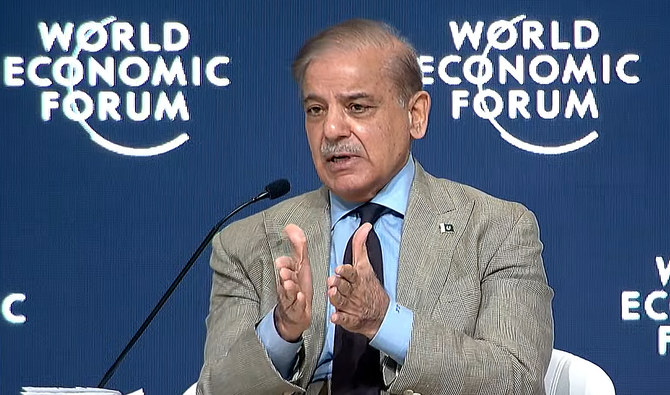
Pakistan Prime Minister Shehbaz Sharif address the closing plenary of a two-day World Economic Forum (WEF) summit in Riyadh, Saudi Arabia, on April 29, 2024. (Photo courtesy: World Economic Forum/YouTube)
Short Url
Updated 29 April 2024
Follow

No peace in world without ceasefire in Gaza, Pakistani PM says at WEF 

  • Pakistan does not recognize Israel and calls for an independent Palestinian state based on pre-1967 borders
  • Sharif is in Riyadh for two-day World Economic Forum summit on growth, has met top Saudi leaders on sidelines 

ISLAMABAD: Pakistan Prime Minister Shehbaz Sharif said on Monday there could be no peace in the world without a permanent ceasefire in Gaza, as Israel’s attacks on the besieged Palestinians territory continue. 

The statement came during the prime minister’s address at the closing plenary of a special two-day World Economic Forum (WEF) summit held in Riyadh, with a focus on global collaboration, growth and energy for development.

Israel’s air and ground assault on Gaza has killed about 34,500 Palestinians, according to Palestinian health authorities. The enclave is also in the grips of severe shortages of food, fuel and medicine since October 7 when the war started after attacks by Hamas on Israel.

“The world will not be in peace unless there is permanent peace in Gaza,” PM Sharif said.

Pakistan does not recognize the state of Israel and calls for an independent Palestinian state based on “internationally agreed parameters” and the pre-1967 borders with Al-Quds Al-Sharif as its capital.

Sharif said conflicts in Gaza, Ukraine and elsewhere had led to inflation globally, which was “breaking the back of developing countries.”

Sharif arrived in Riyadh on Saturday for the WEF special meeting on Global Collaboration, Growth and Energy for Development on April 28-29.

The conference has convened more than 700 participants, including key stakeholders from governments and international organizations, business leaders from the World Economic Forum’s partner companies, as well as Young Global Leaders, experts and innovators.

During his address, the Pakistan prime minister also thanked Saudi Arabia and other friendly countries for supporting Pakistan through difficult times.

“I have to acknowledge from the core of my heart the support we have been given and received from the Saudi leadership,” he said. “I think, a friend in need is a friend in deed and we will never be able to repay back to them what they have done to Pakistan in difficult times.”

Sharif said his government was going for “deep-rooted structural reforms” to put the country on the path to economic recovery.

“It will hit me as prime minister, obviously,” he said. “But ladies and gentlemen, without that nothing will happen.”

Pakistan is facing a chronic balance of payments crisis, with nearly $24 billion to repay in debt and interest over the next fiscal year, three-time more than its central bank’s foreign currency reserves.

The country is in talks with the International Monetary Fund (IMF) to secure a new loan program after its ongoing $3 billion program expires this month.


Pakistan says it struck TTP, Daesh militant camps near Afghan border, Kabul alleges civilian deaths

Updated 5 sec ago
Follow

Pakistan says it struck TTP, Daesh militant camps near Afghan border, Kabul alleges civilian deaths

  • Islamabad says it targeted seven militant hideouts in “retributive response” to attacks 
  • Afghan Taliban accuse Pakistan of bombing civilians in Nangarhar and Paktika provinces 

ISLAMABAD: Pakistan said on Saturday it carried out “intelligence-based selective targeting” against militant camps near the Afghan border after a series of attacks inside the country, while the Afghan Taliban accused Pakistani forces of killing civilians in the assault.

Pakistan has faced a renewed surge in militant violence in recent months, particularly in its northwestern Khyber Pakhtunkhwa province and two major attacks in the capital, Islamabad. Authorities say many of the attacks have been carried out by the Tehreek-e-Taliban Pakistan (TTP) and allied groups that Islamabad alleges are operating from sanctuaries in Afghanistan. Kabul denies this. 

According to Pakistan’s information ministry, recent incidents included a suicide bombing at a Shiite mosque in Islamabad, separate attacks in Bajaur and Bannu, and another recent incident in Bannu during the holy month of

Ramadan, which started earlier this week. The government said it had “conclusive evidence” linking the attacks to militants directed by leadership based in Afghanistan.

“Pakistan in a retributive response, has carried out intelligence based selective targeting of seven terrorist camps and hideouts belonging to Pakistani Taliban ... and its affiliates and ISKP [Daesh] at the border region of Pakistan

Afghan border with precision and accuracy,” the Pakistani information ministry said in a statement on Feb. 21.

The statement, which did not specify the exact nature of the attacks, said it had hit camps of the “Fitna al Khwarij (FAK),” a term Pakistani authorities use for the TTP, as well as the Islamic State Khorasan Province (ISKP), the regional affiliate of the Daesh group.

Islamabad has repeatedly urged Afghanistan’s Taliban authorities to take action against militants it says are using Afghan territory to plan and launch attacks inside Pakistan. The latest statement said Kabul had “failed to undertake any substantive action” despite prior requests.

In an X post, Kabul government spokesperson Zabihullah Mujahid said Pakistani forces had violated Afghan territory.

“Pakistani special military circles have once again trespassed into Afghan territory,” Mujahid said. “Last night, they bombed our civilian compatriots in Nangarhar and Paktika provinces, martyring and wounding dozens of people, including women and children.”

The Afghan Taliban’s claims of civilian casualties could not be independently verified. Pakistan did not immediately comment on the allegation that civilians had been killed in the strikes. 

Tensions between Islamabad and Kabul have escalated since the Afghan Taliban returned to power in 2021. Pakistan says cross-border militant attacks have increased since then and has accused the Taliban of failing to honor commitments under the 2020 Doha Agreement to prevent Afghan soil from being used for attacks against other countries. The Taliban deny allowing such activity and have previously rejected similar accusations.

Saturday’s exchange of accusations marks one of the most direct confrontations between the two neighbors in recent months and risks further straining already fragile ties along the volatile border.