Migrants eyeing Europe bide their time in Tunisia

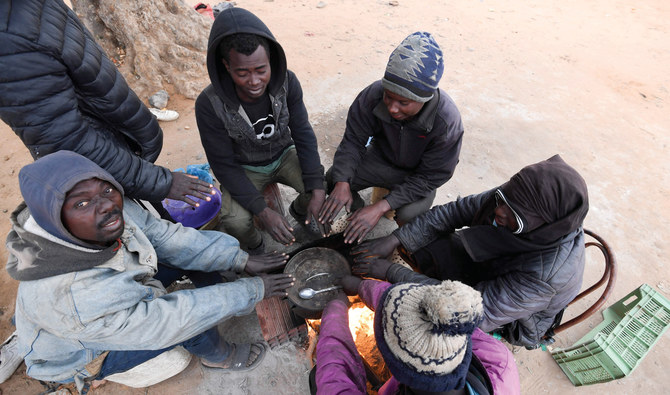
Last year, hundreds of sub-Saharan Africans were kicked out of their jobs and homes. Tens of thousands embarked from Sfax because of its proximity to Italy. (AFP)
Short Url
Updated 28 April 2024
Follow

Migrants eyeing Europe bide their time in Tunisia

EL-AMRA: Thousands of sub-Saharan migrants have huddled in Tunisian olive groves for months, living in makeshift tents and surviving on meager rations while keeping their hopes alive of reaching Europe.

Around 20,000 are in isolated areas near the towns of El-Amra and Jebeniana, some 30 and 40 kilometers north of the port city of Sfax, humanitarian sources say.

Sfax is one of Tunisia’s main departure points for irregular migration to Europe by boat, and was once a hub for sub-Saharan migrants.

After being forcibly removed from the city last autumn, migrants set up camp in neighboring towns as they awaited their chance to make the perilous crossing.

One weary 17-year-old calling himself Ibrahim said he had left Guinea more than a year ago, hoping to reach the other side of the Mediterranean “to provide for his sick mother and little brother” back home.

He said that after walking for three weeks from the border with Algeria, he arrived in El-Amra in midwinter, about three months ago.

“It’s really difficult here,” he said, adding that he and other migrants feel trapped on the sidelines of society.

“Even shopping, we have to do it in secret ... You can go out looking for work, but when it’s time for your employer to pay you, they would call the police,” he said.

Last year, anti-migrant violence broke out and hundreds of sub-Saharan Africans were kicked out of their jobs and homes.

Tens of thousands embarked from Sfax in 2023 because of its proximity to Italy, the closest European country.

“We are only a few kilometers from Europe,” said Ibrahim of Lampedusa island some 150 kilometers away.

Near El-Amra, in tents made of tarpaulins and rods, groups of five — and at times even 10 — share the same sleeping space.

Men, women and children, mostly from Cameroon, Guinea, Nigeria, Senegal, Sierra Leone and Sudan, congregate by language.

The women cook stew as men remove the feathers of inedible-looking yet indispensable bony chickens.

The winter “was very cold, but we managed to survive thanks to the solidarity we have as African brothers,” said Ibrahim.

“If someone has food and you don’t, they give you some,” he said.

“We bought the tarpaulins with our money,” which relatives managed to send them, “or by begging.”

Some 7,000 migrants received their first food aid in months from NGOs earlier in April, but they said this was not enough and called for more help from Europe, which has ramped up measures aiming to curb irregular migration.

According to Romdhane Ben Amor, spokesman of the Tunisian NGO FTDES, the North African country “is turning into a de facto detention center because of border control agreements signed with the EU.”

Hygiene is a pressing concern at the encampments. “There have been many births and sicknesses,” said Ibrahim.

One humanitarian source said there had been one migrant birth per day in recent weeks at a hospital in Jebeniana.

Salima, 17, said she had no diapers for her four-month-old baby and had to use plastic bags instead.

While awaiting the resumption of departures for Europe, delayed because of bad weather, Salima said she was still determined to make the crossing.

Tunisian authorities raided several encampments recently, tearing down tents and kicking out some migrants, after locals allegedly reported thefts.

Near Jebeniana, journalists saw used tear gas canisters, bulldozers and destroyed tents — some of which were already being put back up.

“We’re very tired of the police,” said 22-year-old Sokoto — also a pseudonym — who left Guinea three years ago and entered from Algeria last January.

“Just yesterday, I was chased from shops” in the town of El-Amra, he said.

Mohamed Bekri, a resident of El-Amra, said he often brings food and water to the migrants for “humanitarian” reasons.

“There are babies who are three and six months old,” he said.

Despite the tensions and the dire situation the migrants find themselves in, none of those interviewed said they wanted to return to their countries of origin.

“The reverse gear is broken,” said Sokoto. “I left to help my family and I suffered a lot to get here.”


Israel’s Somaliland gambit: what’s at risk for the region?

Updated 28 December 2025
Follow

Israel’s Somaliland gambit: what’s at risk for the region?

  • Somaliland’s strategic location near the Bab Al-Mandab raises fears an Israeli security presence could turn the Red Sea into a powder keg
  • Critics argue the decision revives Israel’s “periphery” strategy, encouraging fragmentation of Arab and Muslim states for strategic advantage

RIYADH: It perhaps comes as no surprise to seasoned regional observers that Israel has become the first and only UN member state to formally recognize the Republic of Somaliland as an independent and sovereign nation.

On Dec. 26, Israel’s Prime Minister Benjamin Netanyahu and Foreign Minister Gideon Sa’ar signed a joint declaration of mutual recognition alongside Somaliland’s President Abdirahman Mohamed Abdullahi.

For a region that has existed in a state of diplomatic limbo since declaring independence from Somalia in 1991, this development is, as Abdullahi described it, “a historic moment.” But beneath the surface lies a calculated and high-stakes geopolitical gamble.

While several nations, including the UK, Ethiopia, Turkiye, and the UAE, have maintained liaison offices in the capital of Hargeisa, none had been willing to cross the Rubicon of formal state recognition.

Israel’s Prime Minister Benjamin Netanyahu, assisted by Foreign Minister Gideon Sa’ar, signs the document formally recognizing Somalia's breakaway Somaliland region on Dec. 26, 2025. (AFP)

Israel’s decision to break this decades-long international consensus is a deliberate departure from the status quo.

By taking this step, Israel has positioned itself as the primary benefactor of a state that has long sought a seat at the international table. As Dya-Eddine Said Bamakhrama, the ambassador of Djibouti to Saudi Arabia, told Arab News, such a move is deeply disruptive.

“A unilateral declaration of separation is neither a purely legal nor an isolated political act. Rather, it carries profound structural consequences, foremost among them the deepening of internal divisions and rivalries among citizens of the same nation, the erosion of the social and political fabric of the state, and the opening of the door to protracted conflicts,” he said.

Critics argue that Israel has long lobbied for the further carving up of the region under various guises.

This recognition of Somaliland is seen by many in the Arab world as a continuation of a strategy aimed at weakening centralized Arab and Muslim states by encouraging peripheral secessionist movements.

Somaliland’s President Abdirahman Mohamed Abdullahi. (AFP file photo)

In the Somali context, this path is perceived not as a humanitarian gesture, but as a method to undermine the national understandings reached within the framework of a federal Somalia.

According to Ambassador Bamakhrama, the international community has historically resisted such moves to prioritize regional stability over “separatist tendencies whose dangers and high costs history has repeatedly demonstrated.”

By ignoring this precedent, Israel is accused of using recognition as a tool to fragment regional cohesion.

In the past, Israel has often framed its support for non-state actors or separatist groups under the pretext of protecting vulnerable minorities — such as the Druze in the Levant or Maronites in Lebanon.

This “Periphery Doctrine” served a dual purpose: it created regional allies and supported Israel’s own claim of being a Jewish state by validating the idea of ethnic or religious self-determination.

However, in the case of Somaliland, the gloves are off completely. The argument here is not about protecting a religious minority, as Somaliland is a staunchly Muslim-majority territory. Instead, the rationale is nakedly geopolitical.

Israel appears to be seeking strategic depth in a region where it has historically been isolated. Netanyahu explicitly linked the move to “the spirit of the Abraham Accords,” signaling that the primary drivers are security, maritime control, and intelligence gathering rather than the internal demographics of the Horn of Africa.

The first major win for Israel in this maneuver is the expansion of its diplomatic orbit. It could be argued that the refusal of the federal government in Mogadishu to join the Abraham Accords was an artificial barrier.

The evidence for this claim, from the Israeli perspective, is that Somaliland — a territory with a population of nearly six million and its own functioning democratic institutions — was eager to join.

Abdullahi said Somaliland would join the Abraham Accords as a “step toward regional and global peace.” Yet, this peace comes with a clear quid pro quo — formal recognition.

Residents wave Somaliland flags as they gather in downtown Hargeisa on December 26, 2025, to celebrate Israel's announcement recognizing Somaliland's statehood. (AFP)

Israel can now argue that the “Somaliland model” proves that many other Arab and Muslim entities are willing to normalize relations if their specific political or territorial interests are met.

This challenges the unified stance of the Arab League and the Organization of Islamic Cooperation, which maintain that normalization must be tied to the resolution of the Palestinian conflict.

The second major gain for Israel is the potential for a military presence in the Horn of Africa. Somaliland’s strategic position on the Gulf of Aden, near the Bab Al-Mandab Strait, makes it a prime location for monitoring maritime traffic.

This is a ticking time bomb given that just across the narrow sea lies Yemen, where the Houthi movement — whose slogan includes “Death to Israel” — controls significant territory.

Israel may claim that a military or intelligence presence in Somaliland will boost regional security by countering Houthi threats to shipping. However, regional neighbors fear it will likely inflame tensions.

Ambassador Bamakhrama warned that an Israeli military presence would “effectively turn the region into a powder keg.”

Ambassador Dya-Eddine Said Bamakhrama, Djibouti's envoy to Saudi Arabia. (Supplied)

“Should Israel proceed with establishing a military base in a geopolitically sensitive location... such a move would be perceived in Tel Aviv as a strategic gain directed against the Arab states bordering the Red Sea — namely Egypt, Saudi Arabia, Somalia, Yemen, Sudan, and Djibouti,” he said.

The Red Sea is a “vital international maritime corridor,” and any shift in its geopolitical balance would have “repercussions extending far beyond the region,” he added.

The recognition is also a clear violation of international law and the principle of territorial integrity as enshrined in the UN Charter.

While proponents point to exceptions like South Sudan or Kosovo, those cases involved vastly different circumstances, including prolonged genocidal conflicts and extensive UN-led transitions.

In contrast, the African Union has been firm that Somaliland remains an integral part of Somalia.

The backlash has been swift and severe. The Arab League, the Gulf Cooperation Council, and the OIC have all decried the move. Even US President Donald Trump, despite his role in the original Abraham Accords, has not endorsed Israel’s decision.

When asked whether Washington would follow suit, Trump replied with a blunt “no,” adding, “Does anyone know what Somaliland is, really?”

This lack of support from Washington highlights the isolation of Israel’s position. The OIC and the foreign ministers of 21 countries have issued a joint statement warning of “serious repercussions” and rejecting any potential link between this recognition and reported plans to displace Palestinians from Gaza to the African region.

Israel’s recognition of Somaliland appears to be a calculated gamble to trade diplomatic norms for strategic advantage.

While Hargeisa celebrates a long-awaited milestone, the rest of the world sees a dangerous precedent that threatens to destabilize one of the world’s most volatile corridors.

As Ambassador Bamakhrama says, the establishment of such ties “would render (Israel) the first and only state to break with the international consensus” — a move that prioritizes “narrow strategic calculations” over the stability of the international system.