

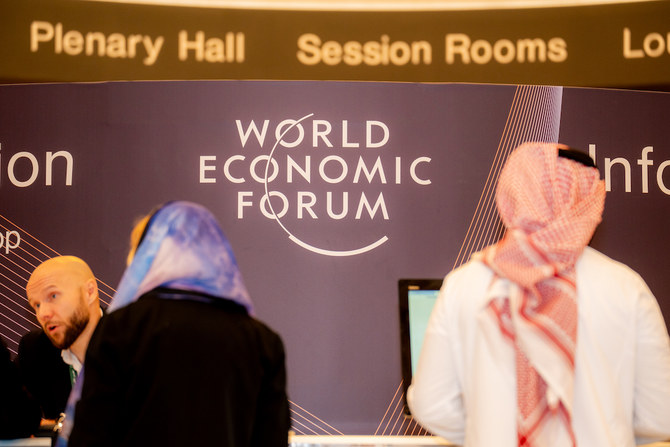

RIYADH: Tensions in the Red are weighing heavily on Egypt, adding to the burdens caused by recent global crises such as the war in Ukraine and the pandemic, the country’s minister of planning and economic development told the World Economic Forum special meeting.
Speaking during a panel discussion on “What Homeland Economics Means for Trade,” Hala Elsaid Younes said that Egypt, like the rest of the world, has faced unprecedented crises in recent years, stemming from climate change problems, the global pandemic, the Russian-Ukraine war, and now the conflict in Gaza.
In order to combat these problems, Egypt has been focusing on controlling inflation, and investing in its labor force and infrastructure, she said.
“What is taking place in the Red Sea at the moment, where 50 percent of shipments are now rerouting, has caused a massive recedes in our profits. Regional and international tensions have also led to a rise in interest rates and soaring food prices.
“If this continues, governments will have little capacity to take care of their poor. We are working very hard on investing in our infrastructure by building more ports, and high railways to link the Mediterranean and Red Sea with inland destinations to expand our exports. We are lucky that over 70 percent of our population are less than 40 years old, so we are also investing in vocational training.”
Aloke Lohia, CEO of petrochemical firm Indorama Ventures, said that the company had to make “significant pivots” in recent years.
“We had a brilliant 20-year run where geopolitics were stable, interest rates were low, and the petrochemical business was growing. However, this all changed after COVID and current wars. Consumer demands and production are not matching anymore, and we are reducing 10 percent of our capacity.
“Homeland economies are great for countries which can leverage it, but not all countries are capable. Some countries, like my own Thailand, have to rely on tourism. So we are now looking at manufacturing our products in countries like India, where a large population resides alongside a stable government,” Lohia said.
US Congressman Brad Schneider said many countries are “looking for leadership.”
He added: “Complexities and uncertainties produce challenges for business; we need to engage in partnerships and alliances. I believe the world is safer when the US is engaged with the rest of the world. Creating equilibrium will be easier established when there are partnerships.”
Ahn Duk-geun, South Korean minister of trade, industry and energy, said that the world is “entering a dangerous phase of industrial competition, and we have to find a way to contain this race that so it won’t cause too much trouble for global trade.”
Clifford Kupchan, CEO of the consulting firm Eurasia Group, highlighted the risks posed by artificial intelligence.
“If AI gets into the wrong hands, the results will be worrisome. It will be very easy to create deepfakes and to create destructive weaponry. This will create an imbalance in world powers,” he said.
“When we talk about homeland economics, national security intervening with trade, I don’t think the prognosis is very good. This applies whether it is (Joe) Biden or (Donald) Trump who will head the presidency. We can be heading toward strategical degradation between the US and China.”


